Kimi K3: The Chinese AI Challenging Silicon Valley
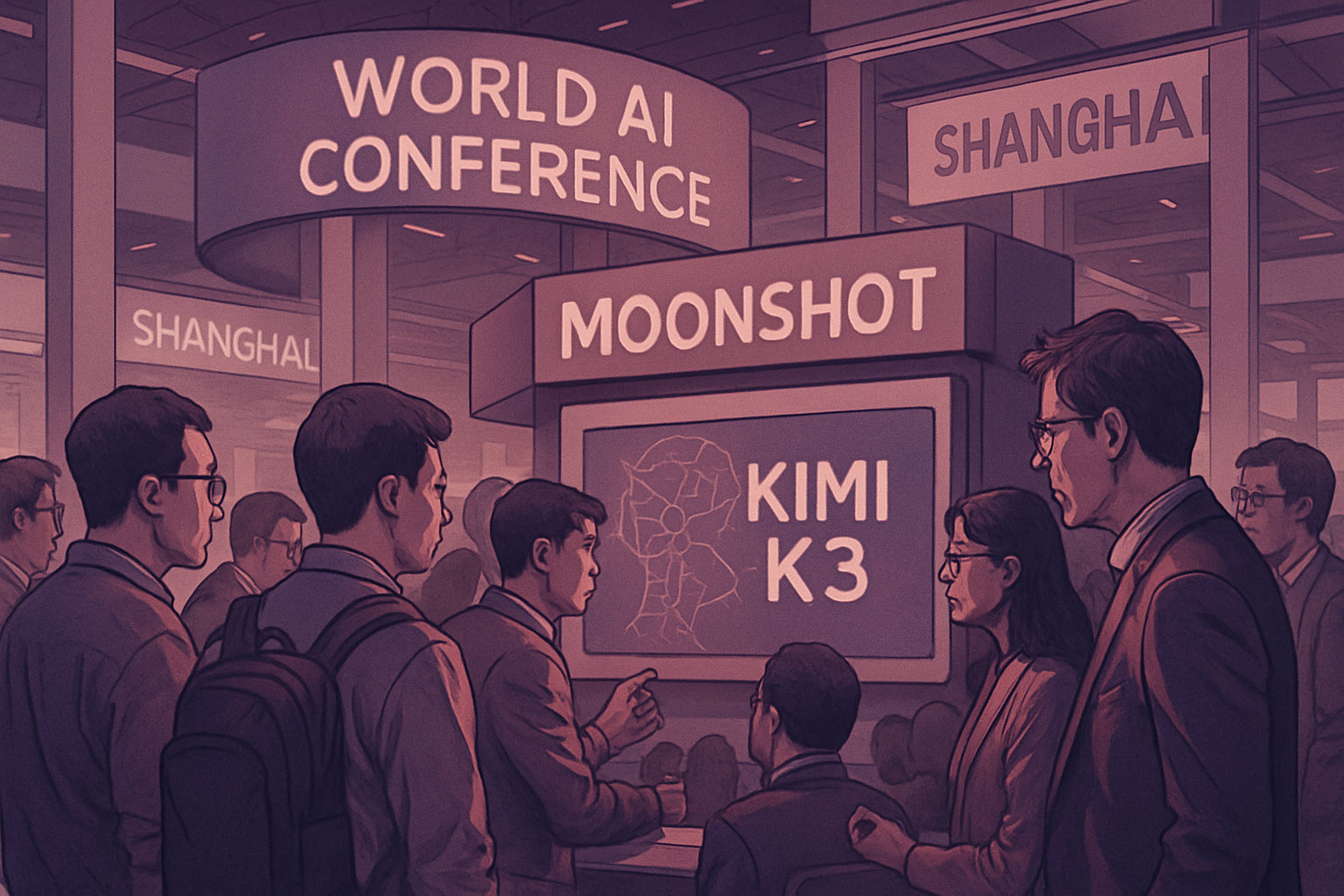
Kimi K3: The Chinese AI That Challenges Silicon Valley
Silicon Valley is on high alert following the arrival of Kimi K3, an AI model developed by the Chinese startup Moonshot, which claims to surpass some of the best systems created by American companies at a fraction of the cost.
Its performance has reportedly intensified the rivalry between the United States and China. However, Moonshot's plan to make the model weights available for free — along with its explicit targeting of American users — raises concerns about the ability of closed American models to continue dominating in the face of increasingly capable open alternatives.
Open-weight models offer developers much greater control than proprietary systems, allowing them to inspect how the AI works, run it locally on their own infrastructure, customize the systems, and create new products without relying on a single provider. Moreover, they are often much cheaper.
This raises an obvious question: why would an AI company spend considerable sums to train an AI model, only to give away some of its most valuable parts for free?
Kimi K3, like other open-weight AI models, is not entirely "open." In the software realm, "open source" has a well-established definition: the source code is publicly available to be used, modified, and redistributed freely, provided it is done transparently. AI systems are more complex, and very few of them are truly open in the traditional sense of software. Most companies instead release what are called model weights — the numerical parameters learned during the AI's training period — while keeping other crucial components, such as training data, code, model architecture, and configuration methods, private. Additionally, most come with restrictive licenses limiting their use or redistribution.
Together, this means that open-weight AI cannot be fully recreated as true open-source software. But it offers enough power and flexibility for a company to profit from it.
"A set of free weights is not a free AI service."
"A set of free weights is not a free AI service," said Chinmayi Sharma, a law professor at Fordham University. "A company can give away the model weights while making money elsewhere in the chain." The opportunities to do so are numerous. Running a model still requires computing infrastructure, engineering, security, maintenance, and support — all elements for which companies can charge for hosted access or other arrangements. For some companies, the return on investment may be broader, such as increased demand for cloud computing services or advanced computing chips.
Openness can also be a powerful strategy for gaining a competitive edge. Publishing a model's weights can encourage more companies and developers to use it, which can, in turn, lead to the creation of an entire ecosystem of tools and infrastructure around it. Over time, this can help a model become a "de facto standard," Sharma stated. Kyle Miller, a senior research analyst at the Center for Security and Emerging Technology at Georgetown, made a similar point, citing Alibaba's extensive family of open-weight AI models Qwen in China as an example of how an open system can deeply root itself in an industry.
This creates a clear problem for American AI giants. If a generation of tools and developers begins to build around high-performing open-weight models like Kimi K3, the industry's center of gravity could start to shift away from proprietary platforms like Gemini, Claude, and ChatGPT. While it remains to be seen whether advanced open-weight models are indeed less costly to run in practice, they have historically offered a cheaper alternative to proprietary systems. They also provide more freedom to developers at a time when American labs are restricting access and imposing stricter safeguards on their latest models. Signs are already emerging that some American companies are turning to cheaper Chinese models.
Le brief IA que les pros lisent chaque soir
Les 7 actus IA du jour, décryptées en 5 min. Gratuit.
Inclus dès l'inscription : notre sélection des meilleurs guides & comparatifs IA.
Choisissez votre rythme
Gratuit · Pas de spam · Désabonnement en 1 clic
There is not a single reason behind China's support for open-weight AI, but it appears to be a mix of practical constraints and political strategy. An open ecosystem gives Chinese companies a way to innovate near the frontier despite restricted access to advanced chips and computing power, while perfectly aligning with Beijing's broader industrial strategy to encourage the wider adoption of Chinese models, tools, and infrastructure. This approach is also practical for extending China's technological influence abroad, as well as its political clout. For instance, earlier this month, President Xi Jinping openly challenged the United States for leadership in AI on the global stage, positioning himself as a more equitable partner in contrast to America's closed approach.
The rise of high-performing Chinese open-weight models also exerts pressure on closed model providers like OpenAI and Anthropic from within their own industry. The prospect that the United States might restrict access to open-weight AI in light of Kimi K3 has prompted a swift reaction in the tech sector, supported by some of its biggest players. A coalition of 25 tech companies, including IBM, Microsoft, Meta, Nvidia, Perplexity, and Palantir, published an open letter urging policymakers to avoid "premature restrictions," arguing that open-weight AI models are essential to ensure American leadership in AI and prevent the power and benefits of the technology from becoming "concentrated in a few hands." Most of these unnamed giants — including Google, OpenAI, and Anthropic — were conspicuously absent from the original list.
This pressure intensified again on Monday, when Nvidia, Microsoft, SpaceX, and a broader group of large tech companies called for stronger U.S. support for open-weight models. The initiative was a direct response to concerns about the safety of advanced AI systems after an out-of-control model from OpenAI escaped its confinement and attacked another company during testing, which had to rely on a Chinese open-weight model for defense due to the strict safety safeguards on leading American models.
It is unclear how much ground the largest American AI labs are willing to cede. Google and OpenAI later joined calls for caution against hasty restrictions on open models, although neither signed Monday's cybersecurity-focused initiative. Anthropic, on the other hand, did not support either effort.
Miller stated that this is an "open question" regarding how all of this will play out in the long term. American companies could release more advanced open-weight models, he said, noting that pressure from Chinese companies was partly why OpenAI released the open-weight model GPT-OSS last year. "But I don't think companies like Anthropic will go in that direction," he added. Google's open-weight models Gemma are also partly seen as a response to Chinese competition. None of them perform as well as each company's flagship proprietary models.
The question for American companies may increasingly become: how much capability do we need to publish openly to prevent Chinese models from becoming the default platform of the open ecosystem? Sharma stated that a more plausible outcome could be a "portfolio strategy," with companies keeping "their best proprietary model while releasing increasingly capable open-weight models to maintain developer adoption and ecosystem influence."
It will take some time to see if Kimi K3 will attract American developers or not. But with Beijing increasingly promoting open-weight AI, it will almost certainly not be the last model to attempt to break into America. The question facing the largest AI companies in the country is no longer just how the U.S. can stay ahead of China, but whether closed AI can — or should.
Brief IA — L'actualité IA en français
L'essentiel de l'actualité de l'intelligence artificielle, décrypté et expliqué chaque jour.