Kyiv Shares War Data with the UK for AI
Le brief IA que les pros lisent chaque soir
Les 7 actus IA du jour, décryptées en 5 min. Gratuit.
Inclus dès l'inscription : notre sélection des meilleurs guides & comparatifs IA.
Choisis ton rythme
Gratuit · Pas de spam · Désabonnement en 1 clic
A fatal case attributed to autonomous targeting in July in Zaporizhzhia and Ukrainian tests without casualties in Crimea illustrate the rise of more autonomous weapons. In this context, Kyiv grants the UK controlled access to its Avengers Labs platform and a unique combat dataset as part of their "100-Year Partnership." British pilots are already underway, with technical safeguards on the Ukrainian side.
In Zaporizhzhia, a Russian drone reportedly chose its target, three dead
In July, a Russian Molniya drone killed three civilians in Zaporizhzhia, including a 19-year-old student, Tetiana Bubynets. The drone had been programmed to strike a gas station, but nearby, the software reportedly selected the precise target on its own, likely propane tanks. In the rubble, a team of experts found a mini-computer, the Nvidia Jetson Orin, which was said to have made the targeting decision. Kateryna Bondar from CSIS describes the incident as the first documented case of a Russian drone equipped with an AI self-selecting system causing civilian deaths. However, Ukrainian investigators emphasize that the mere presence of the Nvidia chip is not enough to establish autonomous selection: for them, the lack of a radio link combined with the code and training hardware examined on the computer is crucial. This is not the first fatal autonomous strike in the world, but according to available evidence, it is the first documented Russian case involving civilian casualties.
Since 2022, rare data and an opening announced in March
In 2022, the Ukrainian military began using artificial intelligence, with a soldier reporting that neural networks were trained on already available drone images to accelerate the detection of Russian soldiers and vehicles, ultimately enhancing the OODA loop. Until now, this data had only been shared with domestic companies, a choice that, according to the Financial Times, penalized foreign competitors often limited to synthetic data. For Misha Nestor (Swarmer), the availability of high-quality labeled battlefield data is one of the biggest constraints for ensuring the reliability of AI in autonomous systems, and he considers the Ukrainian asset difficult to replicate elsewhere. In March, Ukraine announced its intention to share access with allies for AI training to accelerate the development of more autonomous systems.
Unprecedented British access and political framework of the "100-Year Partnership"
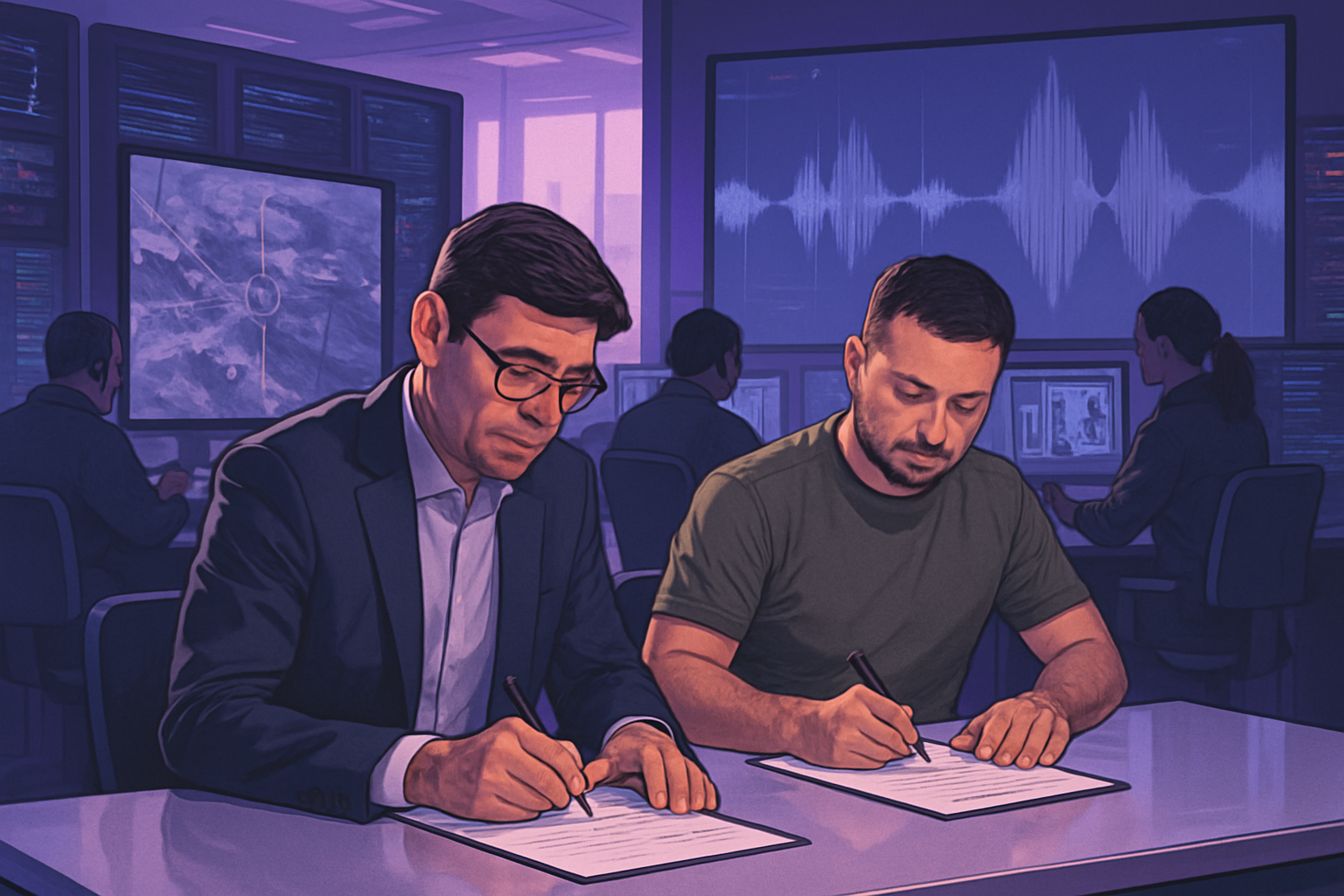
Andy Burnham and Volodymyr Zelensky signed an AI partnership in Kyiv, opening the Avengers Labs platform to British researchers and companies. According to the Financial Times, the UK is the first foreign country to gain access to this vast corpus as part of the "100-Year Partnership" linking the two countries. The platform is fed by millions of observations from thousands of sensors and cameras along the front line. A significant portion of the data comes from the DELTA combat system, which aggregates real-time streams from drones, satellites, and other sensors. The Financial Times refers to this corpus as the Universal Military Dataset, composed of real annotated images to train models capable of classifying tanks, drones, and artillery.
Five million images, secure room, and reported performance
According to the Ukrainian Ministry of Defense, the agreement covers approximately five million annotated images. Approved companies can only train and test their models in a secure data room, partially built with Palantir, and the finalized AIs remain in Ukraine. Kyiv also reports operational results: a detection system already deployed would identify 70% of visible enemy equipment in video streams and process each object in 2.2 seconds. The ministry further indicates that a system trained on this data processes over 100,000 drone video streams per month.
British pilots: acoustic sensors and energy-efficient chips
The British army is interested in acoustic sensor data that can identify the approach of Russian drones, an approach that, when well-trained, can surpass radar accuracy, according to the Financial Times. The British government states that pilots are being launched with three local startups: Sintela (Bristol), Mind Foundry (Oxford), and Skyral (London). One aims to transform buried optical fibers into AI-driven sensors to protect bases, then airports or rail networks; another targets the development of low-power AI chips for drones and autonomous systems. The announcement of data openness comes after Andy Burnham authorized the MBDA group to share classified information about British components of the SCALP cruise missile intended for assembly lines in Ukraine.
Three stages of autonomy and reported capabilities on the ground
The development of drone autonomy follows three stages: GPS-free navigation, last-mile pursuit (target chosen by a human, followed by AI), and then autonomous target selection by the machine. The first two are commonly used in Ukraine. In 2024, a privately owned FPV drone without a radio link autonomously struck a previously designated Russian tank. Auterion describes a module combining computer vision and target tracking, embedded in its Skynode S chip. In July 2026, Auterion and SkyFall began delivering 50,000 FPV SkyFall Shrike equipped with this chip. According to the government, Ukrainian interceptor drones operate at about 95% autonomy, and the Swarmer software has coordinated over 100 swarm missions. Meanwhile, Mykhailo Fedorov claims that Ukraine tested a fully autonomous AI system for several months in occupied Crimea against fuel depots and military equipment, with no civilian casualties reported. By 2023, the country gradually introduced drones equipped with artificial intelligence, starting with the Saker Scout unveiled that year, then moving to frequent use of swarms and Skynode S technology. Until April 2026, an analysis of Ukrainian ground robots indicated that no vehicle was yet fully autonomous on the battlefield; subsequent experiments have called this finding into question.
Brief IA — L'actualité IA en français
L'essentiel de l'actualité de l'intelligence artificielle, décrypté et expliqué chaque jour.