Reinforcement Learning: The Key to Modern AI Success
Le brief IA que les pros lisent chaque soir
Les 7 actus IA du jour, décryptées en 5 min. Gratuit.
Inclus dès l'inscription : notre sélection des meilleurs guides & comparatifs IA.
Choisis ton rythme
Gratuit · Pas de spam · Désabonnement en 1 clic
Learning by Trial and Error
Imagine you are teaching a dog to fetch a ball. Instead of giving it a detailed manual titled "How to Fetch a Ball," you take a more intuitive approach. You throw the ball, and when the dog brings it back, you reward it with a treat. If the dog gets distracted and doesn’t fetch the ball, it doesn’t get a treat. Over time and with many repetitions, the dog learns that bringing back the ball earns a reward, while ignoring the ball yields nothing. This process of learning through interaction, trials, and feedback is precisely what reinforcement learning achieves for artificial intelligence.
A Different Type of Learning: Supervised, Unsupervised, Reinforced
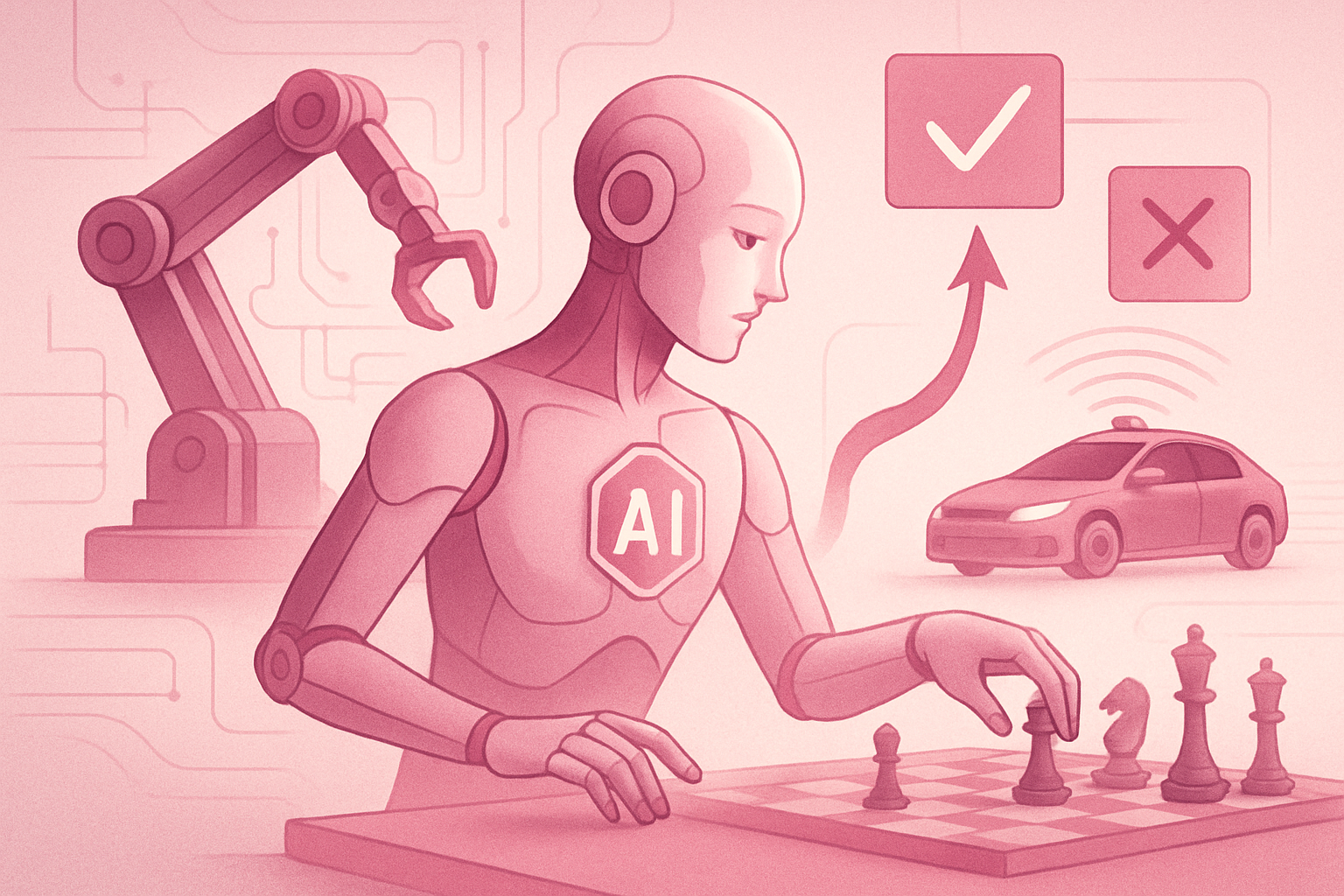
Reinforcement learning fundamentally differs from other forms of machine learning. In supervised learning, the algorithm is presented with thousands of examples accompanied by correct answers, much like flashcards showing an apple on one side and the word "apple" on the other. Unsupervised learning, on the other hand, involves providing the algorithm with data without answers, asking it to detect patterns, like organizing a drawer without instructions. Reinforcement learning places an agent in an environment, sets a goal, and lets it discover how to achieve that goal through experimentation. The agent does not know the correct answer in advance and does not have a dataset of correct moves to learn from. It acts, observes the results, receives rewards or penalties, and gradually learns which actions lead to good outcomes. This is how AlphaGo from DeepMind surpassed world champions in Go, how robotic arms learn to grasp objects, and how autonomous vehicles learn to navigate roads. The agent progresses by acting, making mistakes, and slowly refining its strategy based on the consequences of its actions.
The Essential Components of Reinforcement Learning
At the heart of every reinforcement learning problem are five fundamental components that interact in a continuous loop. Understanding each of these elements and their interaction is crucial to grasping how reinforcement learning actually works.
-
Agent
The agent is the entity that learns or makes decisions. In our example with the dog, the dog is the agent. In a video game, the agent could be the character controlled by the player. In an autonomous car, the agent is the AI system that makes decisions about steering, acceleration, and braking. The agent's mission is to determine which decisions lead to the best outcomes. It starts with no prior knowledge, with a blank slate, and learns entirely through experience. -
Environment
The environment is the set of elements with which the agent interacts. It is the world in which the agent operates. For the dog, the environment includes the room, the ball, the trainer, and all the physical laws governing the behavior of balls. For a chess player, the environment is the chessboard and the rules of the game. For a trading algorithm, the environment is the stock market with its complexity, volatility, and rules. The environment reacts to the agent's actions and provides feedback. It is crucial to note that the agent does not control the environment; it can only influence it through its actions. -
State
A state represents a specific situation or configuration of the environment at a given moment. In the dog's learning to fetch, a state could be "the ball has just been thrown and is in the air," another could be "the ball has landed fifteen feet away," and yet another could be "the dog has the ball in its mouth and is five feet from the owner." States capture all the relevant information the agent needs to make a decision. In a video game, the state might include the positions of characters, their health levels, available items, and the current score. The quality of the state representation is crucial: if important information is not included in the state, the agent will not be able to make good decisions. -
Action
An action is an operation that the agent can perform to interact with the environment. Actions are the means by which the agent influences its world. For the dog, actions might include "running towards the ball," "picking up the ball," "running back to the owner," or "lying down and taking a nap." For a chess player, actions are the legal moves available based on the current position of the board. For a robot learning to walk, actions are the specific motor commands sent to each joint and actuator. The set of available actions can change depending on the current state. In chess, legal moves change with each turn played. In the fetching example, the dog cannot pick up the ball if it is out of reach. -
Reward
The reward is the feedback signal that indicates to the agent whether its action was good or bad. Rewards are numerical values: positive numbers for good outcomes and negative numbers (penalties) for bad outcomes. When the dog brings back the ball, it receives a positive reward (the treat, which we might represent as +10). When it ignores the ball, it receives zero or even a small negative reward (no treat, perhaps represented as -1 or 0). The reward is the only way the environment communicates value to the agent. The entire learning process of the agent is guided by a single objective: to maximize cumulative rewards over time, which drives the agent to adopt strategies that increase its chances of long-term success.
Brief IA — L'actualité IA en français
L'essentiel de l'actualité de l'intelligence artificielle, décrypté et expliqué chaque jour.