AI Pause: The Missing Step 2 Between Innovation and Profit
Le brief IA que les pros lisent chaque soir
Les 7 actus IA du jour, décryptées en 5 min. Gratuit.
Inclus dès l'inscription : notre sélection des meilleurs guides & comparatifs IA.
Choisis ton rythme
Gratuit · Pas de spam · Désabonnement en 1 clic
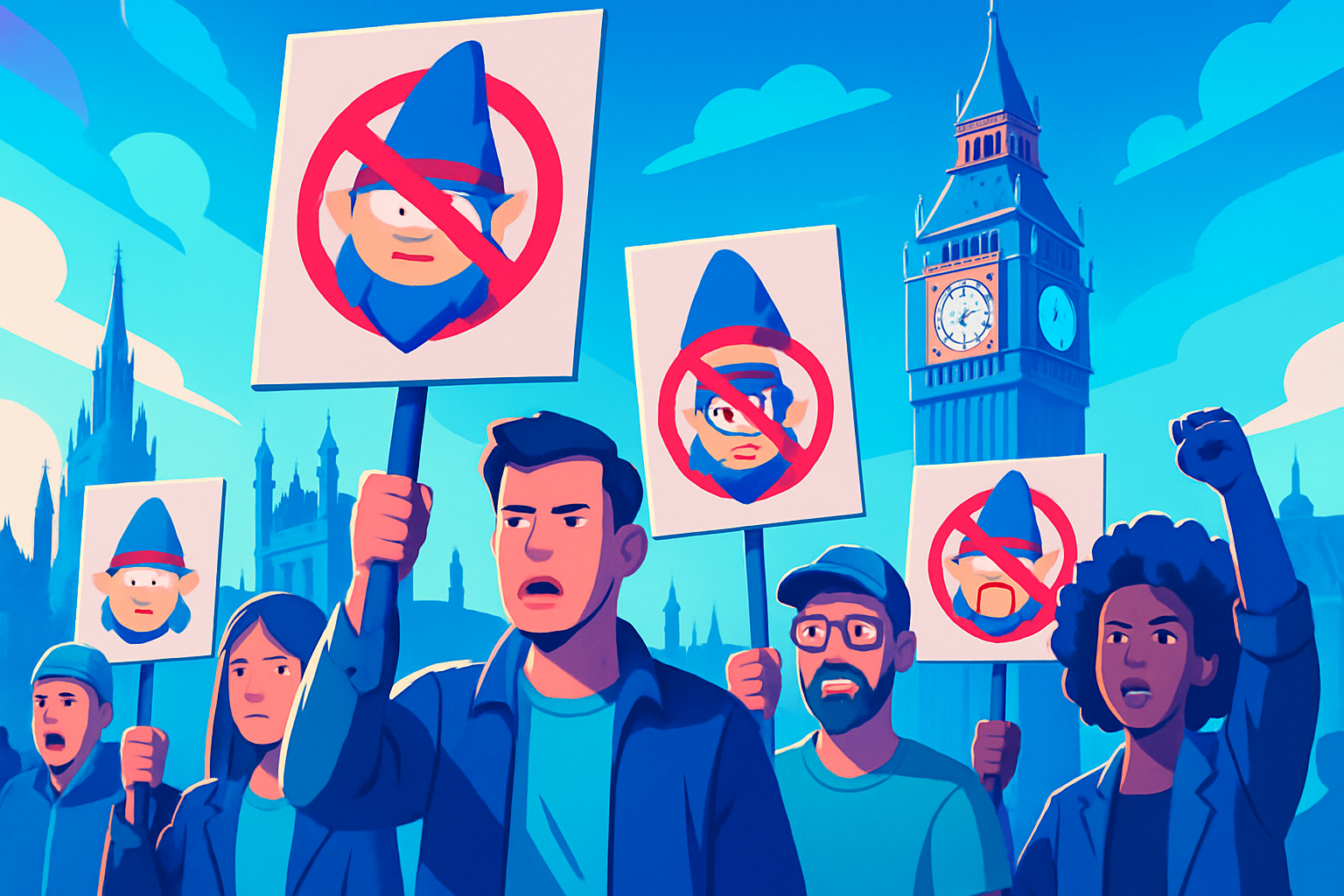
In February, during an anti-AI march in London, a flyer caught the attention of participants. This document, distributed by Pause AI, an international activist group, subtly referenced the gnomes from South Park. The flyer stated: “Step 1: Develop a super digital mind. Step 2: ? Step 3: ?”. It concluded with a call to the reader: “Pause AI until we know what Step 2 is.” This allusion to the South Park gnomes, who in a 1998 episode had an absurd business plan involving the collection of underwear without knowing how to profit from it, aptly illustrates the current uncertainty surrounding AI.
The South Park episode has become a famous meme, often used to critique vague strategies, ranging from startups to public policies. Even Elon Musk referenced this meme during a discussion about funding a mission to Mars. Today, it symbolizes the state of AI: companies have developed the technology (Step 1) and promise a transformation (Step 3), but the intermediate step remains unclear.
For Pause AI, Step 2 should involve some form of regulation. However, the specifics of this regulation and the entities responsible for its enforcement are subjects of debate. Proponents of AI, on the other hand, view Step 3 as salvation, an economic transformation through technology, as recently expressed by Jakub Pachocki, Chief Scientist at OpenAI. However, the path to this bright future is uncertain, and everyone seems to be taking a different route.
For every ambitious claim about the future of AI, there is a more measured assessment of the current situation. Take, for example, two recent studies. The first, conducted by Anthropic, attempts to predict which jobs will be most affected by LLMs. The results suggest that managers, architects, and media professionals should prepare for changes, while gardeners, construction workers, and those in hospitality would be less impacted. However, these predictions are based more on perceived capabilities of LLMs than on their actual performance in the workplace.
Another study, published in February by researchers from Mercor, a startup specializing in AI recruitment, evaluated several AI agents using models from OpenAI, Anthropic, and Google DeepMind across 480 common tasks in the banking, consulting, and legal sectors. The results showed that each agent failed to complete the majority of its tasks, calling into question the actual effectiveness of these technologies.
Why is there such disagreement? Several factors are at play. First, it is crucial to consider who is making these claims and for what purpose. Anthropic has financial interests in the AI field. Moreover, those predicting significant change often rely on the rapid evolution of AI coding tools. However, not all tasks can be solved through coding, and some studies have shown that LLMs perform poorly in strategic decision-making.
When deployed, these tools are not introduced into a sterile environment. They must adapt to already established, often complex contexts, with existing people and workflows. Sometimes, adding AI can even complicate matters. Certainly, these workflows may require a complete overhaul around the new technology for it to achieve a transformative impact, but that takes time and courage.
This significant gap? It lies exactly where Step 2 should be. The lack of agreement on what is about to happen and how it will unfold creates an information void. This void is often filled with extravagant claims, regardless of their basis. We are so far from a real understanding of what is coming and how it will be deployed that a simple social media post can shake the markets.
It is necessary to reduce assumptions and increase tangible evidence. This will require greater transparency from model designers, better coordination between researchers and companies, and new methods to evaluate this technology, in order to understand what is actually happening when it is implemented in the real world.
The tech industry, and with it the global economy, rests on the promise that AI will truly be transformative. However, this is not yet a safe bet. The next time you hear bold claims about the future, remember that most companies are still figuring out what to do with their underwear.
Brief IA — L'actualité IA en français
L'essentiel de l'actualité de l'intelligence artificielle, décrypté et expliqué chaque jour.