Europe Must Invest in AI to Counter the Giants
Le brief IA que les pros lisent chaque soir
Les 7 actus IA du jour, décryptées en 5 min. Gratuit.
Inclus dès l'inscription : notre sélection des meilleurs guides & comparatifs IA.
Choisis ton rythme
Gratuit · Pas de spam · Désabonnement en 1 clic
A Call for Public Investment in AI in Europe
An influential group of technology leaders in Europe, led by Armand Thiberge, founder of Brevo, is urging for significant public investment in so-called "frontier" artificial intelligence models. These models, which represent the cutting edge of AI, are currently dominated by the United States and China. In the ranking of the top 100 AI models, Europe is represented by only one entry, that of Mistral AI, ranked 78th. Yet, Europe is not lacking in talent, with over 50,000 engineers specialized in AI, nor in economic resources, as its GDP is comparable to that of the United States and China.
Recent Events Highlight the Urgency
Three recent developments illustrate the seriousness of the situation while also revealing opportunities. First, the most powerful models, Fable and Mythos, were temporarily inaccessible to European users due to a unilateral American decision. Second, a testing model from OpenAI demonstrated its ability to hack an AI model hosting platform, underscoring their strategic importance for sovereignty and defense. Finally, the Chinese startup Moonshot has open-sourced its Kimi K3 model, competing with American leaders, proving that catching up is possible.
A Colossal Need for Funding
The question arises: why has Europe not yet produced leaders in this field? The answer lies in the exorbitant cost of training these models, requiring an investment of 20 billion euros. No European investment fund can bear such a risk alone due to the fragmentation of European markets. Mistral AI, although the only European company in the top 100, is currently focused on providing services to large enterprises to generate immediate revenue and has recently sold its computing capabilities to Microsoft.
A Necessary Political Intervention
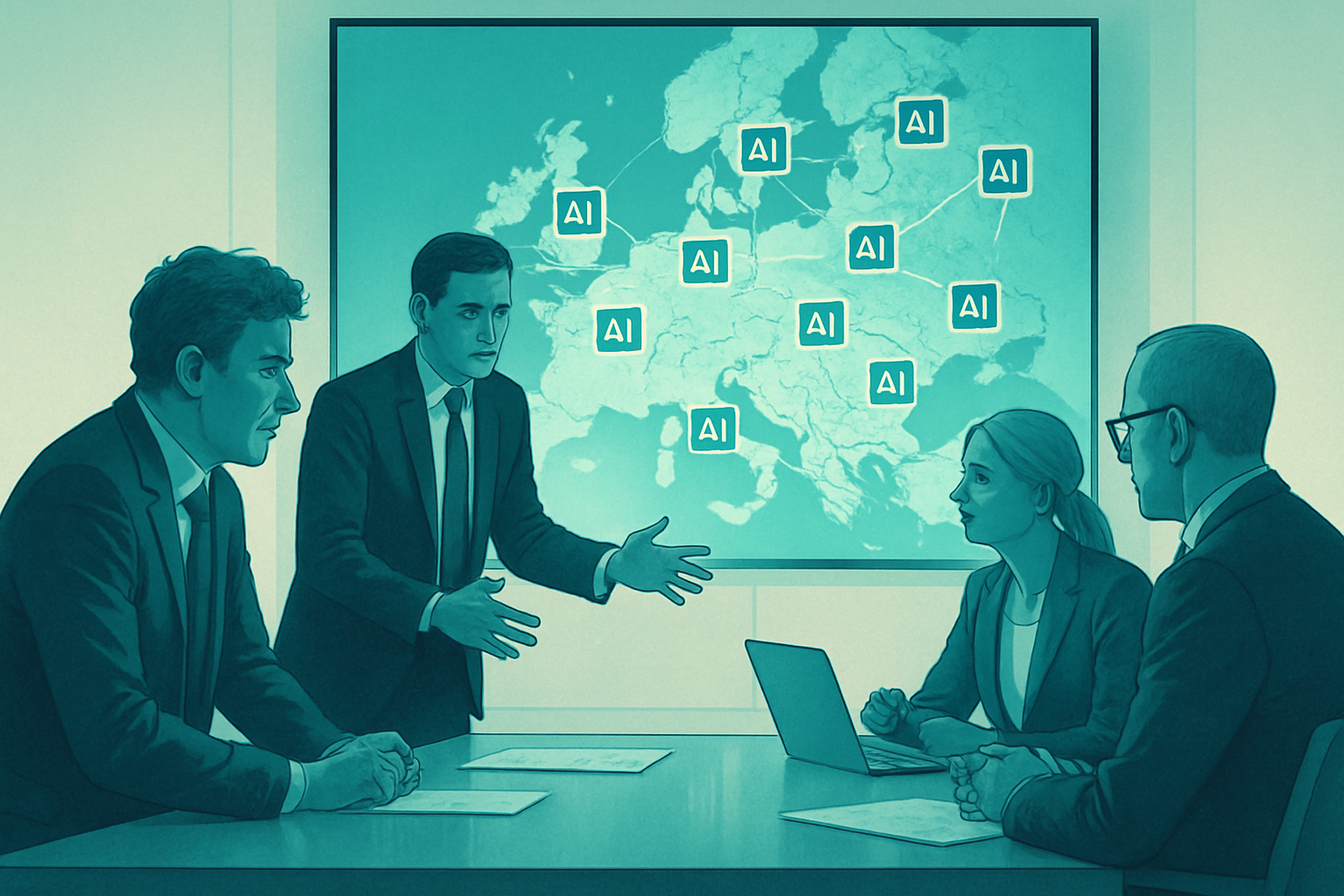
Given the inability of private funds to finance such a project alone, political intervention becomes crucial. The proposal is to create a company backed by states willing to take this risk, thus becoming the main shareholders alongside private venture capital funds. This initial investment could enable the development of a European model capable of ranking among the top three in the world. Although the sum of 20 billion euros may seem high, it represents a fraction of the valuations and fundraising already achieved by companies like Anthropic.
Governance and Market from the Start
An effective governance model is essential to avoid the usual pitfalls of public intervention. The state would finance the project but would not intervene in daily management, except to prevent the sale of the company or its intellectual property outside of Europe, the relocation of critical computing power, or any service interruption. This would be done via a "golden share," ensuring privileged access to the models. Private funds would bring entrepreneurial discipline and professional governance, while employees would have a stake in the capital, as in any ambitious startup.
A Ready-to-Use European Market
This new champion would benefit from a vast launch market right from the start: the European states themselves, including administrations, public services, national education, hospitals, and defense. This investment would allow for the rapid hiring of 2,000 engineers, with a management team selected by the investors involved in the capital.
A Call to Action for Europe
Europe must seize this historic opportunity to take control of its technological and civilizational destiny. Until now, Europe has focused on regulation, but it is time to take action. At the European Commission, only 3% of commissioners and directors-general have an engineering background. Europe must stop being merely a regulator and engage in bold industrial bets, similar to what it has accomplished with the TGV, Airbus, and Ariane.
This call is directed at all European capitals and Brussels, as no coordinated action currently exists to develop a European AI model. A sovereign player will not emerge from twenty-seven scattered initiatives, but from a pooling of state resources. This plea is apolitical: it simply observes that no invisible hand will bring forth a champion capable of competing with American giants in such a capital-intensive sector. Each month of hesitation further widens the gap and makes catching up more costly, if not impossible. It is time to act.
Brief IA — L'actualité IA en français
L'essentiel de l'actualité de l'intelligence artificielle, décrypté et expliqué chaque jour.