AI Revolutionizes Video Game Development
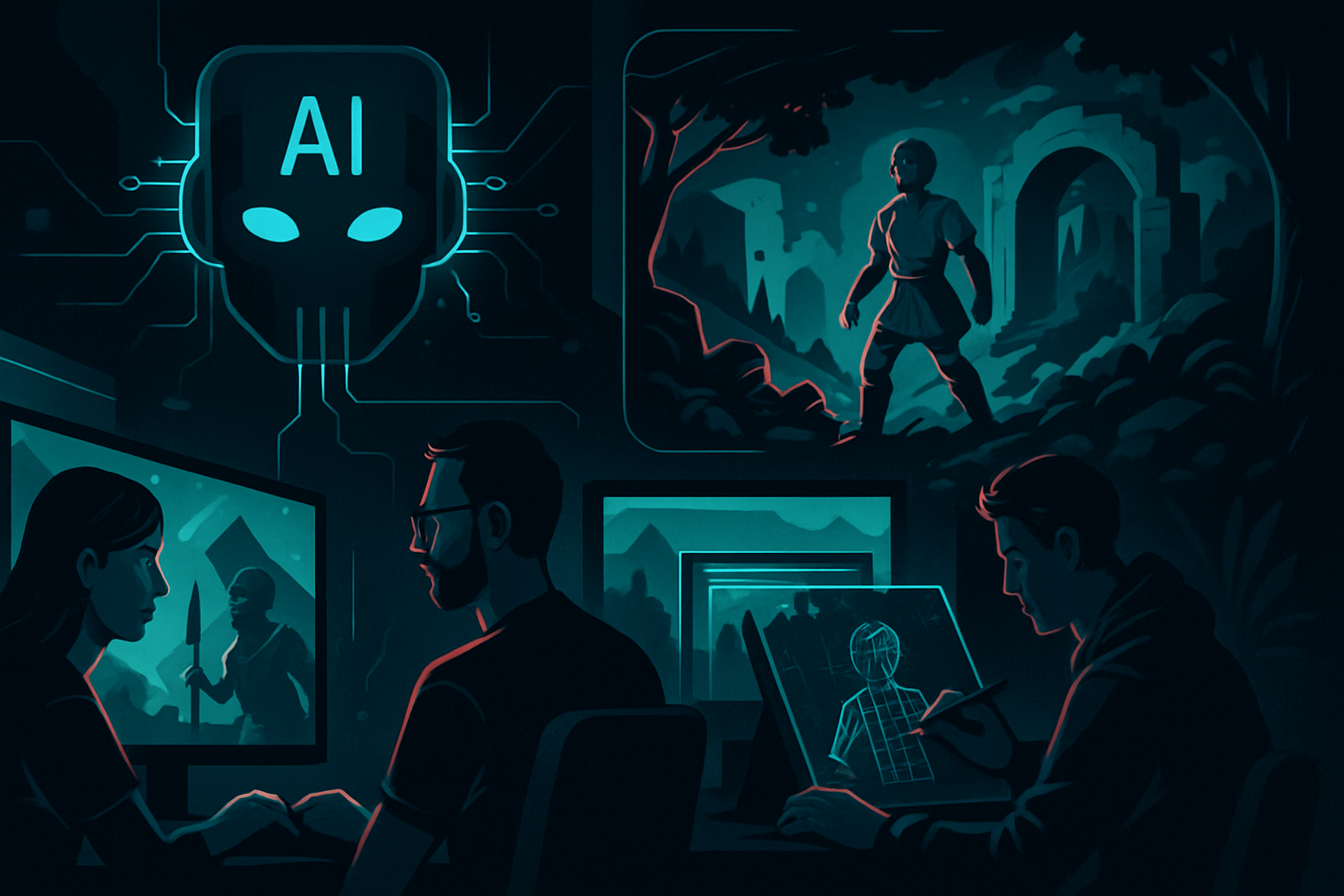
Artificial intelligence (AI) is establishing itself as a key player in video game development, disrupting traditional methods of creation and interaction. According to a survey conducted by Google Cloud, 90% of video game developers are already using AI in their daily work. This massive adoption is reflected on the Steam platform, where 7,818 titles reported using AI in 2025, marking an impressive increase of 681% compared to the previous year. The impact of AI in video game development is profound, restructuring the process from design to launch.
Smarter NPCs and Adaptive Gameplay
Non-player characters (NPCs) now benefit from far more sophisticated behaviors than the old scripted decision trees. Ubisoft, for example, has developed Ghostwriter, a generative AI tool that creates first-draft dialogues for NPCs. This allows writers to focus more on storytelling. Large language models also enable NPCs to retain memory of gameplay sessions and respond more naturally to player actions. Meanwhile, AI systems monitor player performance in real-time to dynamically adjust difficulty, while narrative engines weave branching subplots that respond to player actions and inferred emotional cues, making each playthrough truly distinct.
Generative AI and Asset Creation
AI has also transformed asset creation in video games. Andreessen Horowitz documented cases where the generation of concept art went from three weeks to one hour thanks to AI. Tencent uses Hunyuan3D-PolyGen to produce high-quality 3D assets, increasing artists' efficiency by over 70%. For its part, Meta offers WorldGen, capable of generating a 3D environment in five minutes, ready to be integrated into engines like Unity and Unreal. Audio follows the same trajectory, with tools like ElevenLabs enabling voice generation and localization at a speed that traditional recording pipelines cannot match.
Le brief IA que les pros lisent chaque soir
Les 7 actus IA du jour, décryptées en 5 min. Gratuit.
Inclus dès l'inscription : notre sélection des meilleurs guides & comparatifs IA.
Choisis ton rythme
Gratuit · Pas de spam · Désabonnement en 1 clic
Quality Assurance and Game Testing
Quality assurance (QA) is also benefiting from AI. Electronic Arts (EA) uses reinforcement learning agents to autonomously test games, detecting bugs in scenarios that human testers might miss. Square Enix plans to automate 70% of its QA and debugging by 2027, in collaboration with the University of Tokyo. This hybrid model allows AI to handle mechanical tasks while human testers focus on issues requiring more nuanced judgment.
Procedural Generation and Living Worlds
AI-assisted procedural systems now allow for the creation of more coherent and immersive game worlds. Frameworks like PANGeA demonstrate that large language models can maintain narrative consistency in dynamically generated content, eliminating the need for exhaustive writing. Narrative engines weave branching subplots that respond to player actions and inferred emotional cues, so each session reflects the shape of an individual playthrough rather than a random variation.
AI for Web and Browser Game Development
In the realm of web games, AI greatly facilitates development. Web games are structurally simpler than console or PC titles, featuring HTML5, fast loading times, and easy-to-learn gameplay mechanics. Generative AI tools allow for the rapid creation of assets and functional prototypes, even for developers without extensive technical training. AI-assisted code generation helps less experienced developers achieve a functional prototype in a browser environment. Tools like FRVR AI enable any user to generate a playable game in a browser from a simple text description. Platforms like Poki provide a natural home for these games: free for users, with revenue generated through advertising, making the path from prototype to published title more accessible than ever.
Limitations and Labor Questions
However, the integration of AI is not without challenges. The increase in low-quality AI-generated titles on Steam in 2025 has raised questions about quality standards. Voice actor unions and writers' guilds are still negotiating the terms of AI use for dialogue generation and voice cloning. What the evidence suggests so far is that AI in video game development pays off when it reduces the distance between a creative intention and a usable outcome, and studios that find true value apply it precisely where the production bottleneck lies.
Brief IA — L'actualité IA en français
L'essentiel de l'actualité de l'intelligence artificielle, décrypté et expliqué chaque jour.