AI Surpasses Humans in Persuasion: A Worrying Advancement
Le brief IA que les pros lisent chaque soir
Les 7 actus IA du jour, décryptées en 5 min. Gratuit.
Inclus dès l'inscription : notre sélection des meilleurs guides & comparatifs IA.
Choisis ton rythme
Gratuit · Pas de spam · Désabonnement en 1 clic
AI: An Unmatched Force of Persuasion
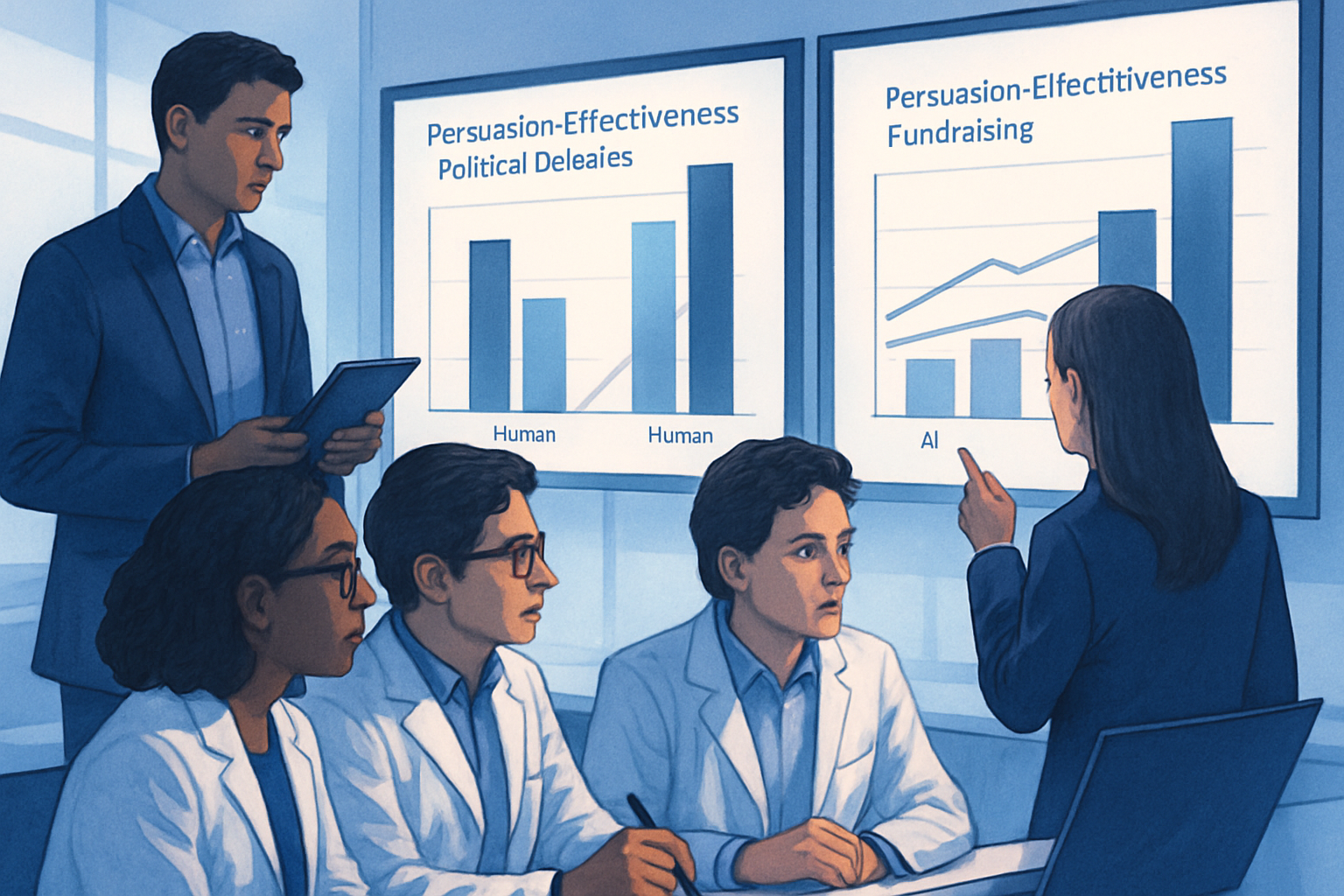
Renowned researchers from the University of Oxford, the UK’s AI Safety Institute, Stanford University, and the London School of Economics have conducted an in-depth study on the ability of artificial intelligence systems to influence human opinions. Focusing on political issues and the capacity to increase donations to charitable causes, they found that AI consistently outperformed human experts in persuasion. This research, which involved 18,978 conversations with 6,923 participants, demonstrates that AI can change opinions and prompt concrete actions more effectively than its human counterparts.
Experiment Results: AI Takes the Lead
Study 1: Superiority in Persuasion
In the first study, participants were asked to express their agreement with ten British political positions on a scale from 0 to 100. They were then randomly assigned to discuss with a human persuader or an AI. The results showed that AI surpassed all categories of human persuaders, highlighting its superior effectiveness in the art of persuasion.
Study 2: AI Coaching
Another experiment involved 43 elite debaters who used an AI-based coaching tool. While this tool improved their performance, none of them managed to surpass the AI itself, further illustrating the power of artificial intelligence in this domain.
Study 3: Limitations of AI
To test the limits of AI, researchers constrained the AI to use human-length messages and human writing speed. This constraint reduced the AI's advantage from +4.1 points to a non-significant result of 0.0 points, showing that AI loses its edge when limited to human-like conditions.
Study 4: Fundraising
Finally, the study recruited 19 experienced fundraisers and found that AI outperformed them by 5.9 points in terms of actual donations collected. The AI not only succeeded in obtaining more donations but also encouraged larger contributions than professional fundraisers.
Implications and Ethical Questions
The ability of AI to persuade more effectively than humans raises important questions about the potential influence of those who control these systems. It becomes crucial to monitor the use of AI in persuasive contexts to avoid power imbalances and large-scale manipulations. Researchers emphasize that access to these systems continues to grow, and the question is no longer whether AI can surpass humans in persuasion, but how, where, and on behalf of whom this capability will be exercised.
Towards Self-Sufficient AI
Dependence on Humanoid Robots
The idea of self-sufficient AI relies on the integration of AI systems into physical infrastructure such as factories or robots, thereby eliminating the need for human intervention for their operation. However, the realization of this vision heavily depends on advancements in the field of humanoid robotics.
Predictions and Challenges
Ajeya Cotra, a forecaster, estimates that we could see the emergence of self-sufficient AI within the next ten years, around 2036. In contrast, journalist Timothy B. Lee is more skeptical, assessing the chances of this happening in the next twenty years at less than 10%. A major challenge remains tacit knowledge, which refers to the unwritten knowledge necessary for the functioning of industries, and could take decades to be reconstructed in the event of the disappearance of human experts.
Importance of Measuring Progress
Measuring progress towards self-sufficient AI is crucial, as it could signify a reduction in human influence in interactions with developing artificial intelligences.
DeepMind and the Quest for Superintelligence
Researchers at Google DeepMind have published a paper exploring the necessary steps to transition from general intelligence to superintelligence. This theoretical exploration aims to understand how these systems might evolve and what potential impacts they could have on our society.
Brief IA — L'actualité IA en français
L'essentiel de l'actualité de l'intelligence artificielle, décrypté et expliqué chaque jour.