Generative AI: Challenges and Strategies for Businesses
Generative AI: A Transition Towards Widespread Adoption
Generative artificial intelligence, after going through a phase of experimentation, is now entering a maturity period where companies are looking to integrate it more deeply into their daily operations. However, this transition from experimentation to widespread deployment presents considerable challenges, particularly for startups that must navigate a complex landscape. The main obstacles encountered include rising costs, governance and trust issues, as well as the management of autonomous "digital workers."
Key Discussions on AI Adoption
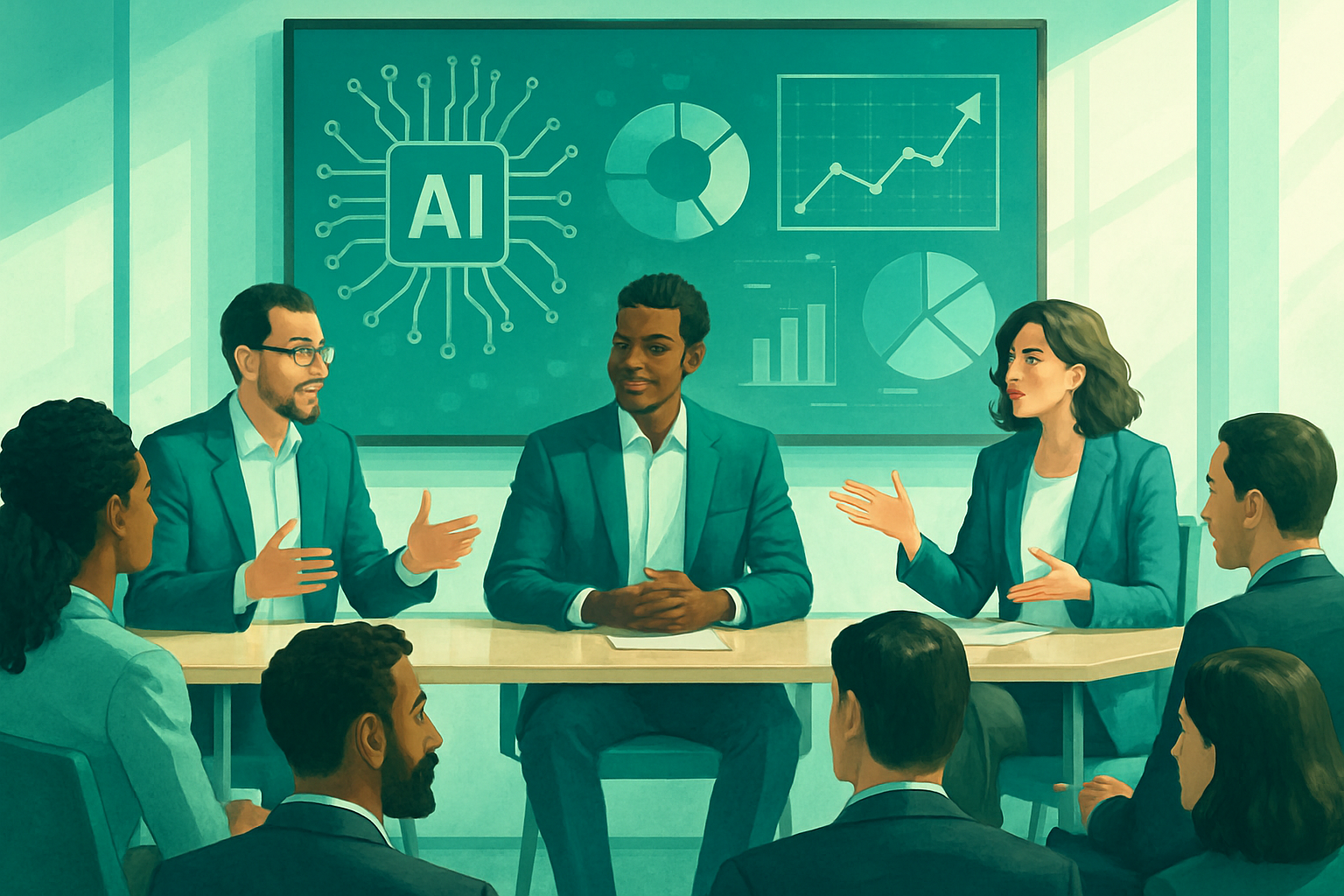
These challenges were at the center of discussions during our recent Sifted Talks event, organized in partnership with Box, an intelligent content management platform. Speakers shared their insights on how founders can move beyond the pilot phase to build resilient and truly AI-native operations.
The expert panel included Omar Davison, Solutions Engineer at Box, Jannat Rajan, Growth Investor at the venture capital fund Forestay, Lucien Bredin, Co-founder and Chief Product Marketing Officer at the AI events and procurement platform Naboo, and Thibault Martin, Ecosystem Lead at the AI company Dust.
Optimizing AI Pilots for Successful Adoption
When it comes to adopting AI, Box first seeks to determine where organizations can derive the most value. Omar Davison explains that this can translate into improved individual productivity, increased departmental efficiency, or gains at the organizational level.
For companies less familiar with AI, the initial benefits often come from enhanced individual productivity. For instance, saving 30 minutes a day through AI can represent a significant starting point for growth. It’s a growth curve that begins from this initial point.
When Naboo launched its AI service, the company assumed that its clients cared about the underlying AI model and how it worked. In reality, they were more interested in the outcomes achieved. Instead of creating a generic chatbot, Naboo trained its agents on four years of past data, voice tone, and booking communications, thus developing its "AI twin." This AI twin manages about 80% of the event organization, while 20% is handled by the account manager to maintain trust.
Governance and Financial Management of AI Operations
According to Thibault Martin, when AI deployments stagnate during the scaling phase, it is usually not due to the technology itself. A company's management team often operates under different incentives. Without a clear framework defining AI safety and budget allocation, deployments can find themselves stuck in a loop.
Within companies, there is a new form of resource: AI, to which part of the work is reassigned. It is crucial to ensure that business leaders are accountable for allocating AI where it is most needed and that they feel empowered to do so.
While AI pilot programs may be viewed as R&D experiments, deploying agentic workflows can lead to unpredictable token costs — the financial and computational expenses that arise from using AI models. Jannat Rajan emphasizes that companies that previously enjoyed gross margins of 80% to 90% are now seeing their margins drop to 50% to 60% when integrating AI into their core workflows. To address this shift, companies are implementing specific practices in financial operations and reevaluating the pricing of their software.
Le brief IA que les pros lisent chaque soir
Les 7 actus IA du jour, décryptées en 5 min. Gratuit.
Inclus dès l'inscription : notre sélection des meilleurs guides & comparatifs IA.
Choisis ton rythme
Gratuit · Pas de spam · Désabonnement en 1 clic
Instead of routing every internal request through models, organizations should build a portfolio of AI engines and pair lightweight, targeted models with proprietary internal data. "It's very similar to the multi-cloud wave we experienced in the 2010s," Rajan explains. "The principle is exactly the same: don’t fully commit to a single provider, but diversify and choose the right expenditures."
The Evolution of Talent in the AI Era
Traditional recruitment methods are no longer sufficient for AI talent. Many organizations are replacing standard behavioral questions with practical assessments where candidates must use AI tools to solve real business problems.
Thibault Martin stresses the importance of candidates' adaptability. Can they anticipate how their current work will differ in six months and prepare for this new wave? Two years ago, there were no coding agents. The ability to reinvent oneself is a skill that was less important before because you had more time to adapt.
Encouraging the entire workforce to embrace AI cannot rely solely on individual efforts. At Naboo, AI adoption is not optional — 10% of an employee's annual performance evaluation is directly tied to how they build, manage, and utilize AI agents. "This should be the same in every company, and the younger you are, the easier it is," says Bredin. "I don’t always agree with many tech companies that stop hiring juniors. They are used to this kind of change."
According to Martin, there are similarities between managing direct reports and managing AI agents. A manager does not do the work for their employees but defines what success looks like and provides feedback. "With AI, you need to be clear about what is expected. This is typically what you would get from managers," he says. "They lay the groundwork for employees to succeed. If the agent produces something useless, it is often due to the humans who worked with these agents and did not fully explain their expectations."
Building Trust, Transparency, and Value
Investors are increasingly looking for founders with industry expertise who use AI to solve specific challenges. "The companies that excite me the most are those that have a clear understanding of a particular domain," says Rajan. "They might have a solution to a very specific problem in international taxation, for example, or in law or in industry."
"When I meet someone with genuine industry expertise who has collected data you’ve never seen before and is building intelligence on it — for me, that’s absolutely magical."
Customers want more than just a quick answer — they want to feel heard and respected, asserts Martin. "Humans are much better at that. You rarely convince someone of something just because the answer is correct," he says. "Sometimes, it requires more, and that’s a good guiding principle."
Trust is built through human oversight, solid proprietary data, and training until the AI output aligns with human standards, explains Davison. "Applying governance, training, and change management are ways to reduce the ‘principle of least surprise’ and ensure that AI model outputs are reliable and correct," he adds. "As we guide and provide the instructions, skills, and data, we can then deploy and reap the benefits of AI."
Brief IA — L'actualité IA en français
L'essentiel de l'actualité de l'intelligence artificielle, décrypté et expliqué chaque jour.