No-Code AI: A Digital Revolution Within Everyone's Reach
Le brief IA que les pros lisent chaque soir
Les 7 actus IA du jour, décryptées en 5 min. Gratuit.
Inclus dès l'inscription : notre sélection des meilleurs guides & comparatifs IA.
Choisis ton rythme
Gratuit · Pas de spam · Désabonnement en 1 clic
The Era of No-Code AI: A Radical Transformation
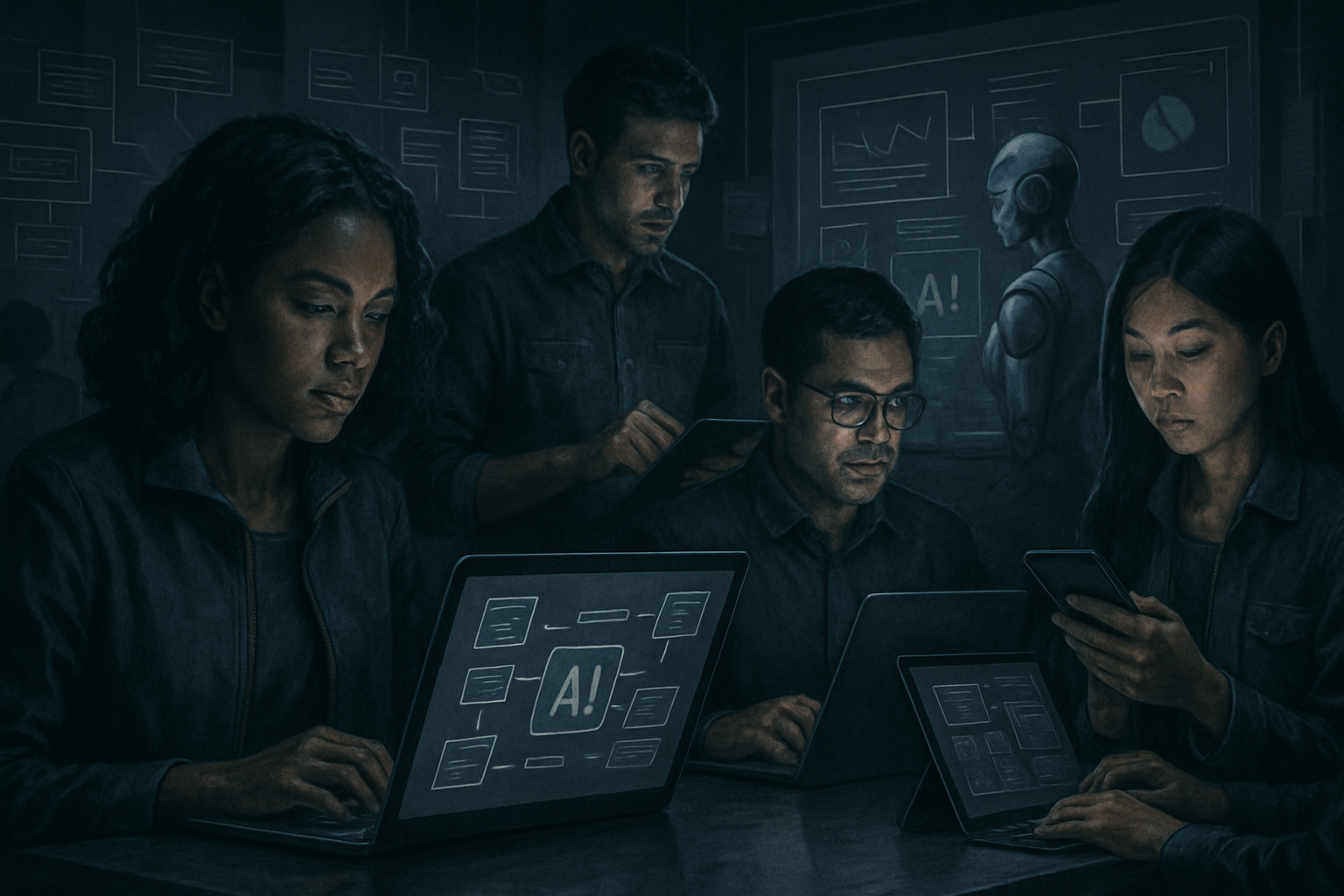
In the past, being a programmer was synonymous with prestige and rare skill. Mastery of programming languages provided an undeniable advantage, enabling the creation of software and the automation of complex processes. However, that era now seems to be over. Today, no-code artificial intelligence is disrupting this balance, offering everyone the opportunity to design AI solutions without requiring advanced technical skills. This revolution democratizes access to tools once reserved for a technological elite.
In the past, knowing how to program was a major asset. Programmers had the unique ability to create software and automate tasks, making them indispensable in many sectors. But today, this skill is no longer as exclusive. No-code AI allows anyone, even without technical training, to create sophisticated applications. This accessibility is transforming how businesses and individuals interact with technology.
From Learning Chatbots to No-Code AI
The evolution of artificial intelligence has been rapid. A few years ago, knowing how to use ChatGPT was enough to stand out in the field of AI. By 2025, developing local agents still involved writing code, often in Python, using tools like LangChain to run open-source models on personal machines. However, since 2026, the pace of change has accelerated dramatically. We have entered a new era where no-code AI allows anyone to create, deploy, and manage custom AI agents without technical effort.
AI has significantly evolved beyond simple chatbots. In 2025, creating local agents still required coding skills, particularly in Python, and the use of tools like LangChain to execute open-source models. However, since early 2026, the AI landscape has experienced a spectacular acceleration. We are now in the no-code AI era, where anyone can quickly create, deploy, and manage multiple custom agents without technical training.
Essential Skills in the No-Code AI Era
To navigate this new era, certain skills are indispensable. The key lies in the ability to write effective prompts. What distinguishes average users from advanced users is not the AI model itself, but the quality of the prompts they write. Crafting good prompts has become the modern equivalent of coding, an essential skill for making the most of available AI tools.
Every interaction with an AI model begins with a prompt. The difference between average and advanced users lies not in the model itself, but in the ability to write effective prompts. Crafting good prompts has become the new coding. To effectively use AI products, mastering industry standards for prompts is crucial.
Prompt Techniques: TCRF and TCREI
Over the years, various prompt techniques have emerged, such as Zero-Shot, ReAct, and Chain-of-Thoughts. Today, two main frameworks dominate the landscape: TCRF and TCREI. The widely used TCRF framework consists of four elements: Task, Context, Role, and Format. The TCREI framework, introduced by Google, adds two additional elements: Evaluate and Iterate, allowing for continuous improvement of AI outputs.
Prompt techniques have evolved, with approaches like Zero-Shot, ReAct, and Chain-of-Thoughts. Currently, the most commonly used prompt frameworks are TCRF and TCREI. TCRF includes Task, Context, Role, and Format. TCREI, an extension introduced by Google, also includes Evaluation and Iteration, enabling the AI to autonomously improve its outputs.
An Explosion of AI Products
The AI market is booming, with thousands of new tools, wrappers, and applications created each week. It is estimated that there are around 90,000 active AI platforms. Cloud giants like OpenAI's ChatGPT, Google's Gemini, Anthropic's Claude, and X's Grok still dominate the market. However, specialized products are emerging for specific fields, such as Perplexity for research or GitHub-Copilot for coding.
There is a multitude of AI products, with thousands of new tools and applications created each week. The total number of active AI platforms is estimated to be around 90,000. The "Big 4" generalist cloud-based agents, such as OpenAI's ChatGPT, Google's Gemini, Anthropic's Claude, and X's Grok, dominate the market. Additionally, specialized products for specific fields, like Perplexity for study and research, and GitHub-Copilot for coding, are on the rise.
Towards Local Models for Greater Privacy
A recent trend is emerging towards the use of local models, which offer advantages in data privacy, cost reduction, and control over workflows. Products like Claude-Cowork and Claude-Code, as well as open-source solutions like OpenClaw and Hermes, allow for the execution of AI models locally, although adequate hardware is required.
The market is shifting towards local models to ensure data privacy, reduce recurring API costs, decrease cloud latency, and maintain control over proprietary workflows. Standalone closed products like Claude-Cowork and Claude-Code, as well as open-source solutions like OpenClaw and Hermes, require a management application for LLMs like Ollama. To run these models locally, a machine with at least 16 GB of RAM and an 8 GB GPU is necessary.
Understanding the Claude Family
Among Anthropic's products, Claude stands out for its various applications. Claude, the web application, is an agentic chatbot for the average user. Claude-Cowork, a desktop application, is aimed at intelligent but non-technical users, while Claude-Code, a terminal application, is designed for developers with full terminal access.
Claude is considered the smartest AI currently available. Understanding the differences between the products in the Anthropic family is essential. Claude, the web application, is a cloud-based agentic chatbot, similar to ChatGPT, Gemini, or Grok. Claude-Cowork, a desktop application, is intended for intelligent but non-technical users, operating in an isolated environment on your PC with selective access to your files. Claude-Code, a terminal application, is aimed at developers with full terminal access, allowing them to execute code.
Proactive AI: A New Way of Working
Proactive AI is a game changer by automating tasks without human intervention. Local AI agents allow for the delegation of tasks that are then executed autonomously. This automation opens up new possibilities, where anything that does not involve physical action can be handled by AI.
We have transitioned from reactive AI to proactive AI. Previously, you had to send a message to your chatbot to ask questions. Now, the agent informs you that the work you delegated to it is complete. With the right setup, you have nothing to do but review and validate the output. AI searches, plans, executes, and deploys results autonomously.
Automation and Integration with MCP Servers
To connect your AI agents to real-world tools and systems, MCP Servers are essential. This open-source protocol allows AI systems to communicate with external applications. With over 30,000 MCP Servers available, platforms like n8n and Zapier facilitate their use.
Local AI agents open up a whole new way of working, and thus, a new way of living. To automate your life, all your daily tasks must follow a workflow that can be automated by giving instructions. To connect your agents to real-world tools, systems, and data, MCP Servers are essential. MCP (Model Context Protocol) is a standard open-source framework introduced by Anthropic that allows AI systems to communicate with external applications and data sources. There are over 30,000 MCP Servers available, as anyone can create and publish one. The main platforms for creating and using MCP Servers are n8n (which runs locally) and Zapier (cloud-based).
Conclusion: Adapting to the Evolution of AI
As AI continues to evolve, it is crucial to stay informed about the products and skills necessary to make the most of it. Reasoning, automation, and software creation capabilities will remain valuable, regardless of which AI products dominate. The no-code AI era offers unprecedented opportunities to automate and optimize our lives, thereby transforming our interaction with the digital world.
As AI continues to evolve, the skills needed to stay ahead are changing. You need to know which products to use and how to maximize the benefits they offer. Underlying capabilities, such as reasoning, automation, integration, and software creation, will remain valuable, no matter which AI products dominate the market. Using Claude-Cowork to automate recurring tasks in your life is recommended. The more you work on it, the more ideas you may have. In that case, move on to Claude-Code and start building things. If you have good hardware and do not want to pay for Claude, run OpenClaw or Hermes locally to achieve the same results. Finally, when something you have built finds success, package it into an MCP Server and publish it for others to use as well. All of this constitutes the "in-demand" skill of this new era of no-code AI.
Brief IA — L'actualité IA en français
L'essentiel de l'actualité de l'intelligence artificielle, décrypté et expliqué chaque jour.