AI: A Vector of Global Digital Inequalities
Le brief IA que les pros lisent chaque soir
Les 7 actus IA du jour, décryptées en 5 min. Gratuit.
Inclus dès l'inscription : notre sélection des meilleurs guides & comparatifs IA.
Choisis ton rythme
Gratuit · Pas de spam · Désabonnement en 1 clic
AI: An Ubiquitous but Unequal Tool
Artificial intelligence (AI) has quickly established itself as an essential element of our daily lives, integrated into sectors as varied as education, healthcare, finance, and public administration. It is used to automate tasks such as writing emails, software development, filtering job applications, and powering recommendation systems. Tech industry leaders promote the idea of “AI for all,” while governments rush to develop national strategies and build sovereign computing infrastructures. However, despite these efforts, AI seems to exacerbate existing digital inequalities. Indeed, each new technological wave, although perceived as transformative, often takes root in a landscape already marked by disparities in connectivity, skills, and institutional capacities.
Over the past decade, digital inclusion and digital literacy projects have been conducted in regions ranging from Europe to Sub-Saharan Africa and Southeast Asia. These initiatives have revealed a recurring pattern: each new so-called “transformative” technology arrives in an environment already stratified by differences in connectivity, skills, and institutional capacities. The current wave of AI is no exception and, on the contrary, amplifies these underlying fractures.
Geographic Concentration of AI Infrastructure
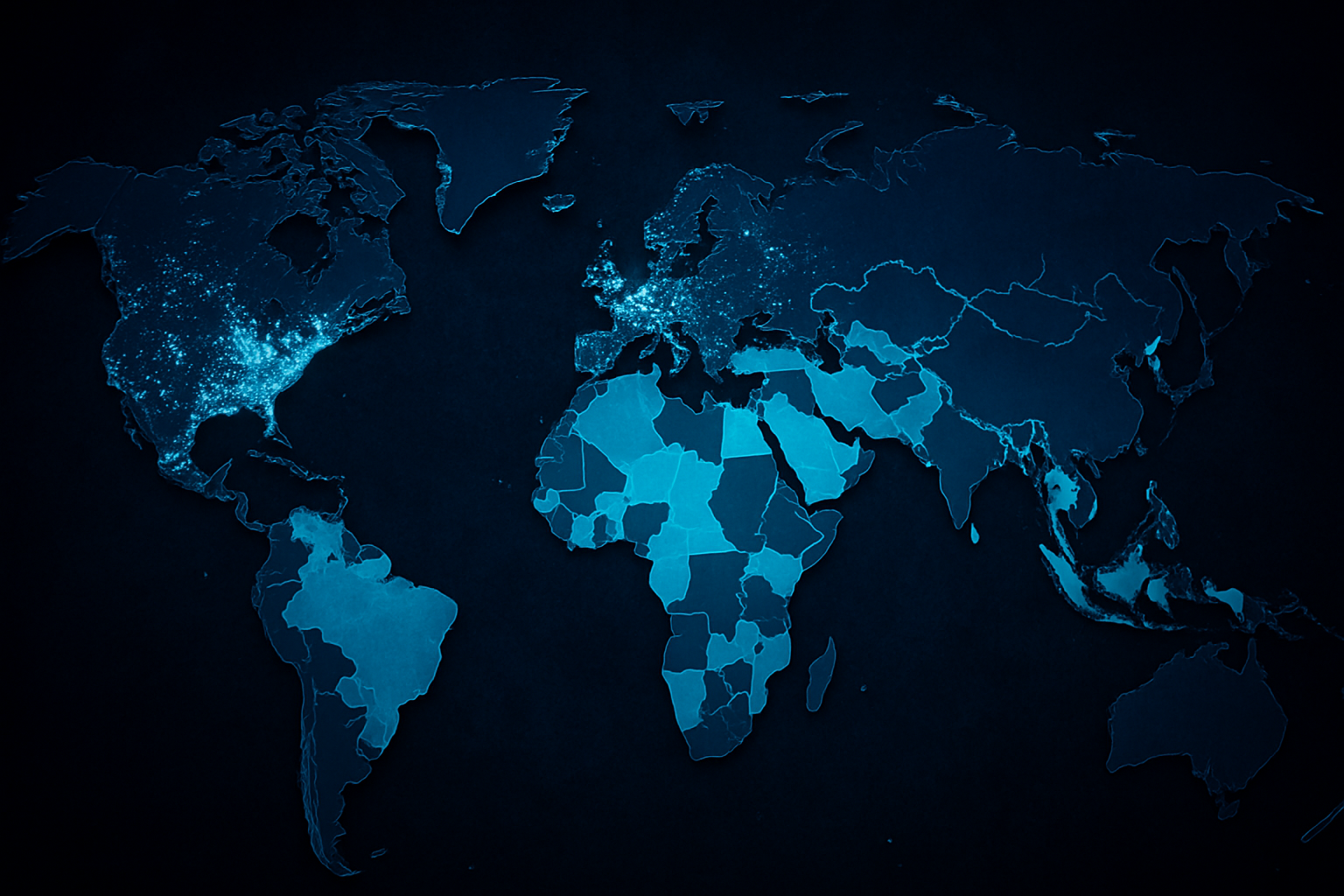
The United States overwhelmingly dominates the global AI landscape, hosting more than 5,000 data centers, which is over ten times the number of any other country, according to the 2026 AI Index from Stanford University. This concentration means that the majority of AI workloads are performed on American cloud platforms, creating a global dependency on this infrastructure. In 2023, the United States accounted for approximately 87% of global exports of cloud computing and data storage services, according to the World Bank.
For many countries, this means that AI development is not only technologically outsourced but also commercially and geopolitically. A small number of countries and companies control the computational engines that power AI systems deployed globally. Systems trained in a limited institutional and linguistic framework may struggle to meet the needs of a truly global audience.
Disparities in AI Skills
Even in regions where connectivity and cloud access are present, not everyone is able to leverage AI. In Organisation for Economic Co-operation and Development (OECD) member countries, only 40% of adults possess digital problem-solving skills beyond a basic level. Advanced computing and AI skills remain concentrated among highly skilled workers and technology-intensive sectors.
Governments are striving to integrate AI into education, often starting with higher education. UNESCO has noted an increase in efforts to incorporate AI into global education, but support for AI literacy in primary and secondary education remains uneven. Individuals with a solid education, advanced digital skills, and stable connectivity are better positioned to use AI as a tool to expand their capabilities. According to an OECD survey, 36% of individuals with a higher education degree received AI-related training in the previous year, compared to only 18% of those with a high school diploma. Those who do not benefit from these advantages often perceive AI as an opaque system that acts upon them, rather than as a technology they can actively interrogate or shape.
Governance and Investment: Limited Access to the Decision-Making Table
Setting AI priorities is often in the hands of a small group of industry players and a few technologically advanced states. Most other countries find themselves in a catch-up position, adapting imported models and standards for “trustworthy AI” to their local contexts, but with limited capacity to assess trade-offs or propose alternatives. In South Africa and Indonesia, although communities generate large amounts of data, they have little influence over the design, governance, or deployment of AI systems. Their languages are underrepresented in training data, their institutions are underfunded in regulatory forums, and their experiences are rarely included in benchmark datasets.
In South Africa, the Department of Communications and Digital Technologies published a draft national AI policy in April 2026, but had to withdraw it after discovering errors in academic citations, apparently generated by AI. This incident illustrates the gap between the ambition for AI governance and the institutional capacity needed for its implementation. Indonesia, on the other hand, has initiated efforts to develop practical AI tools for underserved communities, such as applications using satellite data to assist small-scale fishermen.
Indonesia has also developed multilingual language models trained on Indonesian and local languages such as Javanese and Sundanese, as well as AI chatbots deployed in government services. In August 2025, the Ministry of Communication and Digital Affairs released a national AI roadmap with the goal of training 100,000 skilled AI workers per year.
Rethinking the Digital Divide of AI
This is not about slowing down or abandoning AI, nor about viewing cloud concentration or venture capital as inherently negative. Instead, it is crucial to ask who can influence the direction of this “AI revolution” and who is merely adapting to it.
Discussions about the digital divide have expanded beyond devices and connectivity to include skills and outcomes. The current wave of AI adds a new dimension: disparities regarding who can meaningfully participate in defining AI, what problems it should solve, and what social priorities it should serve.
For engineers and policymakers, this raises essential questions. Are they designing AI systems and infrastructures that broaden participation in defining technological change? When governments deploy national strategies on AI, what constraints, languages, and institutional realities do they take into account?
Many observers see the current AI landscape as a competition. But technological competition is not just about speed; it is also about who can influence the direction of change. AI is already spreading globally, but the crucial question is whether technologists and decision-makers will ensure that meaningful participation in defining this future spreads as well.
Brief IA — L'actualité IA en français
L'essentiel de l'actualité de l'intelligence artificielle, décrypté et expliqué chaque jour.