AI Spending per Employee Drops in August Among Large Companies
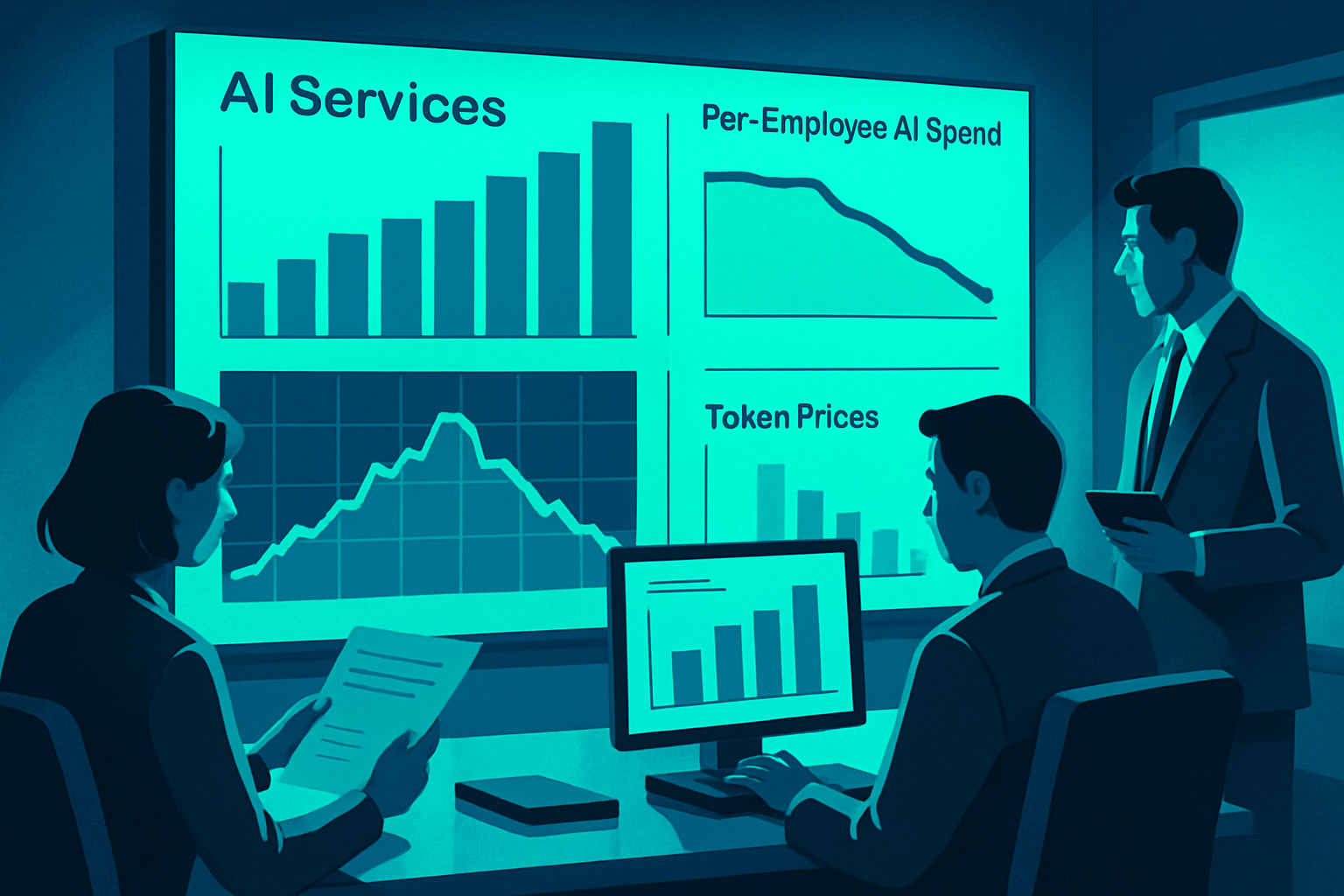
Ramp's data on 70,000 companies indicates that in August, there was a slight plateau in paid AI adoption and a marked decrease in spending per employee among the top 1% of accounts. The average cost of tokens dropped to $0.68 per million, far from the peak of March 2026, due to intense competition between OpenAI and Anthropic.
Among the largest accounts, spending per employee falls and tokens are worth less
In the top 1% of the highest-spending companies analyzed by Ramp, AI spending per employee decreased by nearly 10% to $7,205. Meanwhile, the average cost of tokens fell to $0.68 per million, down from $1.15 in March 2026. OpenAI and Anthropic have reduced their prices, and according to Ramp economist Ara Kharazian, the decline observed in this segment is also explained by this pricing evolution, in addition to the vacation effect. Ramp indicates that labs have not yet compensated for these price drops with an increase in volumes. Kharazian believes that the competition between OpenAI and Anthropic makes AI more accessible and drives prices down, which reduces spending in this group of companies that has long been considered a growth engine.
Paid adoption: a plateau in August and a contrast with official figures
In August, 56% of Ramp's clients paid for AI products, representing a limited increase of 0.4% compared to the previous month, marking a slowdown in paid adoption during this period. These figures come from Ramp's analysis of 70,000 companies. In comparison, a survey by the U.S. Census Bureau, updated on August 23, indicates that 22% of businesses report using AI. Ramp may overrepresent tech-savvy companies, but its data is one of the few direct tracking of spending, potentially serving as a precursor. The month of August, a vacation period for much of the industry, may explain this stagnation. Last year, Ramp's AI index had already shown little to no growth between August and October, before a rebound at the end of the year.
Le brief IA que les pros lisent chaque soir
Les 7 actus IA du jour, décryptées en 5 min. Gratuit.
Inclus dès l'inscription : notre sélection des meilleurs guides & comparatifs IA.
Choisissez votre rythme
Gratuit · Pas de spam · Désabonnement en 1 clic
Clients leaning towards cheaper models, effects on cost return and platforms
Many clients prefer older, less expensive models, such as OpenAI's ChatGPT 5.6-Terra or Anthropic's Sonnet, instead of opting for the latest available versions. According to some employees at leading labs, most of the training-related expenses are amortized in the first few weeks after a model's launch, a trend that could be challenged if adoption were to slow down. Although open-weight models are being discussed, in August, only 6.4% of companies investing in AI utilized model or inference service platforms; this rate is increasing but remains insufficient to have a significant impact on overall commercial adoption. These developments contribute to the emphasis labs are placing on non-technical uses through co-working tools. This cyclical signal could be unfavorable to model designers and hyperscalers exposed to very large order books, while, according to Ara Kharazian, AI-using companies are currently finding value in this situation.
Brief IA — L'actualité IA en français
L'essentiel de l'actualité de l'intelligence artificielle, décrypté et expliqué chaque jour.