The FCC Blocks Chinese Robots and Inverters to Protect AI
Le brief IA que les pros lisent chaque soir
Les 7 actus IA du jour, décryptées en 5 min. Gratuit.
Inclus dès l'inscription : notre sélection des meilleurs guides & comparatifs IA.
Choisis ton rythme
Gratuit · Pas de spam · Désabonnement en 1 clic
The FCC Blocks Chinese Robots and Inverters to Protect AI
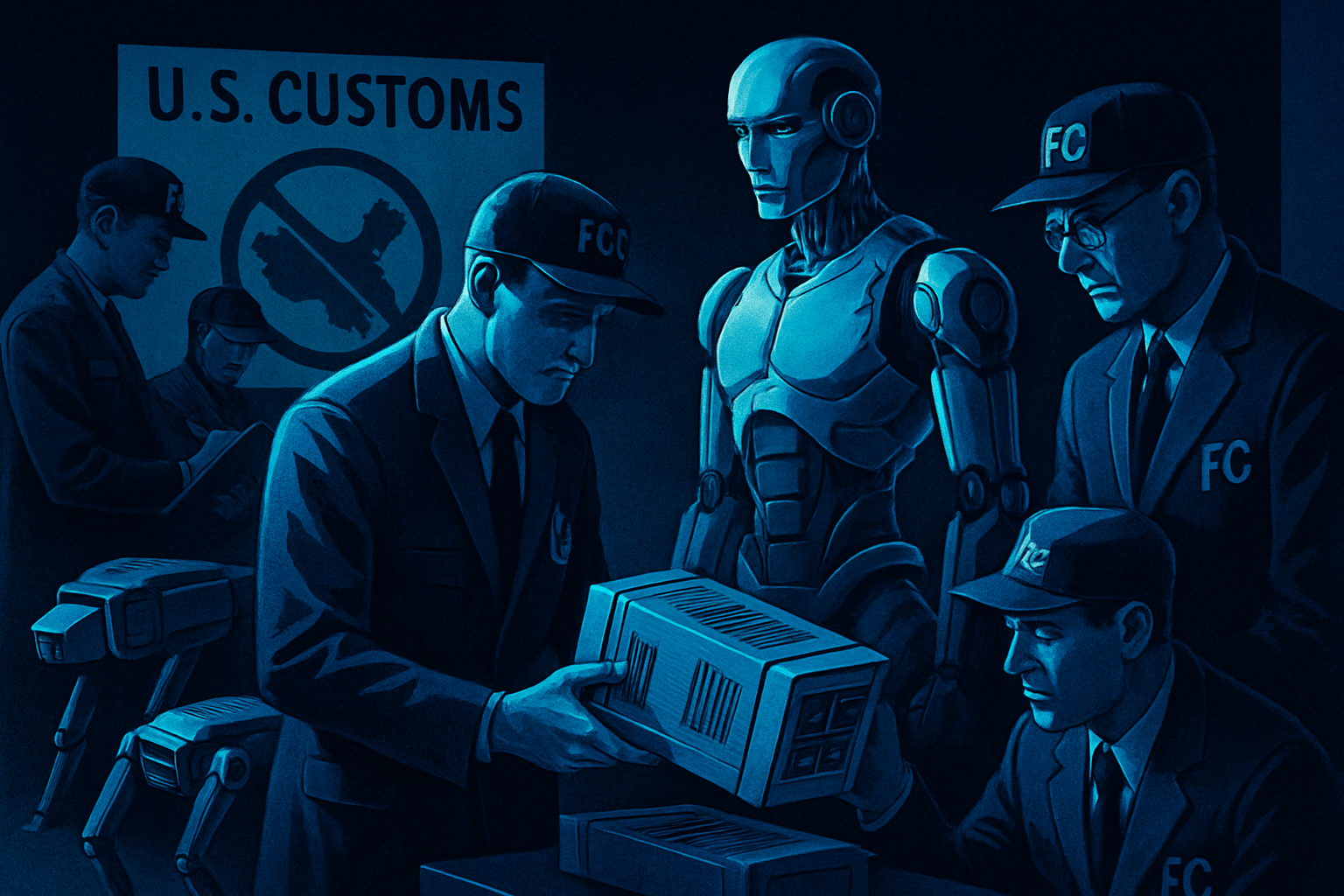
The FCC bans imports of new Chinese humanoid robots and robotic dogs. However, the broad definition of this rule also includes Roombas, robotic lawn mowers, and delivery robots.
The Trump administration used the Federal Communications Commission (FCC) to prohibit imports of new "advanced robotic devices" from abroad and Chinese internet-connected inverters. According to Reuters via Nikkei, this measure took effect on July 28, 2026, the date of its publication. The stated goals are to protect the development of AI in the United States from Chinese threats, including disruptions, data theft, and cyberattacks, and to bring manufacturing back to American soil.
Why the Government Considers Robots a Security Risk
The administration's national security determination presents two main arguments.
-
The first is a supply chain vulnerability. The global manufacturing of advanced robots and their critical components, including actuators, grippers, batteries, and sensors, is increasingly concentrated in a few countries. Some of these countries have repeatedly shown a willingness to disrupt American supply chains during periods of geopolitical tension. If the American economy continues to rely on foreign sources, it exposes itself to "the whims of foreign entities that could disrupt or degrade supply chains at a time of their choosing," the document states.
-
The second is a cybersecurity risk. Robots are inherently interconnected systems with large attack surfaces that allow for data exfiltration, remote control, and insecure updates, according to the document. They collect data that malicious actors could use "to surveil Americans, enhance the capabilities of foreign intelligence services, or to remotely take control of robots." Many devices are equipped with high-resolution sensors such as LiDAR, electro-optical, acoustic, and thermal, capable of creating detailed maps of their environment, making them valuable for foreign intelligence services.
The document cites specific incidents. In early 2026, a vulnerability in a category of foreign robots allowed remote access to thousands of devices in homes worldwide, including live camera feeds, audio recordings from microphones, and detailed floor plans. In another case, a flaw in certain humanoid robots allowed control over their operation and scanning of nearby robots, potentially enabling the creation of a self-propagating "humanoid botnet."
In April 2025, security researchers also discovered what appeared to be a pre-installed backdoor in Chinese robotic dogs, granting complete access to their cameras and controls. The government also emphasizes that some foreign jurisdictions prohibit companies from disclosing security vulnerabilities to their customers, increasing the risk that foreign governments could exploit these vulnerabilities for manipulation or data extraction.
In a military context, the document notes that unmanned ground vehicles and quadrupeds are becoming central to modern warfare for autonomous breakthroughs, resupply, force protection, and offensive strikes.
The Department of War (DOW) will be responsible for making exemption decisions in the future. The FCC Chairman, Brendan Carr, stated that the agency would continue to "do its part to secure America's critical supply chains."
The Ban Goes Well Beyond Humanoids
Headlines have focused on humanoids and robotic dogs, but the ban is much broader. As reported by The Verge, the definition covers almost any software-controlled robot that moves on the ground, weighs more than 2 kg (including its charging station), can perceive its environment, and has wireless connectivity. FCC spokesperson Katie Gorscak confirmed that robotic vacuums are included in the rule, as well as robotic lawn mowers, sidewalk delivery robots, and transport robots in Amazon warehouses.
Existing devices are not affected for now. The ban only applies to models that have not yet been marketed. Autonomous cars, trains, drones, underwater vehicles, surgical robots, wheelchairs, and fixed robotic arms are all exempt.
The Verge highlights a critical detail. The FCC's exemption process does not raise any security questions. It only wants to know where a robot was designed and manufactured, as well as a commitment to American production. Given that virtually all robotic vacuums come from China, including market leaders Roborock, Ecovacs, Dreame, Xiaomi, and Narwal, and that even the Roomba brand is now owned by the Chinese company Picea, the ban targets origin rather than actual security. "There are very few non-Chinese brands these days, and their share is so small that it's hard to track," said IDC analyst Jitesh Ubrani to The Verge.
Inverters Open a Second Front
Alongside robots, the FCC is also banning new internet-connected inverters from China. These inverters convert direct current to alternating current and connect renewable energy sources, batteries, and data centers to the electrical grid, which is becoming increasingly important for AI development in the United States. Since they can be controlled remotely, they are seen as a potential entry point for sabotage. China is the world's largest manufacturer, led by Sungrow and Huawei, which have increased their market share in the West through low prices. Authorities want to avoid a repeat of the Volt Typhoon hacking campaign discovered in 2023, where attackers hijacked private routers to mask attacks on critical American infrastructure.
On the robotics side, the most affected company is Unitree, which dominates the global humanoid market with about one-fifth of all sales, according to Counterpoint Research. The company was recently added to the Pentagon's list of Chinese companies linked to the military and has recently partnered with Nvidia. Unitree emphasized that the data from its robots remains in the United States. Republican Congressman John Moolenaar, chairman of the China committee in the House, stated that this measure "protects our country and strengthens our nation's robotics industry."
The FCC had already imposed similar import bans on foreign routers and drones in recent months.
Brief IA — L'actualité IA en français
L'essentiel de l'actualité de l'intelligence artificielle, décrypté et expliqué chaque jour.