Anthropic Forced to Disable Its AI Claude Fable 5 and Mythos
Le brief IA que les pros lisent chaque soir
Les 7 actus IA du jour, décryptées en 5 min. Gratuit.
Inclus dès l'inscription : notre sélection des meilleurs guides & comparatifs IA.
Choisis ton rythme
Gratuit · Pas de spam · Désabonnement en 1 clic
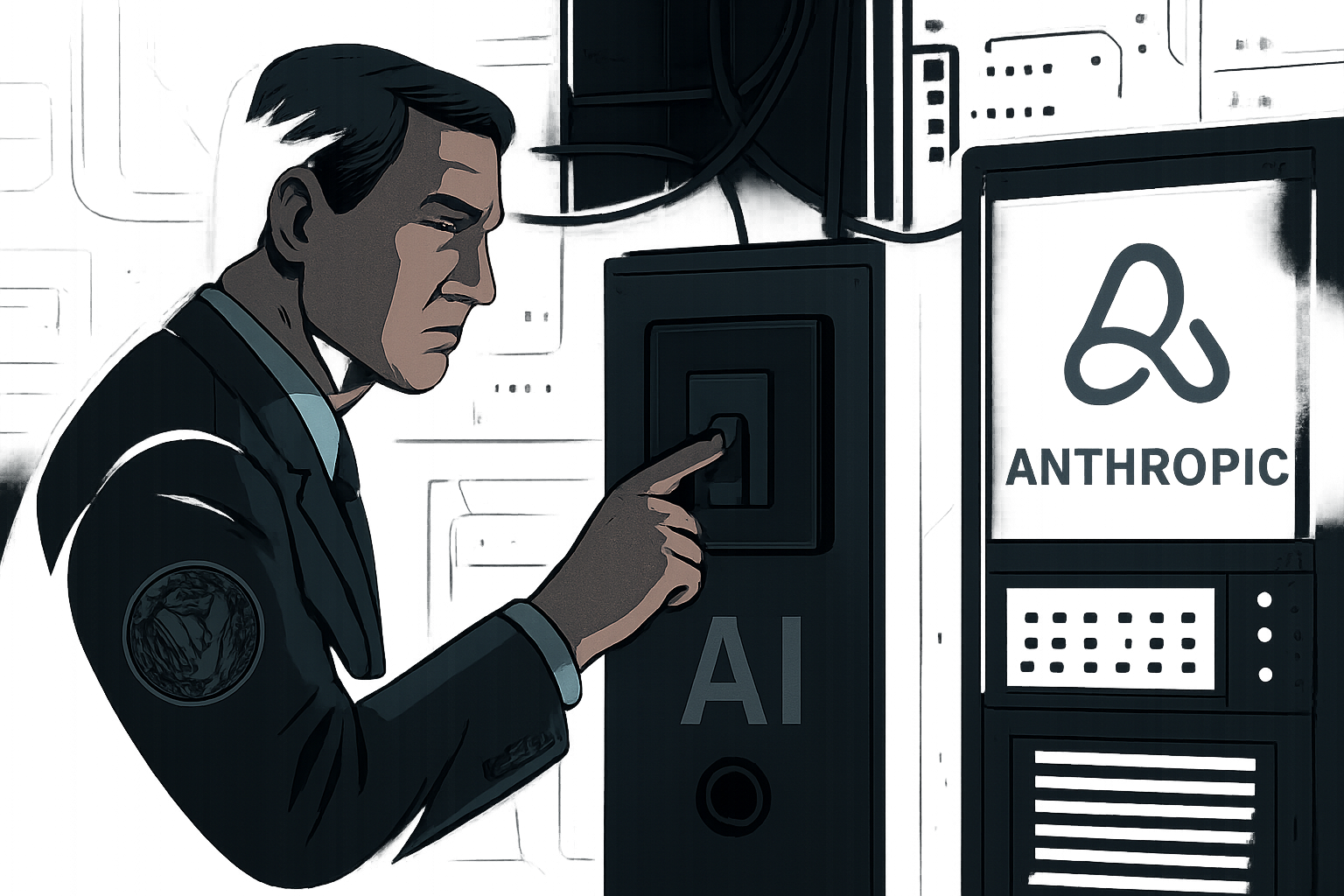
The U.S. government recently made a drastic decision by ordering Anthropic to immediately disable access to two of its most advanced artificial intelligence models: Claude Fable 5 and Claude Mythos 5. This directive, issued on Friday, is based on national security concerns. Anthropic confirmed its compliance with this directive via an announcement on X, while clearly expressing its disagreement with the government's assessment.
The directive, received precisely at 5:21 PM (Eastern Time), requires Anthropic to disable these models for all users worldwide, rather than just for foreign nationals as is typically the case with export control orders. Other Anthropic models are not affected by this suspension.
Mythos is recognized as Anthropic's most powerful AI model, introduced at the beginning of April. It has been kept under strict restrictions due to its exceptional ability to detect security vulnerabilities in software. According to Anthropic, Mythos has identified flaws in all major operating systems and web browsers it has tested. Rather than making it widely accessible, the company chose to share it as part of a controlled program called Project Glasswing. This program includes about 50 verified organizations, including tech giants such as Amazon, Apple, Google, Microsoft, and CrowdStrike, for defensive cybersecurity work.
Fable 5, on the other hand, was launched just three days ago. Designed as a response to commercial pressure, it is a version of Mythos equipped with safeguards that block responses in high-risk areas such as cybersecurity and biology. This makes it safe enough for a general release, according to the company. Based on benchmark tests from Vals AI, a company specializing in tracking AI technology performance, Fable 5 immediately established itself as the most powerful publicly available AI model.
The government's decision is presented as an export control action aimed at restricting access to the models for foreign nationals. However, in a lengthy blog post, Anthropic claims that its understanding is that the underlying concern relates to an alleged jailbreak of Fable 5. So far, the company states that the government has only provided verbal evidence of a "narrow and non-universal potential jailbreak." According to Anthropic, this involves prompting the model to read a specific codebase and identify software flaws. Furthermore, the company adds that this level of capability is already widely available in other publicly accessible models, including OpenAI's GPT-5.5. This capability is also regularly used by cybersecurity professionals for defensive purposes.
Anthropic's broader argument is that its strongest protections operate through independent classification systems that function separately from the model itself. This means that even if someone manages to convince Fable to continue speaking after a refusal, the underlying protections against the most dangerous outputs remain in place.
Clearly, none of this was enough to prevent the government from acting, and Anthropic does not hide its frustration. "We disagree that the discovery of a potential narrow jailbreak should justify the recall of a commercial model deployed to hundreds of millions of people," the company wrote. "If this standard were applied across the industry, we believe it would essentially halt all new model deployments for all leading model providers."
Anthropic is expected to pursue an initial public offering (IPO) this year and has heavily invested in its public identity as a security-conscious alternative to its competitors. Observers note the irony that the very caution Anthropic displayed in restricting Mythos — which it promoted as a model so dangerous it could not be publicly released — has now seemingly attracted exactly the type of government scrutiny that could disrupt its business.
Sam Altman of OpenAI must appreciate this, at least. In April, he told podcaster Ashlee Vance that Anthropic's management of Mythos amounted to "fear-based marketing." "It's clearly incredible marketing to say: 'We built a bomb. We were about to drop it on your head. We're going to sell you a bomb shelter for $100 million,'" Altman said. Altman, whose company is also widely expected to pursue an IPO as soon as possible, did not predict a government shutdown, but he identified something that has come back to haunt Anthropic for now: when you spend months telling the world that your AI is exceptionally dangerous, the world — including the U.S. government — tends to listen.
Brief IA — L'actualité IA en français
L'essentiel de l'actualité de l'intelligence artificielle, décrypté et expliqué chaque jour.