Smart Rings: The AI Gadget That Captivates
Smart Rings: The AI Gadget That Captivates
In recent months, I've spent a lot of time talking to my computer. An underrated feature of the LLM (language model) revolution has been a remarkable leap in all sorts of dictation technologies — even the fastest and cheapest models are becoming very good at understanding and processing speech. I've tested numerous applications, from WisprFlow to Monologue, Spokenly, and Handy, and I found them all to be useful means for quickly drafting emails, Slack messages, and more. They sometimes tend to adopt a style of formatting that is too formal and like to end a text message with a period (like a sociopath), but they are also improving in this regard.
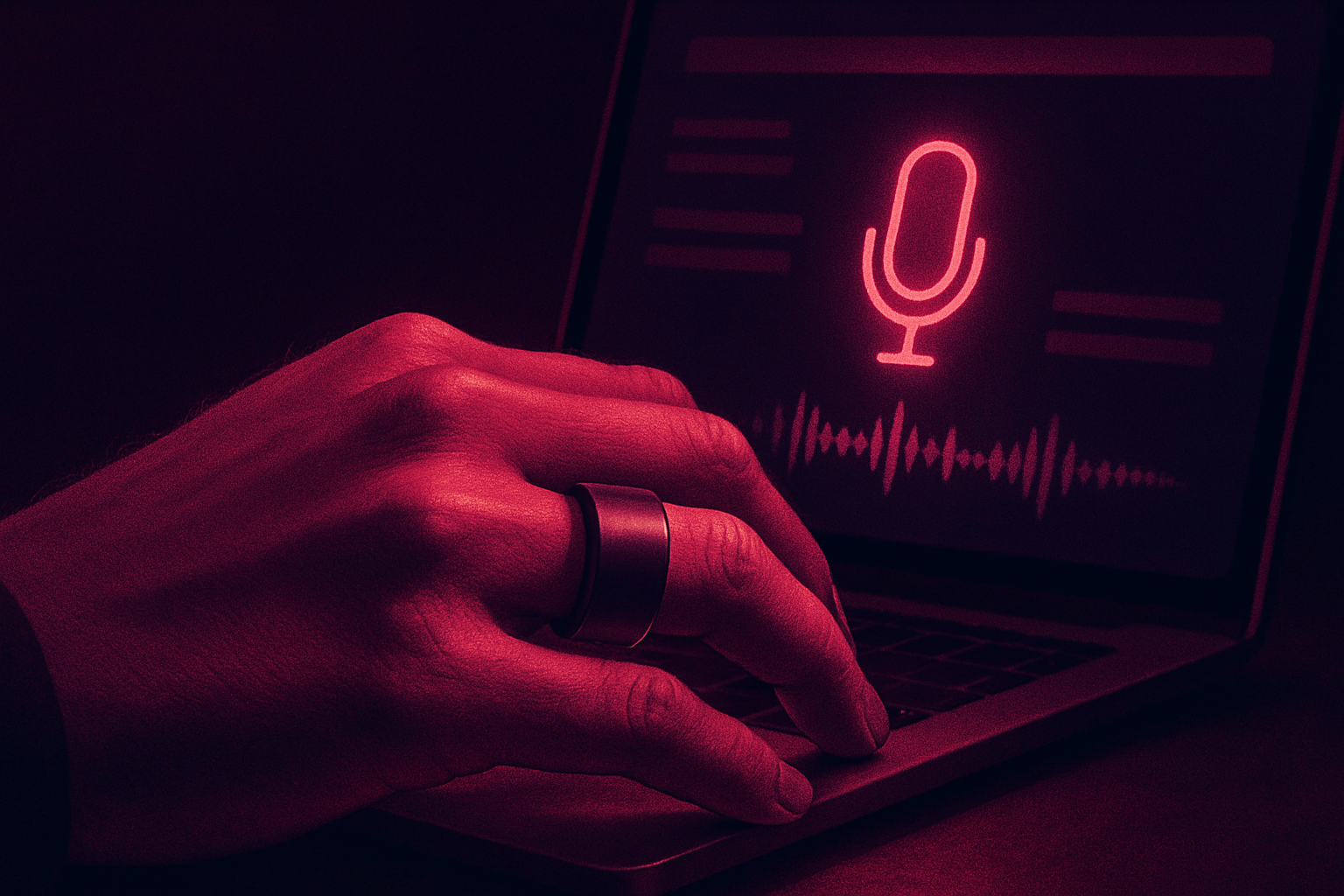
But nothing has convinced me of the future of conversing with my computer quite like a demonstration I recently saw from Mina Fahmi. Fahmi is the CEO of Sandbar, which is developing a smart ring called Stream, set to ship later this year. As I sat in a conference room at Sandbar's offices in New York, Fahmi showcased the device's features, including the latest: dictation to all your devices. He opened a new note in Apple Notes, held the ring near his mouth, pressed the device's touchpad with his thumb, and murmured to himself for a few seconds. Moments after he finished, two complete — and correctly transcribed — sentences appeared in the note.
The Stream is essentially a microphone, a battery, and a Bluetooth connection to your phone. Many AI gadgets could be described in the same way, now that everyone seems eager to sell you a means to record your conversations and meetings to extract summaries and actions. Companies like Plaud, Pocket, FoCase, Mobvoi, and many others are all ready to sell you these portable recorders — bonus points if they attach to your phone to record calls.
Fahmi and Sandbar are trying to do something different. The Stream is a more introverted device, focused on capturing your voice rather than that of others. (Another promised feature of the ring is a whisper mode — Fahmi spoke so softly that I couldn't hear a word, and the Stream still transcribed perfectly. Or at least, that's what Fahmi said.) Fahmi explains that the idea for the device came to him because he enjoys walking and was tired of having to pull out his phone every time he had an idea or wanted to ask something of his AI assistant.
Le brief IA que les pros lisent chaque soir
Les 7 actus IA du jour, décryptées en 5 min. Gratuit.
Inclus dès l'inscription : notre sélection des meilleurs guides & comparatifs IA.
Choisissez votre rythme
Gratuit · Pas de spam · Désabonnement en 1 clic
The Stream thus has three functions: starting a conversation with an AI assistant, taking notes, and dictating text. Currently, most of these actions take place in the companion app Stream. But this is not the long-term answer, nor Sandbar's long-term plan. Ultimately, devices like this should be connected to all the other tools you use, so you can chat with any assistant, take notes directly in your existing app, and dictate in any text field. In this regard, the Stream is already making fascinating progress: at one point during his demonstration, Fahmi flashed new firmware onto the ring, connected it to his Mac and iPhone, and was able to smoothly dictate text from one device to another. He didn't want to tell me how it worked, but it was incredibly seamless.
The Pebble Index is an even simpler version of the ring system as input. I've tested many AI gadgets, and most of them are just poor substitutes for your smartphone. But our phones are bad input systems. You have to take your phone, unlock it, open an app, create a new note or start a new conversation, type and write, just to get a thought out of your head. Voice assistants and AI chatbots make some interactions easier, but much of modern life still involves typing in text fields. Talking to my laptop is acceptable in the comfort and quiet of my home; in a café, on a train, or even walking down the street, it's both socially problematic and technically much more difficult. (And frankly, I'm not very interested in normalizing everyone talking to their AI friends in public.) Smart rings could solve the problem: just bring the ring to your mouth, press a button, and speak. The gesture feels natural, the microphone is close enough to your mouth to capture your voice accurately, and the whole process is much less intrusive than shouting into your earbuds.
A few companies are already working on this type of AI ring. The founder of Pebble, Eric Migicovsky, created the Index 01 for the same reason Fahmi built the Stream: he needed the fastest way to get ideas, reminders, and notes out of his head. There's also Vocci, a more meeting-focused version of the same concept. Over time, we might see existing rings from companies like Oura and Ultrahuman start to add some of these technologies as well. It's not complicated technology! It's a microphone. All the other complicated operations happen elsewhere, on the devices you almost certainly have with you too.
Most of these products are not finished or shipped yet, but I am increasingly convinced by the prospect of talking more with my devices — and more and more persuaded that there is no better place to put a microphone than on my finger. Smart rings are not looking to replace or render your phone obsolete — they simply allow you to keep it in your pocket much more often.
Brief IA — L'actualité IA en français
L'essentiel de l'actualité de l'intelligence artificielle, décrypté et expliqué chaque jour.