Chinese AI Models Challenge the Trump Administration
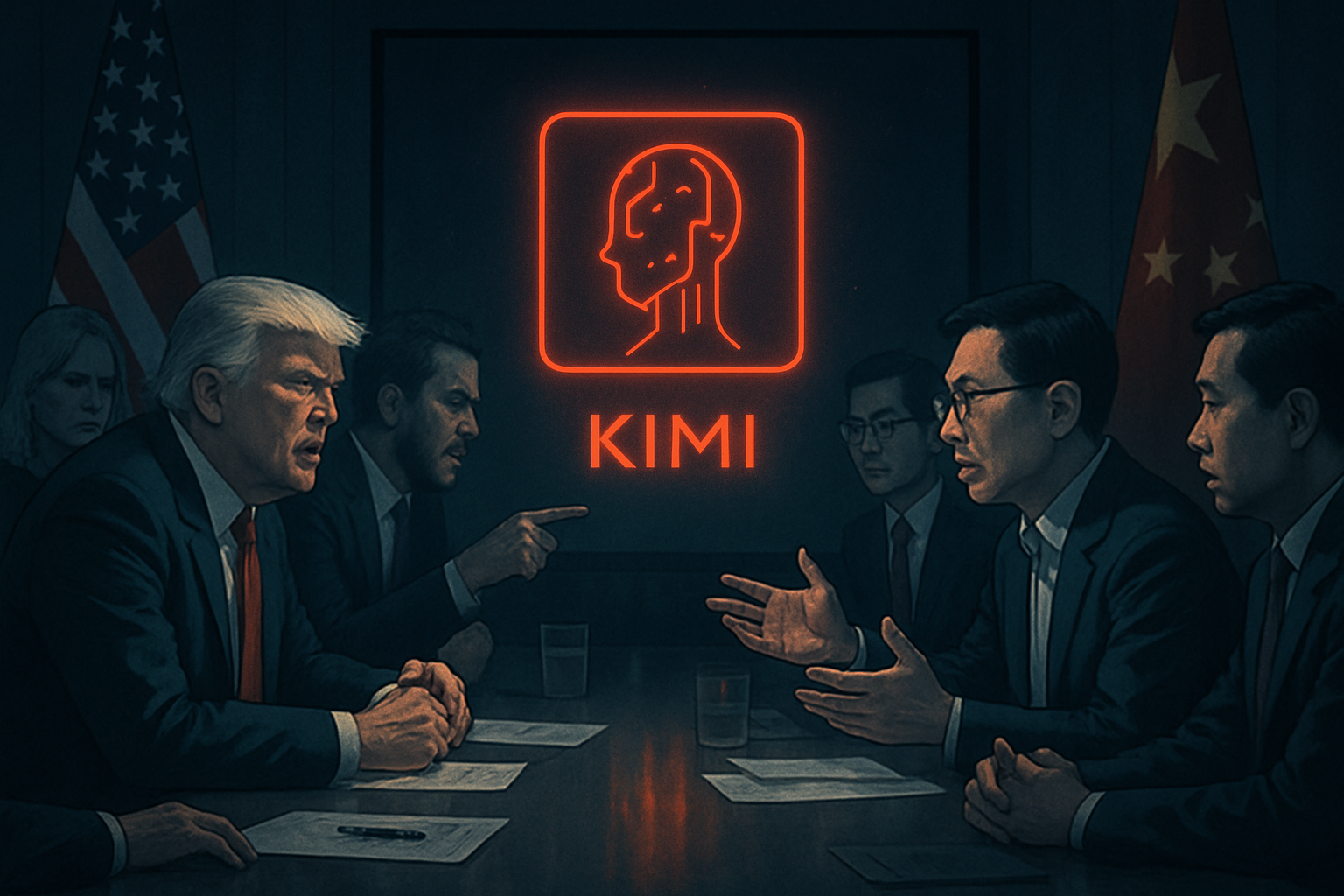
The Sharp Criticism from Trump Advisors
This weekend, a series of scathing critiques were launched by current and former advisors of Donald Trump against major American artificial intelligence companies. David Sacks, who served as the "czar" of AI and cryptocurrencies until March, described the models developed by Anthropic as "lobotomized" and "woke." Meanwhile, Emil Michael, a senior official at the Pentagon, referred to the new head of strategic futures at OpenAI as the "village idiot supreme."
The Emergence of Kimi and Its Implications
The controversy erupted around Kimi, a free and open-source AI model recently launched by the Chinese company Moonshot. This model, which appears to rival the capabilities of OpenAI and Anthropic's models, poses a significant challenge as it is accessible at no cost, unlike its American competitors.
An Economic and Political Dilemma for Trump
The emergence of Kimi and similar models from China has divided AI strategists around Trump into several factions. Each new smart and free model like Kimi reduces the incentive for American companies to invest in the paid models of Anthropic or OpenAI. This situation creates economic and political tensions for the Trump administration, which does not want to exacerbate negative economic news. Anton Leicht, a researcher at the Carnegie Endowment, pointed out on X that these models represent a serious threat to the American economy. Indeed, Chinese AI models have already shaken American stocks.
The Repercussions of a Ban in New York
This complex situation comes shortly after the state of New York imposed a ban on new data centers, reflecting a growing distrust of AI companies. A portion of the American public may not support OpenAI or Anthropic in their struggle against cheaper competitors, believing it is not the government's role to protect their interests.
David Sacks' Position and the Open Source Debate
David Sacks expressed his disagreement with the major AI companies, stating that they want the government to eliminate their open-source competition. He also noted that Chinese AI models are gaining popularity because they are subject to fewer restrictions, despite the inherent state censorship.
Le brief IA que les pros lisent chaque soir
Les 7 actus IA du jour, décryptées en 5 min. Gratuit.
Inclus dès l'inscription : notre sélection des meilleurs guides & comparatifs IA.
Choisissez votre rythme
Gratuit · Pas de spam · Désabonnement en 1 clic
A Shift in Administration Stance
Although Sacks is no longer in office, his vision of a more open AI has been replaced by an approach favoring increased government intervention. The Trump administration now believes that AI models, having become powerful enough to threaten national security, require stringent oversight.
Towards Enhanced Control of AI Models
This new direction has led to the establishment of a review process by the White House to assess the safety of AI models before their launch. Dean Ball, a former AI advisor to Trump and currently at OpenAI, criticized this process, calling it a "de facto licensing regime for cutting-edge AI." He suggested that Trump could indirectly discourage American companies from using models like Kimi.
Internal Tensions and Accusations
This proposal provoked a reaction from Michael, who, along with Defense Secretary Pete Hegseth, plays a key role in the government’s relations with AI companies. Michael condemned Ball, emphasizing that the government should not impose its views through indirect means.
The Origin of Kimi's Capabilities
One often-overlooked aspect is how Kimi achieved such a level of performance. During the Biden administration and the early part of Trump's second term, efforts were made to prevent China from accessing advanced chips. However, these restrictions were relaxed when Trump allowed Nvidia to sell more chips to China in exchange for a stake for the U.S. government. The government alleged that some cases of chip smuggling had occurred.
Distillation: A Controversial Practice
It is possible that Moonshot used distillation, a technique where AI models are trained on the outputs of existing models. OpenAI and Anthropic have long complained about this practice and have sought government assistance to put an end to it. In April, the Trump administration announced measures to limit this practice.
Kimi, a Persistent Threat
Despite these efforts, Kimi is now available and free, offering performance almost equivalent to that of Anthropic's model, which was deemed so powerful that it was temporarily suspended for national security reasons. Weekend discussions show that Trump's circle views this situation as a wake-up call, but no consensus is emerging on how to address it.
Brief IA — L'actualité IA en français
L'essentiel de l'actualité de l'intelligence artificielle, décrypté et expliqué chaque jour.