Software Factories Revive Thanks to AI: Promises and Challenges
Le brief IA que les pros lisent chaque soir
Les 7 actus IA du jour, décryptées en 5 min. Gratuit.
Inclus dès l'inscription : notre sélection des meilleurs guides & comparatifs IA.
Choisis ton rythme
Gratuit · Pas de spam · Désabonnement en 1 clic
Software Factories: An Idea Reinvented by AI
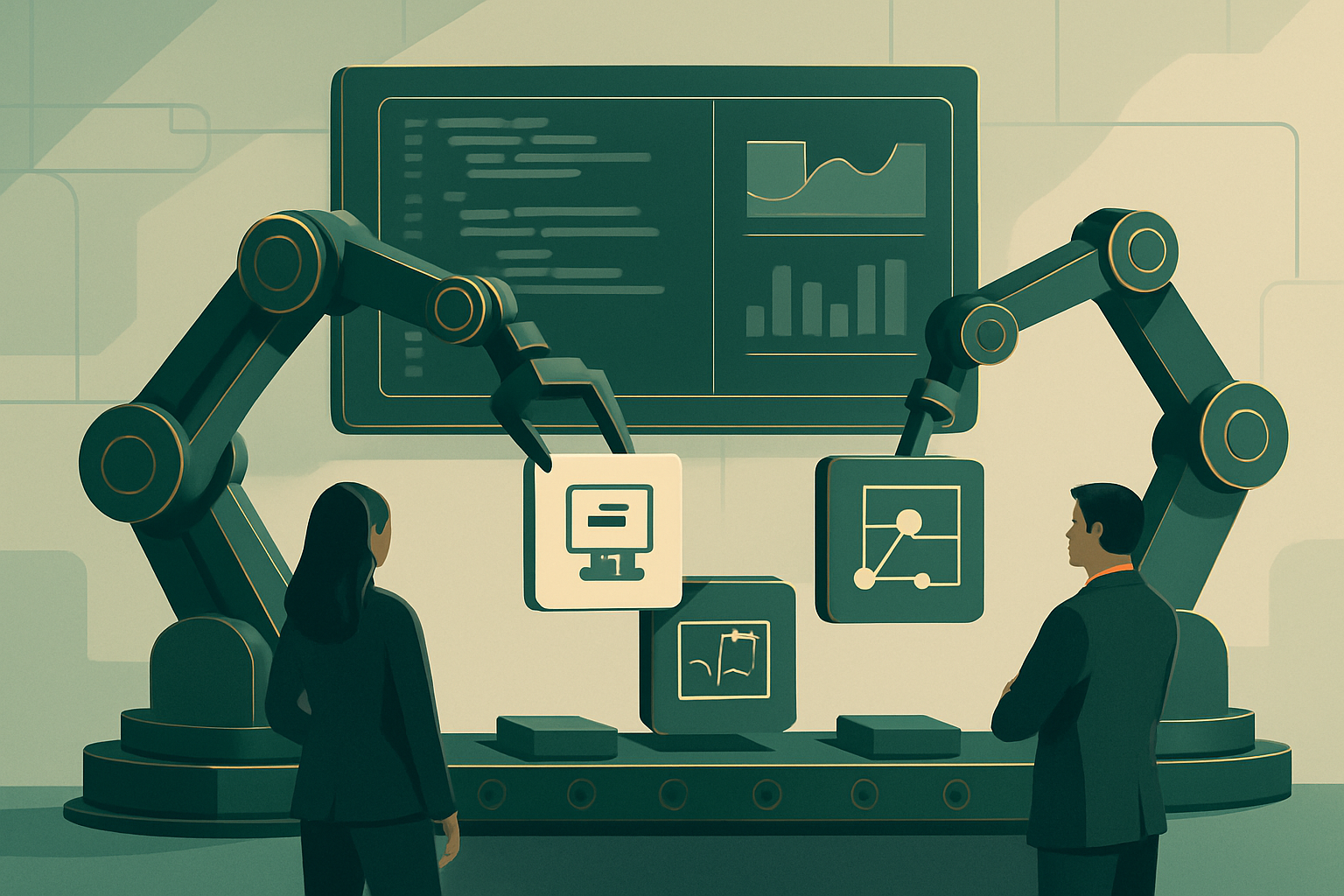
Imagine a service where your application, coded according to your specifications, is validated, tested, and mass-produced in an automated manner for a wide audience. This is precisely what software factories promise.
The concept of mass production in the software domain seems intuitive. You submit your prototype, such as an initial version of an application, to a service that takes care of producing your solution at scale. This is not a new idea; it emerged about twenty years ago when software development became more modular and repeatable. Microsoft was already discussing software factories as early as 2008. Although this idea lost some of its luster for a time, it is making a strong comeback today, driven by the ability of artificial intelligence to quickly generate and manage software code.
The Transformative Impact of AI on Software Development
Until recently, even with automation and DevOps practices, coding remained a major barrier for many companies. "We needed to hire more engineers, but that was very difficult and expensive," explains Moritz Plassnig, CEO of CloudBees.
Today, software factories rely on AI models available on the market, which allow for the automation of the software development lifecycle by breaking it down into repeatable tasks. Thanks to agentic coding, "we are less constrained by coding," Plassnig notes. This also allows for the revaluation of IT professionals' roles. "The craftsmanship of developers does not disappear, but developers and engineers shift from writing code to exercising their judgment on what should be built and shipped."
The Building Blocks of a Software Factory
According to Jaymin West, a typical software factory, supported by foundational models, consists of six key elements:
- Queue: Work arrives in the form of a problem, not a prompt.
- Control Plan: A durable interface, not just a simple laptop.
- Sandbox: One per task, destroyed after use.
- Pull Request: The output unit, retrieved by a human.
- Event Flow: Monitors every action, with the ability to interrupt it without destroying the execution.
- Durable Memory: The sandbox performs each execution, and what is not written to a file does not survive.
The Persistent Challenges of Software Factories
However, even the most efficient software factories are not a silver bullet for ensuring good software practices. "It is no longer a secret that code generation is incredibly easy," asserts West. "It is incredibly cheap. Verification has become the main hurdle for many of these companies. Ensuring that agents write code is very easy. But ensuring that this code is correct remains a major engineering problem."
Conclusion: A Leap Forward with Challenges
Software factories represent a significant advancement in the rapid transformation of ideas into functional products. However, they also pose important challenges regarding verification and code quality, crucial aspects for the long-term success of this approach.
Brief IA — L'actualité IA en français
L'essentiel de l'actualité de l'intelligence artificielle, décrypté et expliqué chaque jour.