Liquid AI releases LiquidCodec, an ultra-fast voice codec
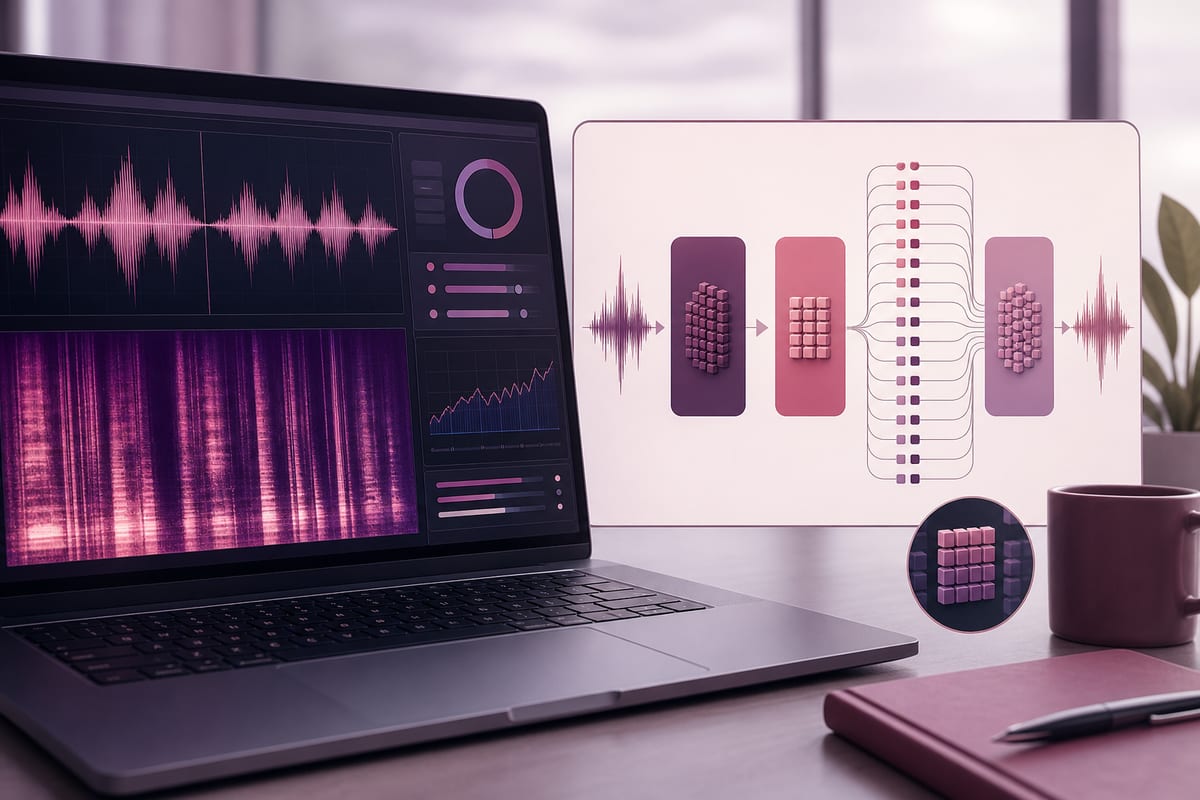
Liquid AI releases LiquidCodec, a streaming speech tokenizer with 74 million parameters designed for its LFM3 models. The company claims speed gains on CPU and quality improvements across eight test sets compared to Mimi, NanoCodec, and X‑Codec 2. The weights are available on Hugging Face, with GGUF variants for edge deployment.
Measurements Published by Liquid AI and an Exception in PESQ
Liquid AI specifies that the speed and quality evaluations are self-reported. On an Apple M4 Max CPU in FP32, the publisher announces approximately 361 times real-time encoding and an encoding RTF of 0.0028, compared to 0.0361 for Mimi, 0.2145 for NanoCodec, and 0.7359 for X‑Codec 2. For decoding, the reported RTF is 0.0115, against 0.0329, 0.2543, and 0.0379 for the same references. In terms of reconstruction, Liquid AI reports the best ViSQOL and the lowest mel distance across eight sets, with a ViSQOL of 4.319 on LibriSpeech. In text-to-speech synthesis, the company indicates the best UTMOSv2 across the eight sets and the best WER/CER on four, with a WER of 3.15% on LibriSpeech compared to 6.27% for Mimi. However, a caveat appears regarding wideband PESQ: NanoCodec outperforms LiquidCodec on seven of the eight sets.
Deployment: CPU, Transformers, Streaming Cache, and GGUF
LiquidCodec operates on a single CPU thread, in tests conducted in FP32 on an Apple M4 Max, and also runs on CUDA GPUs via Transformers. Loading is done through Hugging Face Transformers with trust_remote_code=True, using encode() and decode() calls to produce codes and waveforms, respectively. A component called LiquidCodecStreamingCache supports chunked decoding, and the provided examples utilize CUDA in bfloat16. For edge use, GGUF constructions Q4_0, Q4_K_M, and Q8_0 are offered for llama.cpp, with repositories provided alongside LFM3-Audio-2B and LFM3-Omni-2B. Liquid AI reports that with Q4_0 and a QAT limited to the decoder, the decoder's footprint is reduced by 3.5, with the LibriSpeech ViSQOL dropping from 4.319 to 4.292, for a quality loss deemed minimal.
Le brief IA que les pros lisent chaque soir
Les 7 actus IA du jour, décryptées en 5 min. Gratuit.
Inclus dès l'inscription : notre sélection des meilleurs guides & comparatifs IA.
Choisissez votre rythme
Gratuit · Pas de spam · Désabonnement en 1 clic
Compression Specifications and Symmetric Pipeline
LiquidCodec operates at 24 kHz, with frames at 12.5 Hz and 12 codebooks, totaling approximately 73.6 million parameters. It compresses audio into 12 token streams and, according to the model map, converts each 80 ms frame into 12 discrete tokens. The pipeline includes an encoder, quantization, and a decoder, with both parts reusing LFM3 blocks and forming a symmetric architecture, the encoder being fully causal for streaming. The quantization relies on GFSQ rather than RVQ: while RVQ encodes successive residuals, GFSQ groups are independent and allow for parallel prediction of the 12 codebooks using MaskGIT-type transformers. The decoder directly predicts spectral coefficients, avoiding learned transposed convolution upsampling. On the profiling side, Liquid AI mentions 12 codebooks at 1.1 kbps and differences in quantizer and causality compared to Mimi, NanoCodec, and X‑Codec 2, with the bitrates for LiquidCodec and X‑Codec 2 not disclosed.
Two-Stage Training and Adversarial Fine-Tuning
Training occurs in two phases: first, 264,000 hours of speech covering 107 languages, with waveform and spectral losses without adversarial components. Then, fine-tuning on 55,000 hours of full-band speech, with adversarial critiques. Liquid AI claims that this second stage eliminated residual metallic artifacts. A final quantization-aware training step, limited to the decoder, targets edge inference. For TTS evaluation, identical models were trained with 101,000 hours of data in six languages under controlled conditions, with results reported as stable using Qwen3‑1.7B and LFM3‑1.7B backbones.
Positioning Against Mimi, NanoCodec, and X‑Codec 2
LiquidCodec replaces Mimi in Liquid AI's stack, with Mimi being a 96.2 million parameter model developed by Kyutai. Compared to Kyutai's solutions, NVIDIA, and HKUST Audio, Liquid AI highlights a 73.6 million parameter model operating at 24 kHz and 12.5 Hz per frame, with 12 codebooks. Comparisons are made across eight standardized test sets including LibriSpeech and Seed‑TTS, against X‑Codec 2, NanoCodec, and Mimi configured with 12 codebooks. Liquid AI reports speed gains (encoding RTF of 0.0028) and superior quality scores across several metrics. The RTF factor, defined as the ratio of processing time to audio duration, is lower when performance is better, and the publisher indicates approximately 13 times less encoding time than Mimi.
Brief IA — L'actualité IA en français
L'essentiel de l'actualité de l'intelligence artificielle, décrypté et expliqué chaque jour.