LLM: Optimizing Reasoning Budget Without Sacrificing Latency
Understanding the Reasoning Budget of LLMs
Large Language Models (LLMs) are often seen as powerful tools capable of solving a multitude of tasks. However, their effectiveness can vary significantly from one task to another. A model that excels in one task may turn out to be surprisingly slow in another. This disparity is not due to a sudden degradation of the model, but rather to a poor allocation of the reasoning budget. Indeed, it is common to see the same reasoning budget applied to tasks as varied as a simple search, complex code correction, or a critical production decision. This mistake is becoming increasingly frequent as reasoning controls are integrated into developers' workflows.
The release notes for Claude Opus 5 from Anthropic illustrate this trend with reasoning enabled by default, a comprehensive effort scale, and support for long-context agent work. Similarly, the documentation for OpenAI's reasoning models indicates that invisible reasoning tokens are billed as output tokens and consume context space. The changelog for Google's Gemini API follows this direction, with Flash models optimized for token efficiency, reduced latency, and agentic planning. GitHub, for its part, enriches its Copilot with models such as Claude Opus 5 and Gemini 3.6 Flash.
The lesson is clear: choosing a model is no longer enough. Developers must now develop a reasoning budget policy. This guide explains how to design such a policy, learning to use different levels of effort, to orient tasks according to their difficulty, to measure quality rather than guess, and to avoid paying for deep reasoning when only a clear answer is needed.
The Stakes of an LLM Reasoning Budget
An LLM reasoning budget determines the amount of inference work a model is allowed to perform before providing an answer. Depending on the provider, this can manifest in various forms: reasoning.effort, effort, reasoning budget, adaptive reasoning, deep reasoning mode, or a model level that implicitly does more internal work. This parameter is not merely a style but a resource allocation. Higher reasoning effort can help a model plan, explore alternatives, use tools more precisely, or overcome ambiguities. However, it can also lead to increased latency, raise the cost of output tokens, clutter the context window, and complicate simple tasks through over-analysis.
The appropriate budget depends on the task, not the model's reputation. The best reasoning budget is one that meets your quality threshold for a specific class of work while being as cost-effective as possible. This quality threshold is crucial. A customer support labeler, a code migration planner, a security triage agent, and a financial analysis assistant should not share the same default setting. Each has different failure costs, latency expectations, tool needs, and feedback paths.
Why This Has Become a Production Issue
In the past, AI applications often boiled down to a major decision: which model to use for a response? A team might choose a fast model for chat, a more powerful model for code, and an economical model for batch tasks. While this remains relevant, reasoning models add a new dimension. It is now possible to choose not only the model but also the depth of reasoning of that model. A cutting-edge model can operate with reduced effort for routine tasks, or a smaller model can be used with more structured checking for complex tasks. It is also possible to spend considerable amounts by doing all this inefficiently.
Le brief IA que les pros lisent chaque soir
Les 7 actus IA du jour, décryptées en 5 min. Gratuit.
Inclus dès l'inscription : notre sélection des meilleurs guides & comparatifs IA.
Choisissez votre rythme
Gratuit · Pas de spam · Désabonnement en 1 clic
Research on runtime computation supports this complexity. A study on computation optimization found that the best way to spend additional inference computation varies depending on the problem's difficulty and the underlying model. Simpler problems may benefit from refinement, while more complex problems may require broader search or more powerful models. Another article focused on infrastructure notes that heavy reasoning workloads generate many output tokens, which can make decoding a dominant latency cost. This aligns with developers' complaints in practice. Discussions on Reddit around Claude, OpenAI, and local models frequently mention the same frustration: reasoning modes can improve difficult responses, but they can also waste tokens, slow down chat, hide costs in output billing, and make migrations confusing when default settings change.
The Four-Level Policy
To effectively manage the reasoning budget, start by adopting a tiered approach. These levels are simple enough for a product team to understand and specific enough for an engineering team to implement.
-
Low: Quick Responses for Low-Risk Work
Use low effort when the task is clear, narrow, and easy to verify. This includes classification, short transformations, rewriting search queries, formatting, simple extraction, light synthesis, and small code modifications with solid testing. Low effort should be your default for high-volume automation. If a support workflow labels 50,000 tickets a day, high effort on each ticket is generally a tax, not a feature. Start with low effort, then escalate only when confidence is low or downstream validation fails. -
Medium: The Default for Normal Product Work
Medium effort is suitable for tasks that require multiple steps but do not need deep exploration. Use it for moderate code generation, API mapping, product content analysis, data cleaning, normal RAG responses, and workflow planning where errors are recoverable. Medium is also a good fallback when your router is uncertain. It is not often the least costly path, but it provides a balanced foundation for initial production testing. -
High: Costly Attention for Ambiguous Tasks
Use high effort when the task presents real ambiguity, hidden constraints, or significant failure costs. Examples include debugging a race condition, comparing architecture options, planning a data migration, reviewing security-sensitive code, or deciding whether an agent should take an irreversible action. High effort should be intentional. If every request lands here, you do not have a reasoning strategy. You have a premium default. -
Max: Critical Work for Capacity with a Human Filter
Max effort belongs to rare cases: incident response analysis, major architectural decisions, risky tool actions, reasoning sensitive to legal or compliance aspects, and final checks before production changes. Use it where the cost of a wrong answer is clearly greater than the cost of slower inference. Do not pass max effort results directly into production side effects. Treat them as senior recommendations: valuable, but always subject to review, testing, approvals, and audit logs.
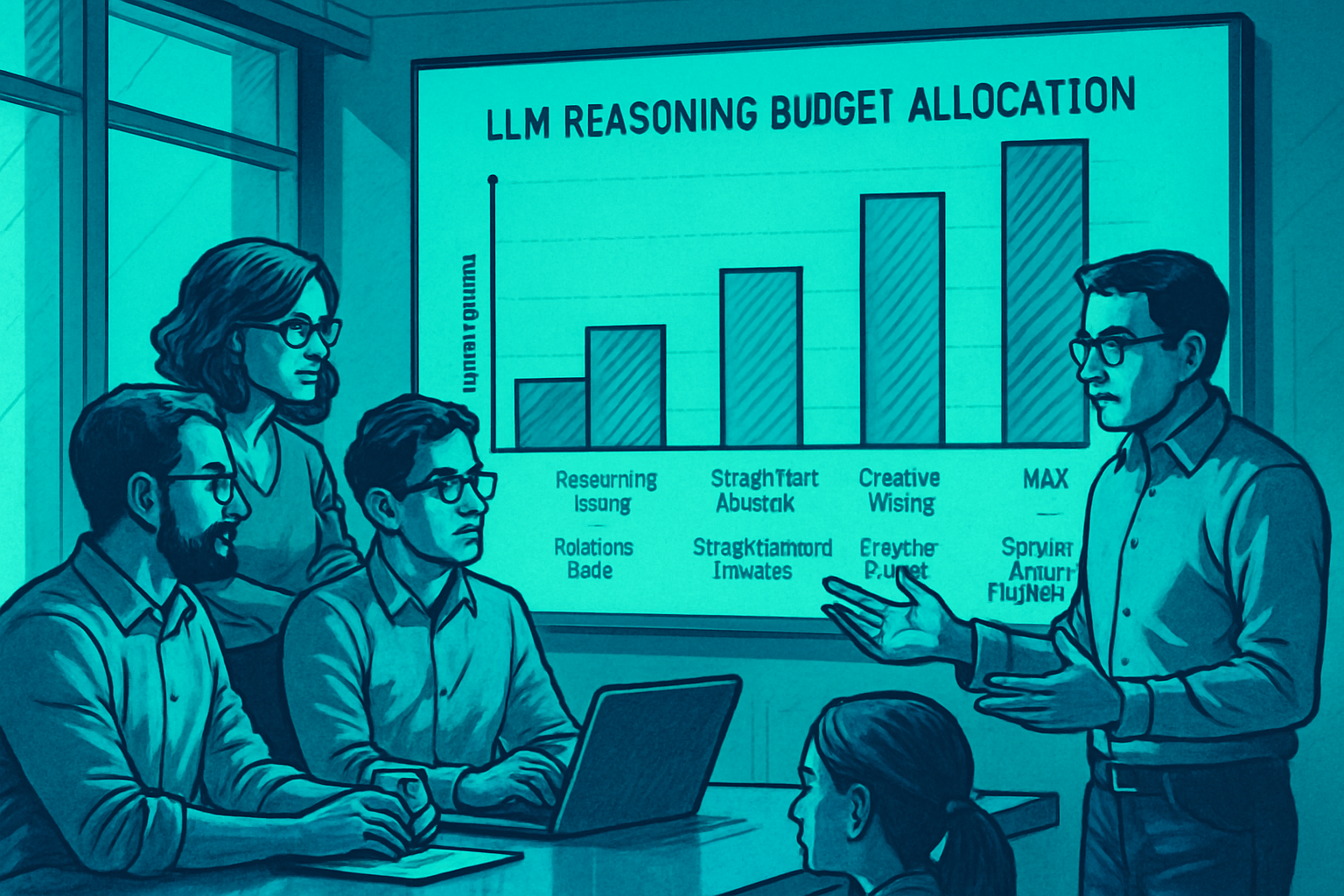
A reasoning policy in production directs task classes into budget levels and then measures whether the chosen level has actually improved the outcome.
How to Orient Requests by Difficulty
A reasoning budget router does not need to be sophisticated at the outset. Start by...
Brief IA — L'actualité IA en français
L'essentiel de l'actualité de l'intelligence artificielle, décrypté et expliqué chaque jour.