Enterprise Software: AI Drives Towards Autonomous Agents
Le brief IA que les pros lisent chaque soir
Les 7 actus IA du jour, décryptées en 5 min. Gratuit.
Inclus dès l'inscription : notre sélection des meilleurs guides & comparatifs IA.
Choisis ton rythme
Gratuit · Pas de spam · Désabonnement en 1 clic
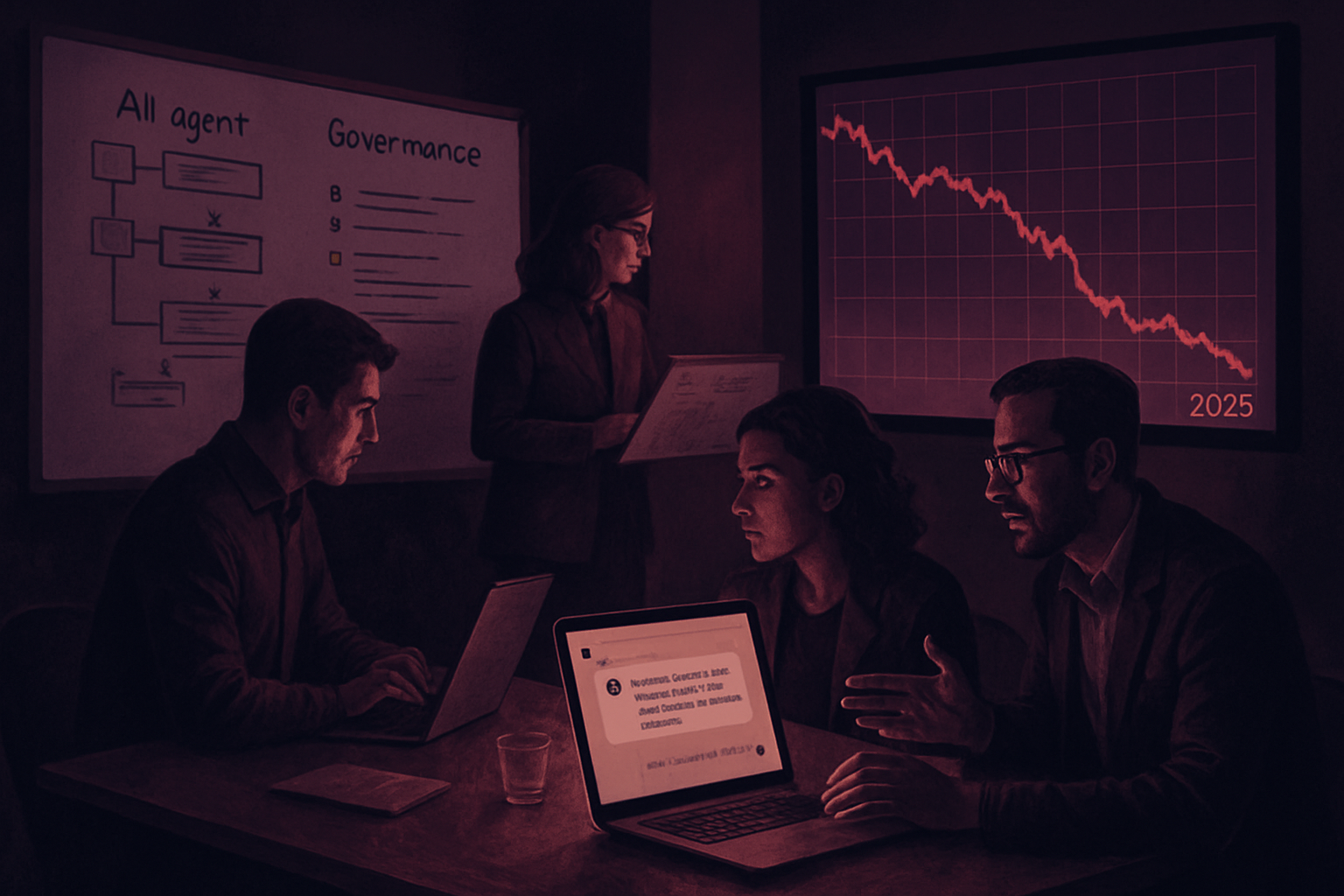
Shaken between August 2025 and early 2026 by a "SaaSpocalypse," the software sector is not at its swan song yet. For Arin Bhowmick, Chief Design Officer at SAP, AI shifts usage towards autonomous agents fueled by business context, rather than replacing software. While the Wall Street Journal reminds us of a $1.2 trillion industry, clients described by PwC are reallocating budgets to AI and stacking it on their existing stacks. Trust, governance, and new design roles are becoming major areas of focus.
Trust and Governance Shift Designers' Work
As systems autonomously apply judgments, very operational questions arise for design teams: when should an agent act, pause to ask, or display a warning before an irreversible action? In cases of uncertainty, should it indicate this or deliver a confident estimate, who bears responsibility in case of error, and how does the user regain control? Often, the right decision is for an agent to admit its uncertainty and return the choice to the human, but this transition must be designed to appear natural; perceiving it as an admission of error undermines trust. Design plays a central role, as the adoption or avoidance of AI depends on the trust it inspires. This evolution of focus directs the discipline towards data issues, governance, and behavioral standards of models, while fostering the emergence of new hybrid roles such as context designer, AI governance expert, or UX researcher specializing in models.
Useful Agents Require Business Context
An AI model can respond to almost anything, but it intrinsically lacks understanding of how an organization operates, which data is reliable, and what it is allowed to manipulate. The model is the "cheap" part; the costly capital lies in business knowledge: processes, exceptions, and rules accumulated over decades. It is this context, encapsulated by software, that makes an agent truly useful. When equipped with it, the user stops navigating from application to application and formulates the expected outcome: an agent can, for example, close the month’s accounts, extract entries, flag unreconciled items, draft corrections, and await approval. Weeks of work then become days, and the human role shifts towards oversight and review, progressing towards increased autonomy.
AI Becomes the Interface, Apps Fade into the Background
The announced transformation is significant, comparable to the shift from keyboards to touch screens. AI occupies the main interface layer, while legacy applications fade as specialized agents operating in the background. Three structural changes are emerging: the user states a goal, and the system chooses tools, data, and steps; routine tasks are executed in the background, requiring human input only for decisions; instead of twelve tabs, a conversational interface aggregates the right elements at the right time. This shift makes AI the place where work is accomplished, marking a turning point for software teams and design, which has historically focused on screens, as the interface now varies according to needs, including chat, voice, and other modes. The application-centered interaction model appears to be at the end of its cycle, especially since interactions only hold value when embedded in a business context. Deloitte's forecasts for 2026 confirm this trajectory.
Massive Sales in 2025-2026, Budgets Reallocated to AI According to PwC
Between August 2025 and early 2026, the software sector experienced a sales sequence described by traders as a "SaaSpocalypse." CNN linked the decline in software values to AI, fearing a demand erosion as models gain capabilities. Two days later, the Wall Street Journal tempered this by arguing that AI is far from annihilating an industry valued at $1.2 trillion. In the investment arena, Dallas Dolen (PwC) states that his clients are redirecting software budgets towards AI. He describes systems that sit above existing stacks, maintaining operations while adding intelligence, betting on the value of the foundation built over years.
Products, Roles, and Horizon: Autonomy Rather Than Replacement
Interfaces are increasingly generated on demand, and software is beginning to execute autonomously, elevating the designer's role. Design systems, once libraries of components for assembling screens, must now incorporate judgment: what is relevant, what should be removed or prioritized, within the limits of a brand, accessibility, and regulations. The work involves formalizing this judgment so that an AI can apply it and produce a reliable experience, even in unanticipated situations. From this perspective, AI does not replace software: it evolves it towards greater autonomy, to the point where usage resembles delegation to someone who understands the business. The debate over the "death" of software could eventually echo that of the cloud, which changed the nature of products without making them disappear. Designers are now defining the relationship with autonomous behavior software and guiding where human judgment is most useful. Arin Bhowmick, Chief Design Officer at SAP in San Francisco, presents this vision personally.
Brief IA — L'actualité IA en français
L'essentiel de l'actualité de l'intelligence artificielle, décrypté et expliqué chaque jour.