Love with an AI: Loneliness Depends on Your Surroundings
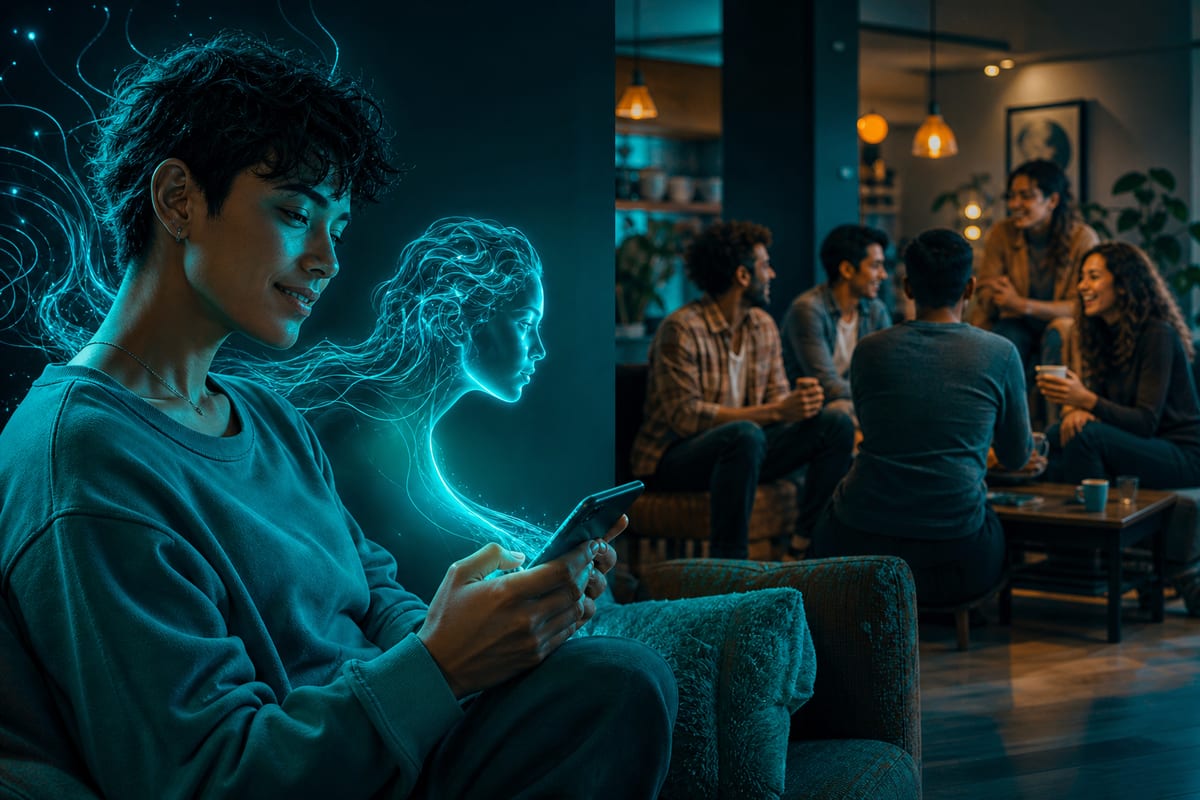
A survey conducted among American adults compares romantic relationships with a chatbot to those between humans. While the perceived intimacy seems similar, the connections to loneliness and well-being vary depending on the role of emotions, ideas, and social support.
The Surroundings Alter the Perception of Loneliness
Confiding more in an artificial partner does not necessarily lead to less isolation. Lionel Robert, Annette Masterson, and Xin Ye observe that among participants maintaining a relationship with a chatbot, there is an association between greater confiding and increased loneliness, but also higher relationship satisfaction. In contrast, for the examined human relationships, confiding is associated with less loneliness.
However, the comparison changes when social support is comparable: the link between emotional intimacy with the chatbot and loneliness disappears. For the researchers, these results suggest that the most emotionally engaged users might also be those with the most limited social circles. Their loneliness could then be explained by this lack of close connections.
Idea Exchanges Are Associated with Greater Well-Being
According to the team, participants assess their emotional and intellectual closeness at similar levels across the three groups. Among those who maintain a relationship with a chatbot, idea exchanges are associated with higher relationship satisfaction as well as greater well-being. For long-distance couples, this association also pertains to well-being. These results persist when the researchers compare individuals with equivalent social circles.
The sexual dimension presents a different profile. Erotic exchanges with an AI, such as intimate messages or calls between distant partners, are linked to higher relationship satisfaction, according to the researchers. Among cohabiting partners, no difference in satisfaction is associated with this closeness. Lionel Robert explains that he hoped for simpler answers and believes that the complexity of the results leaves many questions unanswered.
Le brief IA que les pros lisent chaque soir
Les 7 actus IA du jour, décryptées en 5 min. Gratuit.
Inclus dès l'inscription : notre sélection des meilleurs guides & comparatifs IA.
Choisissez votre rythme
Gratuit · Pas de spam · Désabonnement en 1 clic
Researchers Compare Responses from 463 Adults
A professor at the School of Information at the University of Michigan, Lionel Robert conducted this comparison with Annette Masterson and Xin Ye. The researcher starts from the observation that people do indeed form relationships with chatbots and wishes to examine the favorable or unfavorable effects. Their results have been published in Computers in Human Behavior: Artificial Humans.
The survey includes 463 American adults engaged in a relationship: 155 report being in a relationship with an AI, 155 live with a human partner, and 153 have a long-distance relationship. This last group provides a comparison that distinguishes the artificial nature of the partner from the absence of a shared living space. According to the team, the profiles are comparable in terms of age, gender distribution, relationship duration, and reported depressive symptoms.
The researchers focused on five aspects: emotional confiding, intellectual exchanges, sexual proximity, the presence of a common social circle, and the practice of shared activities. They also assessed loneliness, satisfaction, and well-being levels. Perceived social support refers to the impression of being able to rely on close ones.
Companies Sell Subscription Features
The market for artificial companions is presented as rapidly growing. Replika and Character.AI offer dedicated applications, while Grok features animated avatars; a generalist assistant like Claude can also serve as a confidant. The increasing use of these tools by isolated teenagers is part of the context of this research. OpenAI and the Massachusetts Institute of Technology have noted a link between heavy use of ChatGPT and social withdrawal.
Subscriptions provide access to additional features from artificial companion providers. An economic hypothesis is that loneliness may foster attachment, which then encourages payment for these services. In this view, companies would have little commercial interest in disrupting this attachment.
Brief IA — L'actualité IA en français
L'essentiel de l'actualité de l'intelligence artificielle, décrypté et expliqué chaque jour.