M&T Bank Rolls Out AI to Thousands of Employees After Modernization
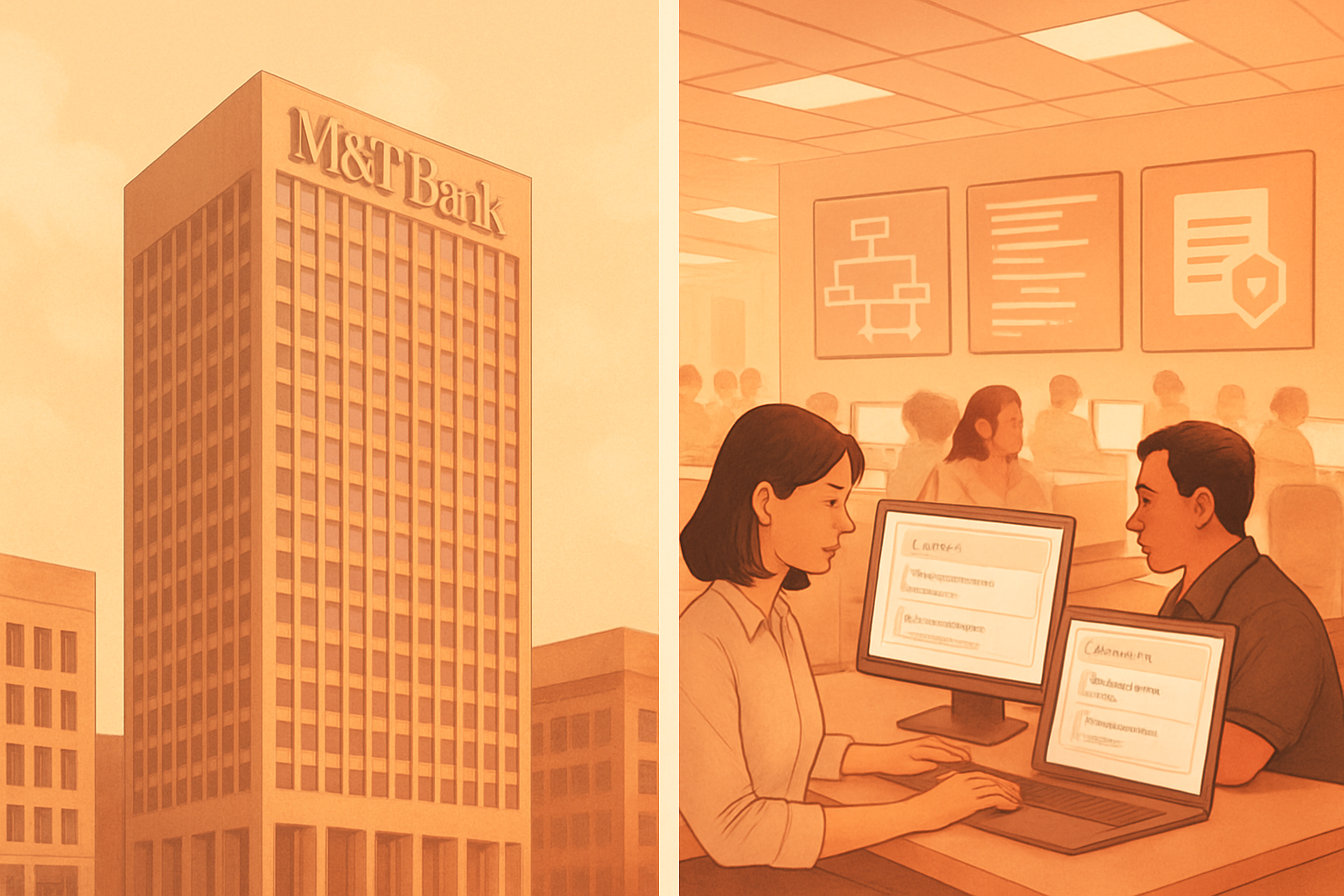
M&T Bank is rolling out AI tools to thousands of employees after several years of technical modernization and data structuring. The institution is regulating these uses with strict rules while testing new use cases. This movement is part of a broader trend among major American banks.
Massive AI Deployments at JPMorgan and Bank of America
The American banking sector has initiated large-scale AI deployments. JPMorgan Chase launched its internal suite of language models to over 200,000 employees in 2024. By 2025, more than 65,000 employees from its corporate and investment bank were active users, and over 90% of its engineers were using coding assistants. The bank stated that its AI-enhanced transaction screening allowed it to review more than double the previous volume while halving manual checks. Bank of America, on the other hand, employs EricaAssist for over 18,000 customer service representatives. In July 2026, the bank reported that the tool provided contextual recommendations in under three seconds and reduced the average call duration by nearly a minute. It plans to expand this system to other service cases and lines of business later in 2026.
M&T Establishes Safeguards and Requires Human Review
Before broadly opening access to AI, M&T had restricted the use of public models. Andrew Foster explains that these services were blocked because sensitive data could be entered. Since then, the bank has integrated a requirement for human verification into its 2026 Code of Conduct and Business Ethics. The policy mandates the use of validated tools and prohibits the introduction of confidential, proprietary, customer-related, employee-related, or regulated information into unvalidated systems. Employees remain responsible for the accuracy and relevance of the deliverables generated using AI.
Concrete Adoption at M&T: Co-Pilots for Thousands of Employees
M&T has deployed AI co-pilots to over 15,000 employees for uses covering operations, customer relations, software development, and risk management. Applications include analyzing call center conversations, drafting reports, generating code, identifying customer needs, and detecting portfolio risks. After evaluating enterprise offerings, the bank selected Microsoft Copilot, initially for about 800 people before expanding. By September 2025, 16,000 of the approximately 22,000 employees were using Copilot for drafting emails and reports as well as summarizing calls. Andrew Foster notes that an automated summary of a phone call saves about six minutes per call. Developers also rely on GitLab tools to generate code, with mandatory reviews by teams.
Le brief IA que les pros lisent chaque soir
Les 7 actus IA du jour, décryptées en 5 min. Gratuit.
Inclus dès l'inscription : notre sélection des meilleurs guides & comparatifs IA.
Choisissez votre rythme
Gratuit · Pas de spam · Désabonnement en 1 clic
Technological Overhaul and Data: Internal Staff, Spending, and Reliability
The deployment of AI is supported by a transformation that began in 2018. M&T states that at that time, more than half of its IT specialists were external, compared to 80% of internal technology staff today. The bank has aligned around 2,000 technicians across more than 300 agile teams and has hired over 1,000 specialists during the program. Dozens of legacy platforms have been replaced. According to the bank, technological failures have decreased by more than 80% since 2018, while annual upgrades have increased by 300%. IT investments surpassed $1.2 billion in 2025. Mike Wisler indicated in August 2026 that the number of annual releases had risen from about 15,000 in 2018 to 65,000 in 2025. After becoming CIO in 2018 and then Senior Executive Vice President in 2025, he now leads technology and operational activities. On the data side, Andrew Foster, hired in 2023, launched a traceability program to track the origin, use, and flow of information. He presents it as an essential capability, not born from generative AI. The bank has created a Data Academy with around 2,000 participants, an internal repository called Edison, and uses Solidatus and Monte Carlo to map flows across its databases, applications, and decision-making systems. According to Foster, this traceability provides visibility into the source, meaning, quality, and governance of data, and particularly supports the use of Copilot.
Application Scope and AI Strategy: Three Paths and Continuous Evaluation
M&T is pursuing generative AI along three axes described by Mike Wisler: widespread use by employees, existing AI capabilities in current applications, and proprietary systems built on the bank's data and processes. More than 1,800 applications, often from external vendors, are used by the institution, which aims to leverage the AI functions already present in these tools. Internal developments include the automation of recurring operational tasks, software creation, fraud prevention, and protection against cyberattacks. M&T continues to analyze solutions developed internally as well as third-party products, whether general enterprise software or specialized tools for the banking sector. Initial employee uses focused on drafting, summarizing, call processing, and programming, and then expanded to detecting customer needs and identifying portfolio risks. The institution also employs augmented generation by retrieving from its own controlled internal data. Experiments with agentic AI are also underway in the fields of cybersecurity and fraud detection.
Brief IA — L'actualité IA en français
L'essentiel de l'actualité de l'intelligence artificielle, décrypté et expliqué chaque jour.