MagicSchool AI: The Rise of an Innovative Edtech Startup
Le brief IA que les pros lisent chaque soir
Les 7 actus IA du jour, décryptées en 5 min. Gratuit.
Inclus dès l'inscription : notre sélection des meilleurs guides & comparatifs IA.
Choisis ton rythme
Gratuit · Pas de spam · Désabonnement en 1 clic
An Unconventional Path to Educational Innovation
In November 2022, Adeel Khan, a seasoned educator, took a well-deserved break after a career marked by various roles in the educational system. Having started as a teacher in Atlanta's public schools, he climbed the ranks to become an assistant principal before founding a public high school in Denver. After spending a year advising principals in a district office, Khan decided to take a personal sabbatical.
It was during this time that ChatGPT emerged. Intrigued by this emerging technology, Khan began to explore it, curious about its potential in the educational field.
He revisited his former school, the one he had founded, to test ChatGPT with teachers. He organized workshops, encouraging educators to integrate the tool into various teaching scenarios.
Reactions were mixed. While the majority of teachers used the tool sparingly, some found that traditional methods remained quicker. However, a small number of them were truly transformed by this technology.
"For a few teachers, it completely changed their approach to teaching," Khan shared in an interview. This observation sparked a deep reflection within him.
"I thought this technology could impact every teacher, not just those enthusiastic about adopting new technologies," he explained. "The question became: how do we make this technology accessible to all teachers?"
Developing an AI Dedicated to K-12 Schools
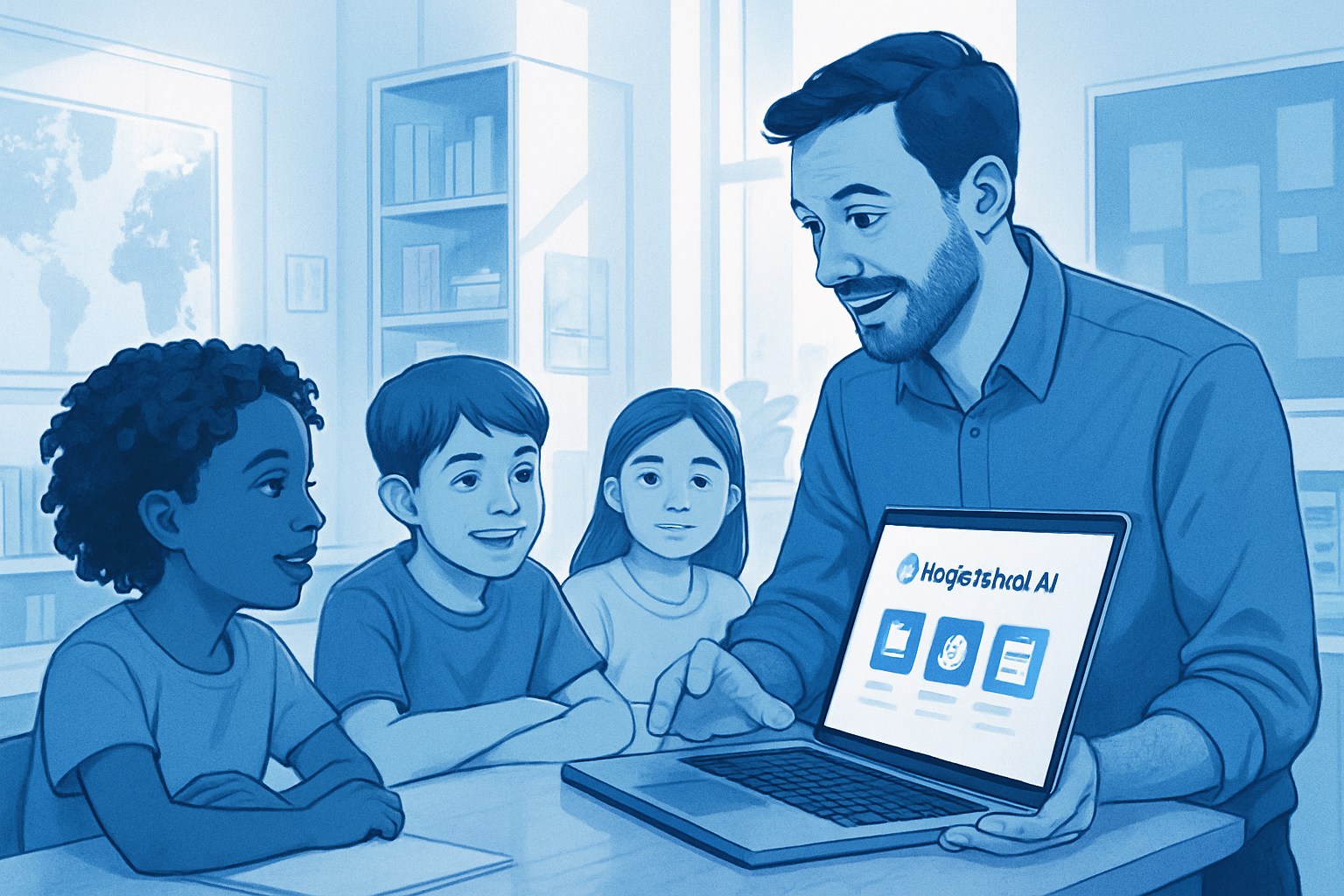
This reflection led to the creation of MagicSchool AI, a platform designed to serve as an all-in-one AI operating system for educators and students in K-12 schools. For teachers, this tool acts as a daily assistant, facilitating tasks such as creating assessment rubrics, adapting assignments to different learning levels, and generating exercise sheets and reading materials.
The platform also allows educators to offer supervised AI experiences directly to students. These experiences include algebra tutors and personalized writing assistants, with state exam rubrics providing tailored feedback to help students improve their essays.
"MagicSchool is the vertical AI solution for K-12 schools," Khan stated. "While other sectors are adopting generative AI, like law with Harvey and Legora, we are doing the same for K-12 schools."
Today, MagicSchool's primary clients are school districts looking to provide a secure and compliant environment for generative AI, adhering to data privacy regulations and local program priorities. MagicSchool collaborates with large school systems, including Denver Public Schools, as well as schools in Broward and Hillsborough counties in Florida, and private institutions.
"One in five children in America attends a school partnered with MagicSchool," Khan noted. Additionally, around 8 million educators worldwide have signed up on the platform.
The Challenges of Funding
Despite the rapid adoption of the platform, raising funds for MagicSchool has been a challenging journey for Khan. Initially, he worked with hourly contractors and lacked a formal business model.
"I didn't have a real business plan," Khan admitted. "The most successful tech companies, in my view as a consumer, were those that simply had a lot of users, and that was my goal — to attract a large number of users and see what would come of it."
When MagicSchool's user base reached nearly a million, Khan began pitching his project to venture capital investors. However, his background as an educator proved to be more of a hindrance than an asset compared to the typical profiles in Silicon Valley.
"No one wanted to give money to a former principal," Khan recalls, reflecting on the many meetings before convincing an institutional investor.
"Investors are trained to make model matches," he observed. "They ask: 'Did you go to Stanford? Are you a tech expert? Have you worked at Google?'... I have none of those qualifications."
Even investors specializing in edtech were hesitant, leaving Khan frustrated to see other founders raising millions based solely on tech-focused resumes.
"I saw other edtech companies of similar size raising funds... with no product, no sales, nothing," he remembers. "I thought: 'People know what our product is. Millions of teachers know it, and no one has heard of that one.'"
To overcome skepticism, Khan relied on impressive growth metrics, convincing investors at every stage that the company's traction was undeniable.
This strategy paid off. After initial angel investments, MagicSchool raised a $2.4 million funding round led by Range Ventures, based in Colorado. To date, the company has raised nearly $63 million in total, supported by strong financial growth, including a 3x year-over-year revenue increase at the end of last year, according to Khan. Other investors in the startup include Bain Capital Ventures, Valor Equity Partners, Smash Capital, and GSV Ventures.
Expertise as a Driver of Innovation
Although Khan no longer leads the high school he founded, he remains connected to the educational landscape through regular visits to school districts. The school continues to thrive under the leadership of a former founding team member, he noted.
"Of course, I miss it," Khan admits. "Nothing can replace the long-term relationships you build with students."
However, his extensive experience in the education field has become MagicSchool's greatest asset — a trend Khan observes in the broader AI landscape, where domain experts are emerging to create industry-specific tools.
"What we've learned over time is that the model is no longer the differentiator," Khan explains. "How you contextualize the model with the real problems people face in their work, and the specific expertise, is what will unlock the next wave of innovation and impact for generative AI."
Brief IA — L'actualité IA en français
L'essentiel de l'actualité de l'intelligence artificielle, décrypté et expliqué chaque jour.