Managers and AI: An Essential Duo for the Future of Businesses
Managers, Drivers of AI Integration
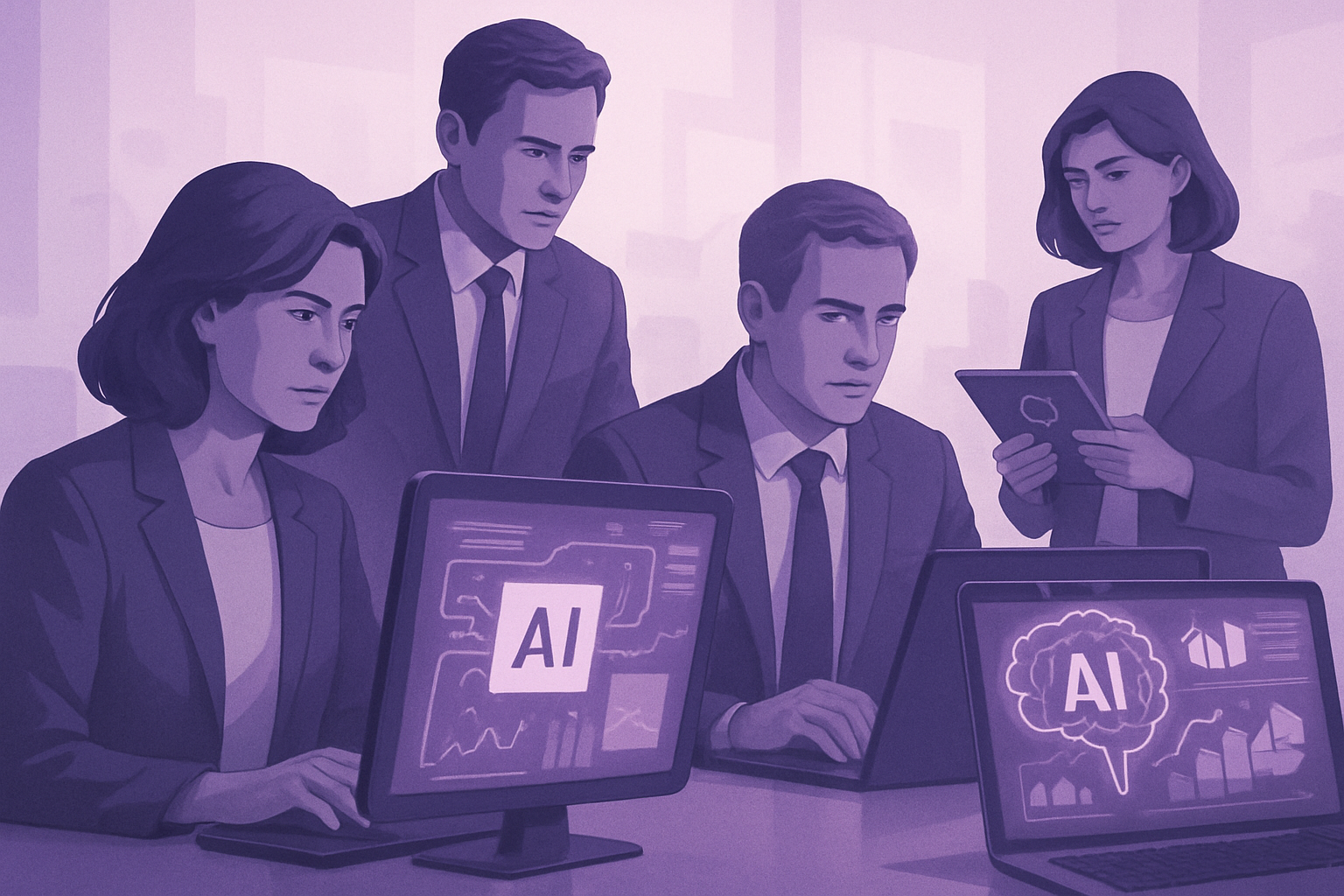
Optimism prevails among middle managers regarding the impact of artificial intelligence on the future of work. A significant majority, over two-thirds, believe that AI will play a positive role in the evolution of their functions. They also feel a personal responsibility to ensure that their teams effectively adopt these new technologies.
A study conducted by Salesforce, involving over 500 middle managers, highlights that 78% of them feel it is their duty to ensure the successful integration of AI within their teams. Furthermore, these AI tools enable 77% of managers to gain more than three hours per week, a considerable time savings that can be reinvested in higher-value tasks.
Relational Transformation, Key to the Future
The transition to a so-called "agentic" company is not limited to the adoption of new technologies. It requires a profound relational transformation. This process involves several crucial steps: redefining internal processes, reskilling employees, reallocating talent to new roles, restructuring organizations and their finances, and recovering value from often-overlooked stakeholders.
To succeed in this transformation, it is essential to recalibrate metrics by centering them on AI and to redefine the leadership mandate, focusing on mission control rather than operational control. These seven "R's" of relational transformation demand both technological and business management and leadership skills. Managers are therefore called upon to follow twelve essential rules to frame the adoption of AI, a critical responsibility that falls on them.
Managers must also demonstrate the tangible benefits of AI, which they often manage to do within 60 days of deploying AI tools.
Le brief IA que les pros lisent chaque soir
Les 7 actus IA du jour, décryptées en 5 min. Gratuit.
Inclus dès l'inscription : notre sélection des meilleurs guides & comparatifs IA.
Choisis ton rythme
Gratuit · Pas de spam · Désabonnement en 1 clic
Strong Commitment Despite Challenges
Salesforce's survey reveals that managers are not just adapting to AI for themselves. They are actively committed to ensuring that their teams do the same, with 78% expressing a strong personal commitment. However, the path to AI adoption is fraught with challenges. About 51% of managers feel anxiety regarding AI use cases and the speed of changes it entails.
Nearly half of the managers also feel pressure from upper management to demonstrate AI adoption. Despite this, only 32% of companies formally track this adoption, which can complicate the task for managers. AI use cases are diversifying, particularly in data analysis, allowing managers to make more informed decisions. AI is also extending to creative and research projects, thus surpassing the mere framework of operational efficiency.
Urgent Need for Training
For AI programs to be successful, several elements are necessary: reliable data, adequate employee training, executive sponsorship, modern technological infrastructure, and well-integrated business applications. A culture of experimentation and continuous learning is also crucial, and managers must be at the forefront of this.
The survey highlights that 37% of managers express an urgent need for hands-on training in AI. Additionally, 35% desire a clearer organizational strategy regarding AI, and 34% request better technical support. To successfully transform business through AI, solid investments from managers are essential.
These managers already feel responsible for this transformation and anticipate major changes in their roles over the next two to three years. The success of this transformation will increasingly rely on individuals rather than on technology itself. With better training, a clearer mission, and appropriate technological partnerships, managers are positioned to effectively guide companies toward an AI-dominated economy.
Brief IA — L'actualité IA en français
L'essentiel de l'actualité de l'intelligence artificielle, décrypté et expliqué chaque jour.