Menlo Ventures: AI Drives Engineers into Crisis
Le brief IA que les pros lisent chaque soir
Les 7 actus IA du jour, décryptées en 5 min. Gratuit.
Inclus dès l'inscription : notre sélection des meilleurs guides & comparatifs IA.
Choisis ton rythme
Gratuit · Pas de spam · Désabonnement en 1 clic
Software Engineers Facing an Identity Crisis
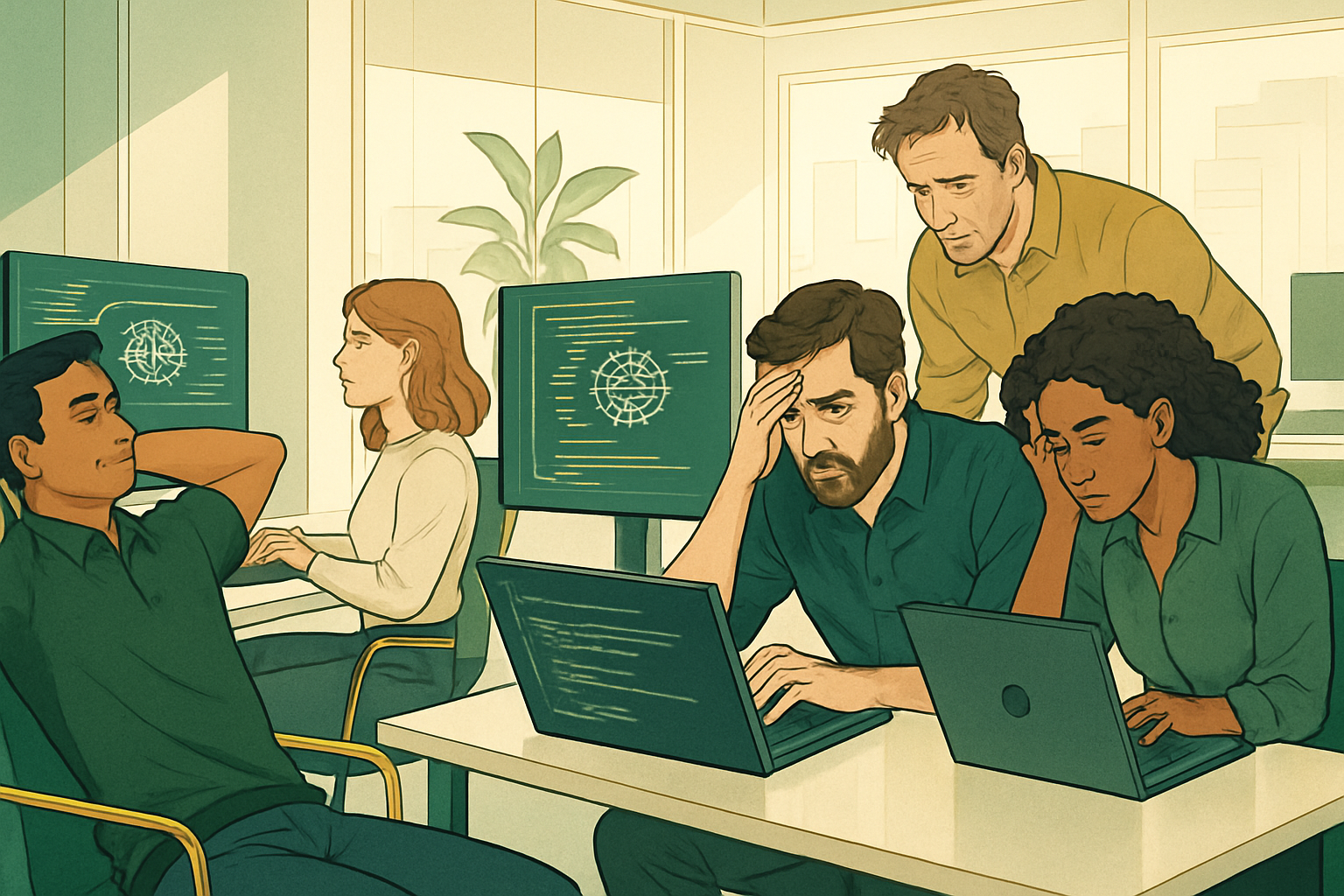
The world of software engineering is undergoing a significant transformation, and this change is not without consequences. The term tokenmaxxing is increasingly used to describe a trend within certain companies where the intensive use of artificial intelligence (AI) to generate code is encouraged. This practice, while promising in terms of productivity, comes with a considerable human cost. According to Deedy Das, a partner at Menlo Ventures, this approach divides engineers into two distinct categories: those who rely on AI to automate their tasks, and those who must then correct and validate this work. This division is leading some engineers to experience a crisis of identity that borders on depression.
In Silicon Valley, tokenmaxxing has become a common phenomenon, pushing developers to adopt AI-based coding tools in hopes of increasing their efficiency. However, this pressure to produce more code has created a rift within engineering teams. Engineers find themselves split between two distinct roles, affecting their perception of their own value within the company.
Two Categories of Engineers
-
"Lazy" Engineers: These professionals largely rely on AI capabilities to accomplish their tasks. They use these tools to write code, answer technical questions, and even prepare updates, all with minimal personal involvement.
-
Craftsmen: In contrast, these experienced engineers are tasked with the heavy responsibility of understanding, reviewing, and correcting the incessant flow of code generated by AI. Their role is crucial to ensuring the quality and reliability of the final product.
Deedy Das recently expressed his concerns about this situation in a post on X, emphasizing that most software engineers are experiencing an identity crisis close to depression.
A Shift in Role
Das's comments are part of a broader debate about the impact of AI-based coding tools on the profession of software engineering. As companies encourage their developers to produce more code with the help of AI, the role of engineers is evolving. They are shifting from software creation to reviewing, managing, and validating the work generated by machines. This evolution leads some to question the value of their contributions within the company.
This phenomenon is part of a larger context that Amanda Hoover of Business Insider has described as the "AI sprawl." Workers juggle a multitude of AI tools, duplicate tasks, and produce ever-increasing volumes of work, without evidence that these efforts translate into greater efficiency for companies.
The Exhaustion of Craftsmen
"Craftsmen are tired. Very tired," Das wrote. These engineers, who bear the burden of reviewing and understanding AI-generated code, often find themselves overwhelmed. While code generation is facilitated by AI, the review and maintenance of this code have become the new bottleneck. This phenomenon echoes the rise of "botsitting," where engineers must oversee AI, correct its errors, and validate its work.
Das also pointed out that many engineers feel that the skills they have developed throughout their careers are no longer as useful in the current AI-dominated context. They often find themselves overwhelmed by pull requests while bugs increasingly make it into production. "The craftsmanship they loved is dead," he added.
While some companies succeed in integrating AI into software development, Das notes that the tension is particularly palpable in large organizations where AI-generated output grows faster than teams' capacity to evaluate it. "This tends to happen in larger companies over 10 years old with a greater variance of talent," he specified. "But it is happening. A lot."
Brief IA — L'actualité IA en français
L'essentiel de l'actualité de l'intelligence artificielle, décrypté et expliqué chaque jour.