Meta Unveils Muse Glimmer and Its Vision for Superintelligence
Le brief IA que les pros lisent chaque soir
Les 7 actus IA du jour, décryptées en 5 min. Gratuit.
Inclus dès l'inscription : notre sélection des meilleurs guides & comparatifs IA.
Choisis ton rythme
Gratuit · Pas de spam · Désabonnement en 1 clic
Meta Unveils Muse Glimmer and Its Vision for Superintelligence
Summary
- Muse Glimmer, a 30 billion parameter model designed to run locally
- Mark Zuckerberg writes a lengthy lobbying letter in the form of a manifesto
- A series of recommendations addressed to Washington
- A comeback after months of gradual closure
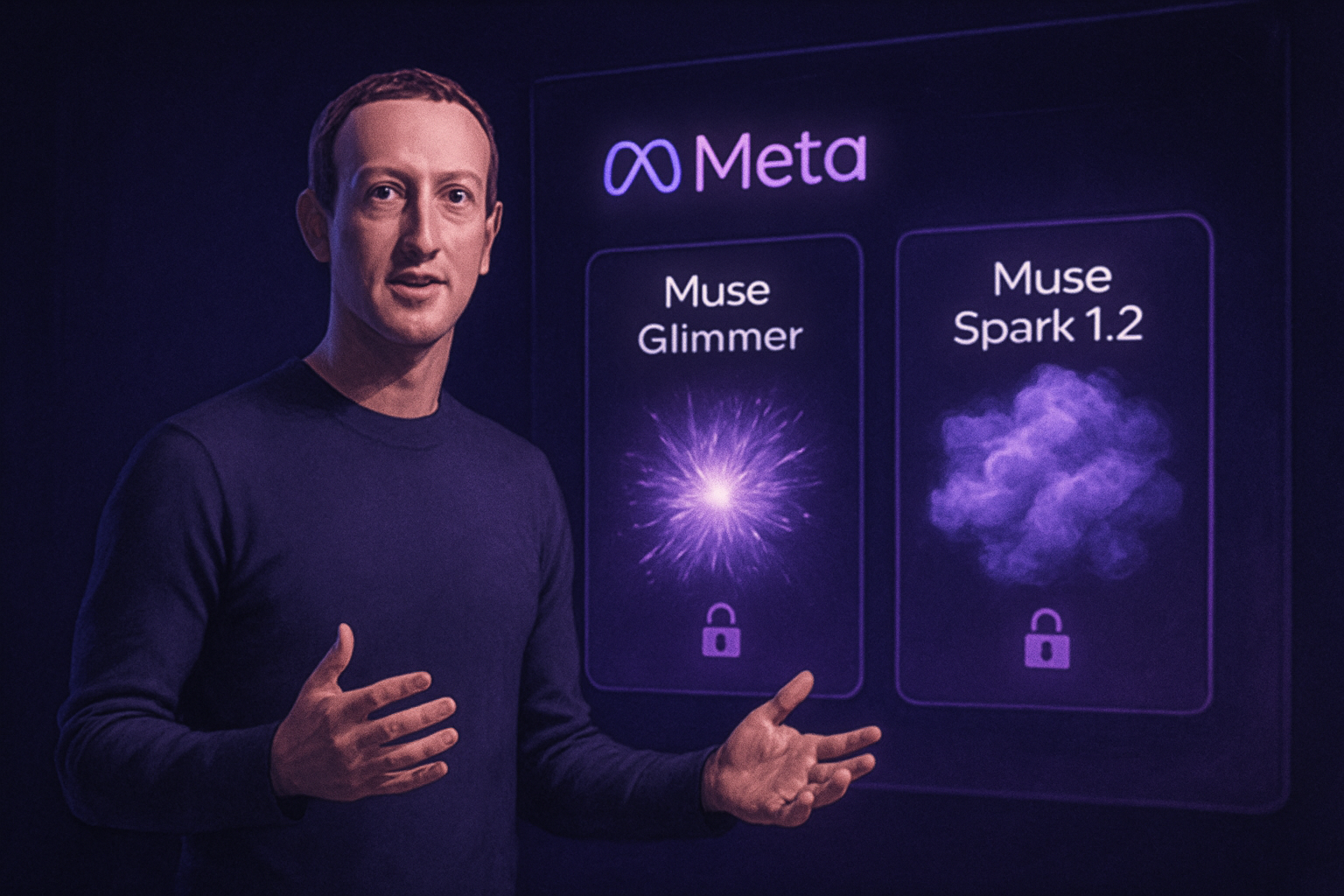
Meta is reclaiming ground it had previously abandoned. As the debate over open weight models has intensified in recent weeks, Mark Zuckerberg published an open letter on Monday, August 10, titled "The Future is for Everyone." The text outlines the company's doctrine on superintelligence and is accompanied by a much more concrete announcement: the release of Muse Glimmer, a 30 billion parameter model whose weights are distributed under the Apache 2.0 license.
Muse Glimmer, a 30 Billion Parameter Model Designed to Run Locally
Muse Glimmer is the first model from Meta Superintelligence Labs released in open weight. It is designed for permanent local agents, with applications ranging from function calls to programming, and even evaluating one model by another. This means it runs entirely on the machine, without a cloud connection, on a Mac or PC equipped with a single consumer GPU.
At full precision, Meta assures that a model of this size would require over 55 GB of memory. The company explains that it has compressed the weights to about 4 bits, bringing the language model under 20 GB and freeing up space for cache, the perception encoder that handles image analysis, and the speculative decoding module. The entire model fits "within a 24 to 32 GB envelope," the statement specifies. The model is also trained to "limit excessive information sharing and resist prompt injections from unreliable content," a sensitive point for an agent accessing files and personal identifiers.
Open Weight and Open Source, Two Concepts to Distinguish
An open weight model makes public the parameters learned during training. Anyone can then download it, run it on their own servers, and adjust it. However, the training data and the details of the process remain confidential. The Apache 2.0 license chosen for Muse Glimmer allows for commercial use, modification, and redistribution, but it does not make the model open source in the strict sense, where the entire source code is published under a license that allows anyone to use, study, modify, and redistribute it freely.
Everything is available on Hugging Face, accompanied by documentation for developers. The model comes with support from a significant part of the local ecosystem:
- Ollama, LM Studio, and Unsloth for local execution and adjustment,
- vLLM, SGLang, Together AI, Fireworks AI, and OpenRouter for inference and large-scale service,
- Optimized integrations announced in the coming days for llama.cpp, MLX, and ExecuTorch.
Meta also notes that it is working with AMD, Arm, Dell, Intel, and NVIDIA on hardware optimizations. The company compares Muse Glimmer to Gemma4-31B from Google and Qwen3.6-27B from Alibaba, and announces the upcoming release of weights for a version of Muse Spark 1.2, its foundational model unveiled on August 5.
Mark Zuckerberg Writes a Lengthy Lobbying Letter in the Form of a Manifesto
The 6,500-word letter published by Mark Zuckerberg is based on a philosophy that Meta has been trying to convey for several weeks. The founder of the company humbly proposes "individual emancipation as a source of prosperity, invention as the primary purpose of superintelligence, and the balance of power as the foundation of security." He contrasts this vision with that of his competitors: "I do not understand why anyone thinks that AI will eliminate most jobs and a good part of humanity's relevance would rush to build this future," he writes, adding that the idea that the only safe path would involve extreme concentration of power seems "intrinsically problematic" to him.
The most direct criticism targets model alignment, which involves ensuring they adhere to the same set of values and limits. Mark Zuckerberg deems the approach of other labs "fundamentally flawed," arguing that "humanity is not a monoculture" and that no single system can therefore serve contradictory values. He cites the example of a competing model that allegedly refused to help draft a letter intended for parents of students, deeming standardized tests unethical. In contrast to this logic, he offers his own definition: "We believe that alignment means ensuring that agents share the goals and values of a person, not those of our company," writes the Meta CEO. He adds that "the most dangerous scenario" would be for leading labs to train powerful models and keep them to themselves, regardless of how they justify this choice in the name of responsibility and security.
A Series of Recommendations Addressed to Washington
Beneath the philosophy, Zuckerberg's lobbying outlines specific political requests. These constitute the most operational part of the document and the least reiterated in the company's communication:
- Sharing with the U.S. government intermediate training checkpoints before the models' training is complete, as well as technical human resources,
- Maintaining export controls on semiconductors, deemed effective in slowing down foreign labs,
- Accelerating the construction of energy infrastructure and data centers,
- Easing constraints on training data for U.S. labs,
- Protecting distillation as a principle, summarized by the idea that "we can learn from everything we can observe,"
- Refusing to ban foreign open weight models, in favor of strengthening the competitiveness of U.S. models,
- Revising FDA (Food and Drug Administration) evaluation procedures to keep pace with drug discovery.
The timing gives particular emphasis to the defense of distillation: Muse Glimmer is precisely a model distilled from Muse Spark, through "logit distillation." Meta thus publishes both the principle and its application on the same day.
A Comeback After Months of Gradual Closure
The announcement marks a turnaround in Meta's strategy, which had not released an open weight model since Llama 4 in April 2025, while Llama 4 Behemoth, presented at the time as still in training, never came out. Instead, the company had gradually closed its phased release, with Muse Spark in April 2026, followed by Muse Spark 1.1 and its first paid API in July, then Muse Code and Muse Spark 1.2 on August 5.
The letter also fits into a sequence of communication. On July 23, Mark Zuckerberg launched an advertising campaign focused on technological optimism, already built around the phrase "the future is for everyone" and contrasting Meta with competitors accused of selling a dystopian vision of the future. On the regulatory front, the position defended in the text aligns with that of the open letter supported by Nvidia in July, advocating for maintaining access to open weight models, which Meta had signed alongside Microsoft, IBM, Dell, and Palantir. But will these various announcements be enough to reposition the company at the center of an ecosystem where Chinese models captured 48% of traffic on OpenRouter in June 2026, compared to 20% a year earlier?
Brief IA — L'actualité IA en français
L'essentiel de l'actualité de l'intelligence artificielle, décrypté et expliqué chaque jour.