Meta unveils Muse Glimmer: Zuckerberg advocates for accessible AI for all
Le brief IA que les pros lisent chaque soir
Les 7 actus IA du jour, décryptées en 5 min. Gratuit.
Inclus dès l'inscription : notre sélection des meilleurs guides & comparatifs IA.
Choisis ton rythme
Gratuit · Pas de spam · Désabonnement en 1 clic
Meta Introduces Muse Glimmer, an Accessible and Modifiable AI Model
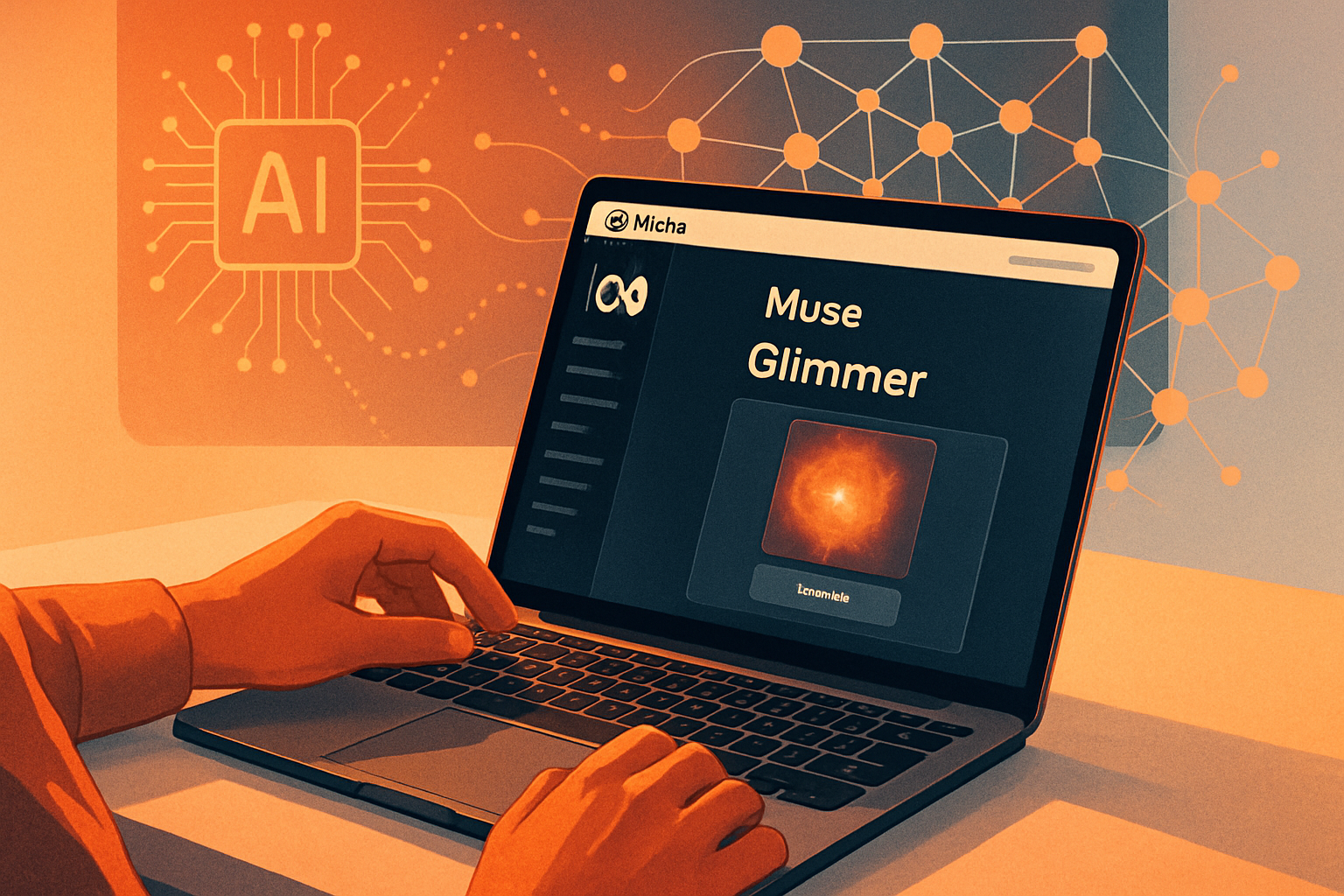
Meta recently unveiled its latest artificial intelligence model, Muse Glimmer, which stands out for its ability to run directly on laptops. This model is described as open-weight, meaning users have the option to download and modify it according to their needs. At the same time, Meta plans to release an open-weight version of Muse Spark, its most advanced AI model.
The Muse Glimmer model was revealed this Monday. It is designed to be compact enough to operate on devices such as Macs or PCs without requiring a cloud connection. This open-weight feature allows users to customize the model for local execution. Additionally, Meta announced that an open-weight version of Muse Spark would soon be available to the public.
Training and Capabilities of Muse Glimmer
Muse Glimmer was developed through a process called distillation, where a smaller model learns from a larger model, often referred to as the "teacher." This model was created by Meta's Superintelligence division, led by Alexandr Wang, former CEO of Scale AI. Muse Glimmer is capable of performing complex reasoning tasks and managing a variety of agentic tasks, while being optimized to run on consumer devices equipped with a single graphics card. It can break down tasks, such as programming or administrative management, into distinct steps. According to Meta, Muse Glimmer stands out for its performance in its size category across several benchmarks dedicated to large language models.
Zuckerberg Advocates for AI for All
Meta CEO Mark Zuckerberg also published a detailed 6,500-word essay in which he advocates for superintelligent artificial intelligence that is accessible to everyone. In this essay titled "The Future is for Everyone," Zuckerberg wrote that it is "surprising" how much of the discourse from those developing AI is so "filled with despair." He argues that it would be a mistake to limit access to superintelligent AI to a small group of individuals or companies for safety reasons.
Zuckerberg states: "Some argue that superintelligence itself or a small group of experts controlling it should decide what is best for humanity. We disagree."
The Debate on Open-Weight AI Intensifies
The launch of Muse Glimmer by Meta comes at a time when the tech industry is deeply engaged in a debate over open-weight AI. Last month, nearly all major AI labs, including Meta, signed a public letter in favor of open-weight models. This initiative follows suggestions from the U.S. government, which is considering sanctioning Chinese open models suspected of having distilled AI models developed by their American competitors.
In his essay, Zuckerberg writes: "Foreign labs currently hold several advantages here, as American labs must comply with many additional restrictions on training data. U.S. policy needs to reduce this additional friction if we want American open-source models to dominate over time."
While Meta has traditionally supported the open-source model, the Llama series launched in 2023 did not fully convince developers. Meta took a different approach with Muse Spark, launched earlier this year under Wang's leadership, as a closed model. Although this version has not yet matched the most powerful models from Anthropic and OpenAI, it remains competitive across several benchmarks.
Meta's decision to launch Glimmer as an open-weight model under a permissive license reflects the strategy of Chinese AI labs, such as Moonshot and DeepSeek, which offer open models as a cost-effective alternative to American models.
Zuckerberg concluded in his blog on Monday: "Now that Meta's Superintelligence labs are operational, we will soon resume publishing some open-source models."
Brief IA — L'actualité IA en français
L'essentiel de l'actualité de l'intelligence artificielle, décrypté et expliqué chaque jour.