Meta tests V-JEPA 2 on robots with less than 62 hours of video
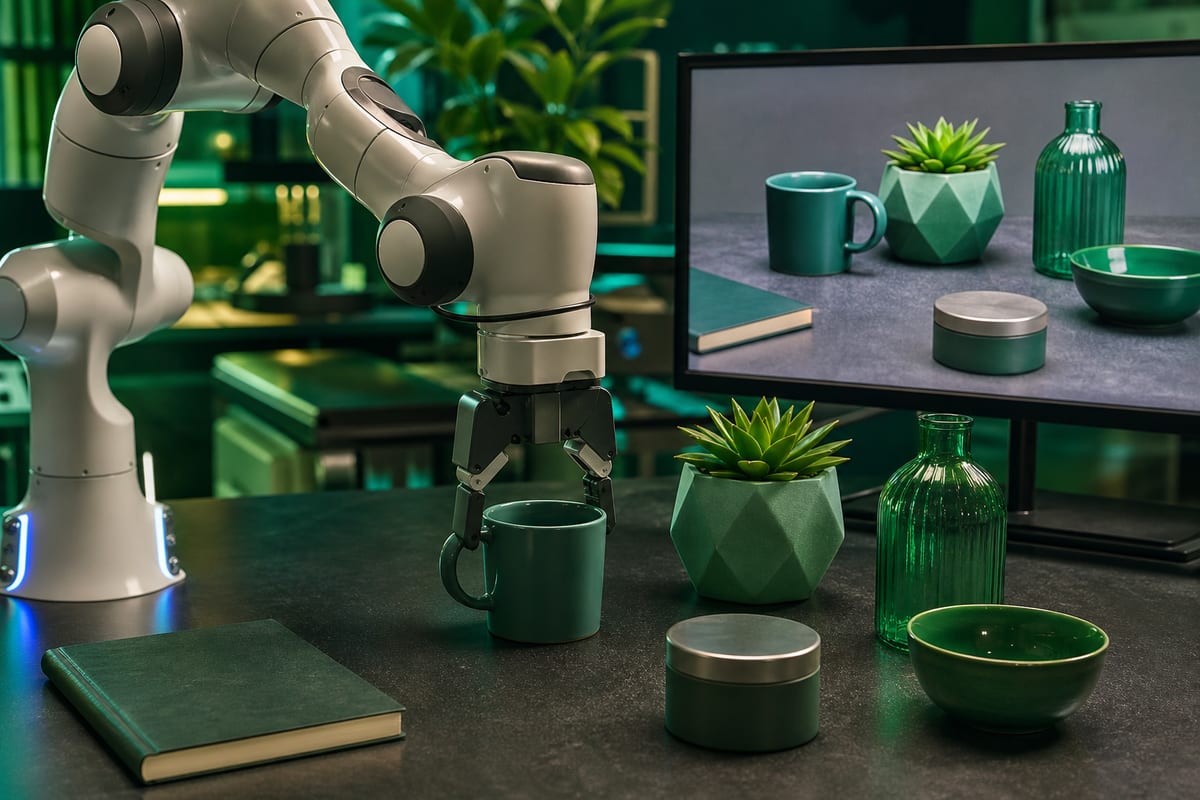
Meta has adapted V-JEPA 2 for robotics using less than 62 hours of video from DROID, following a pre-training phase on over a million hours of video. Franka arms then executed manipulations in environments unknown to the system. These trials embody the world model approach advocated by Yann LeCun, who challenges the possibility of achieving human-like intelligence solely through the scaling up of language models.
Franka Arms Manipulate Objects in Two Laboratories
In two distinct laboratories, the Franka arms successfully reached objects, grasped them, and moved them in rooms that the system had not previously encountered. No prior data collection had been conducted in these locations. The instruction was presented as an image showing the desired final arrangement.
The model employed, V-JEPA 2, has 1.2 billion parameters and dates back to June 2025. After its pre-training on internet videos, Meta added a small layer that integrates actions. This protocol stands out from many robotic learning methods that require a significant amount of task-specific demonstrations.
JEPA Predicts Representations Rather Than Pixels
Predicting the next image in a video is not sufficient, according to LeCun, to construct the desired world model. A simple demonstration illustrates this with a ball positioned at the center of a 7-pixel screen, which can randomly move left or right with equal chances. Adjusted on 1000 examples using least squares, with a mean squared error, the predictor distributes the ball among the possible positions. It calculates an average that does not correspond to any actual state of the scene.
This mechanism explains the blurry images produced by early video predictors. The fall of a pen can follow different trajectories; a video also contains leaves, shadows, or ripples whose movements escape prediction. Pixel prediction dedicates efforts to these uncertain variations.
Proposed by LeCun and detailed in 2022 under the title "A Path Towards Autonomous Machine Intelligence," JEPA stands for Joint Embedding Predictive Architecture. It shifts prediction towards an abstract representation, called latent space: one encoder condenses the observation, another represents the masked or future content, and then a predictor seeks to recover this second representation from the first. Training must guide the encoder to discard details that are impossible to anticipate.
In another demonstration, the encoding of the ball retains only its distance from the center, without keeping track of the chosen side. The target then becomes singular: a movement of two positions, regardless of direction. However, this encoder was manually crafted for the example; automatically learning such a representation remains a central challenge of JEPA.
The AI brief the pros read every evening
The 7 best AI stories, the essentials in 5 min. Free.
Included when you join: our pick of the best AI guides & comparisons.
Choose your rhythm
Free · No spam · Unsubscribe in 1 click
LeCun Distinguishes Between High-Performing Language and Physical Understanding
Yann LeCun, former head of AI at Meta, does not deny the usefulness of ChatGPT. His critique targets four shortcomings of large language models (LLMs), which learn to predict successive tokens from text. The first concerns the nature of the data: in his comparison, a large model absorbs about 10¹⁴ bytes, the reading of which would take several hundred thousand years for a person. A four-year-old child would have received a comparable volume through vision in about 16,000 hours of wakefulness, in a physical and continuous form, whereas text is limited to what humans write.
The second criticism pertains to the generation itself. LeCun likens it to Daniel Kahneman's "System 1": a quick response, without a distinct step of strategy examination. Reasoning models and their long sequences of thought nuance this separation, but their search remains textual rather than conducted within a world representation.
Memory and planning are the other deficiencies he identifies. LLMs use a context window; LeCun criticizes them for not deriving a persistent learning from a completed conversation comparable to that of a child. Listing the steps of a breakfast does not equate to verifying their feasibility in a given kitchen. In his reasoning, anticipating physical outcomes and preparing action precisely requires a world model.
The contrast emerges between a chatbot accurately describing a falling glass and a robot tasked with manipulating it. Humans anticipate a ball's trajectory without conscious calculation, or the effects of a push on a door and on a cup at the edge of a shelf. LeCun thus contrasts AIs passing the bar exam with a robot possessing the intelligence of a cat, which is still lacking. Moravec's paradox describes this gap: writing an essay or playing chess may be accessible to machines, while stacking blocks, a simple action for a young child, remains challenging in robotics.
Planning and Models Developed by Meta
A world model serves to represent the environment and anticipate the consequences of an event based on sensory information, particularly video. To plan, the system evaluates several actions, compares their expected effects to the goal, and selects the most suitable option before acting. A simplified example places an obstacle at position 4 on a line: the available choices consist of moving left, not moving, or moving right.
At Meta, several models explore this principle of predicting representations. I-JEPA, in 2023, worked on still images from which it had to recover missing areas in the form of digital representations. V-JEPA translated this task to video in 2024.
Brief AI — AI news in French
The essentials of artificial intelligence news, decoded and explained every day.