Meta: An Optimistic AI Ad Set to Bowie
Meta and Its New AI Advertisement
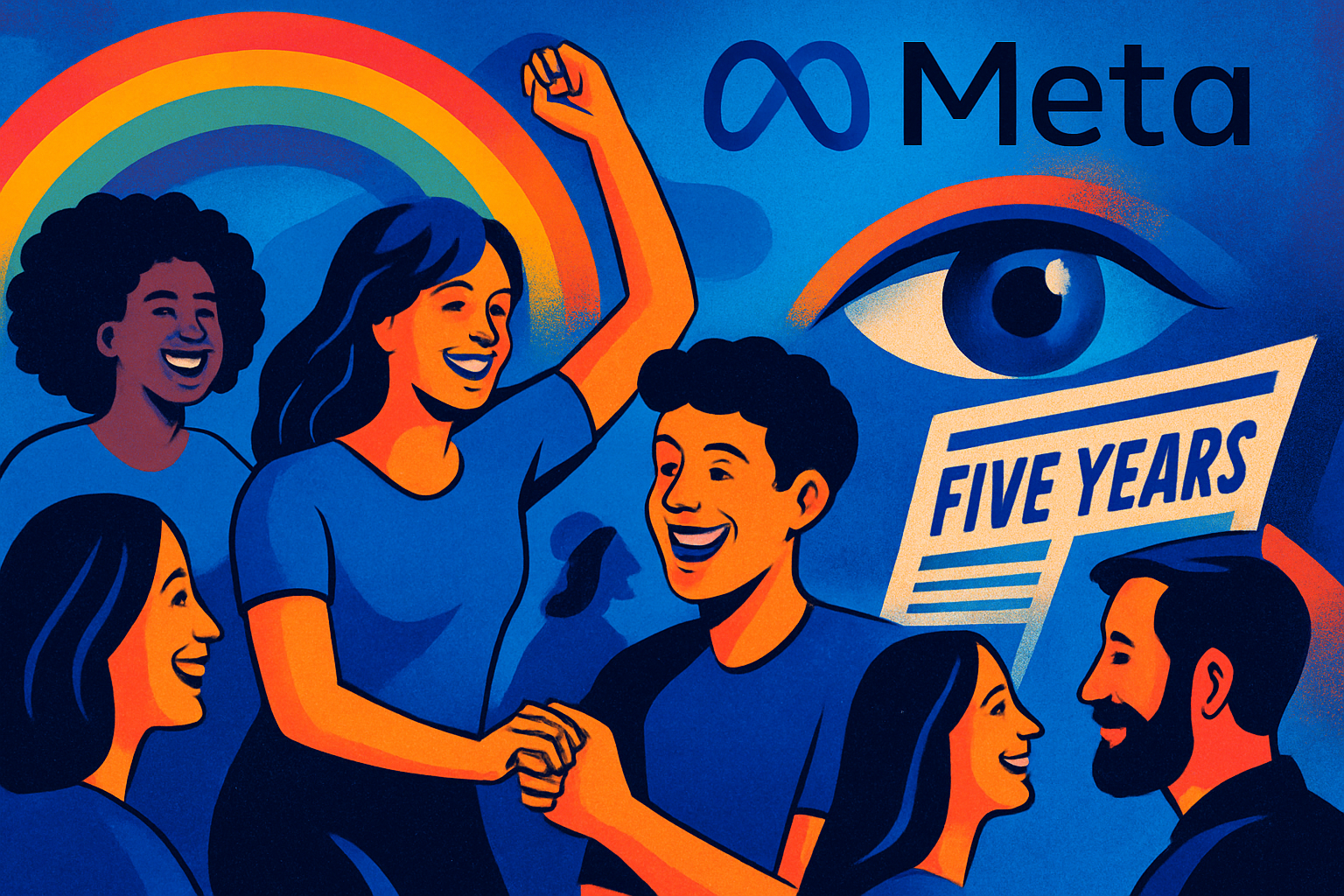
Meta recently unveiled an advertisement that quickly caught attention with its bold approach and unexpected musical choice. The video begins with a black-and-white scene focused on a human eye, symbolizing the reading of alarming headlines about the potential impact of artificial intelligence. These headlines evoke fears of job loss, social isolation, and imminent global crises.
The voiceover in the advertisement counters these fears by stating, “Some people will make you believe that AI will make us feel less connected. That it will leave us behind.” It continues by declaring that Meta completely disagrees with these pessimistic predictions.
An Optimistic Message in Color
The transition of the video from black and white to color marks a change in tone, illustrating a series of scenes of happiness and human connection. We see people waking up with smiles, a couple dancing under a rainbow, teenagers joyfully swimming, and friends reuniting after a long separation. The voiceover emphasizes Meta's optimism: “Call us optimists. Call us dreamers. Call us whatever you want. But we are betting on people, and we love those odds.”
This message of hope is strategic for Meta, which is heavily investing in AI with the ambition of transforming the future of humanity. However, the choice of soundtrack, the song “Five Years” by David Bowie, adds an unexpectedly complex layer to this advertisement.
A Double-Edged Song
For those unfamiliar with “Five Years,” it is a song that describes humanity in a state of panic after learning that it has only five years left before a mass extinction event. My brother, who works in blockchain and is not particularly versed in poetry, interpreted the song as a narrative about imminent disasters such as climate change or a zombie apocalypse.
Bowie's song, while melodic, is actually a cry of alarm about the end of the world. The part used in Meta's advertisement highlights the word “people,” but without the context of the dark lyrics that precede it, the message may seem deceptively optimistic.
Le brief IA que les pros lisent chaque soir
Les 7 actus IA du jour, décryptées en 5 min. Gratuit.
Inclus dès l'inscription : notre sélection des meilleurs guides & comparatifs IA.
Choisissez votre rythme
Gratuit · Pas de spam · Désabonnement en 1 clic
A Questionable Musical Choice
The lyrics preceding the chorus used in the advertisement are explicit:
- The news had just come in
- We had five years to cry
- The journalist cried and told us
- That the Earth was really dying
- He cried so much that his face was wet
- So I knew he wasn’t lying
These words evoke a sense of urgency and desolation that starkly contrasts with the optimistic tone of Meta's advertisement. This musical choice seems to have escaped the attention of many executives at Meta, including its CEO, Mark Zuckerberg.
Meta and the Future of AI
In a message accompanying the video, Zuckerberg reaffirmed Meta's commitment to empowering people to share and connect, emphasizing that the future of AI should benefit everyone. However, the irony of the situation is not lost, as tech leaders are not known for their literary sensitivity.
Precedents in Tech
Meta is not the only company to have made questionable communication choices. For instance, Meta's Oculus had offered new hires the novel “Ready Player One,” a dystopia where a virtual reality company becomes too powerful. Sam Altman, CEO of OpenAI, drew inspiration from the film “Her,” which warns about the dangers of AI in human relationships. Palantir, for its part, takes its name from a malevolent artifact in “The Lord of the Rings.”
A Worrying Trend
Recently, Anthropic also released a troubling advertisement. It begins with a house on fire and follows with images of surveillance, poverty, and mortality, while posing questions about the reliability of AI. This approach aims to show that Anthropic understands the risks of AI, but it rather reinforces fears.
Sam Altman commented on this advertisement, thinking it was satire, highlighting the difficulty companies face in conveying a coherent message about AI.
Public Perception of AI
Despite these efforts, companies struggle to positively influence public opinion. A Pew survey reveals that only 16% of Americans believe that AI will have a positive impact in the next 20 years, while 40% anticipate negative consequences. These figures illustrate the challenge that Meta and other companies face in convincing the public of the benefits of AI.
Brief IA — L'actualité IA en français
L'essentiel de l'actualité de l'intelligence artificielle, décrypté et expliqué chaque jour.