Microsoft Announces AI Transparency Initiative
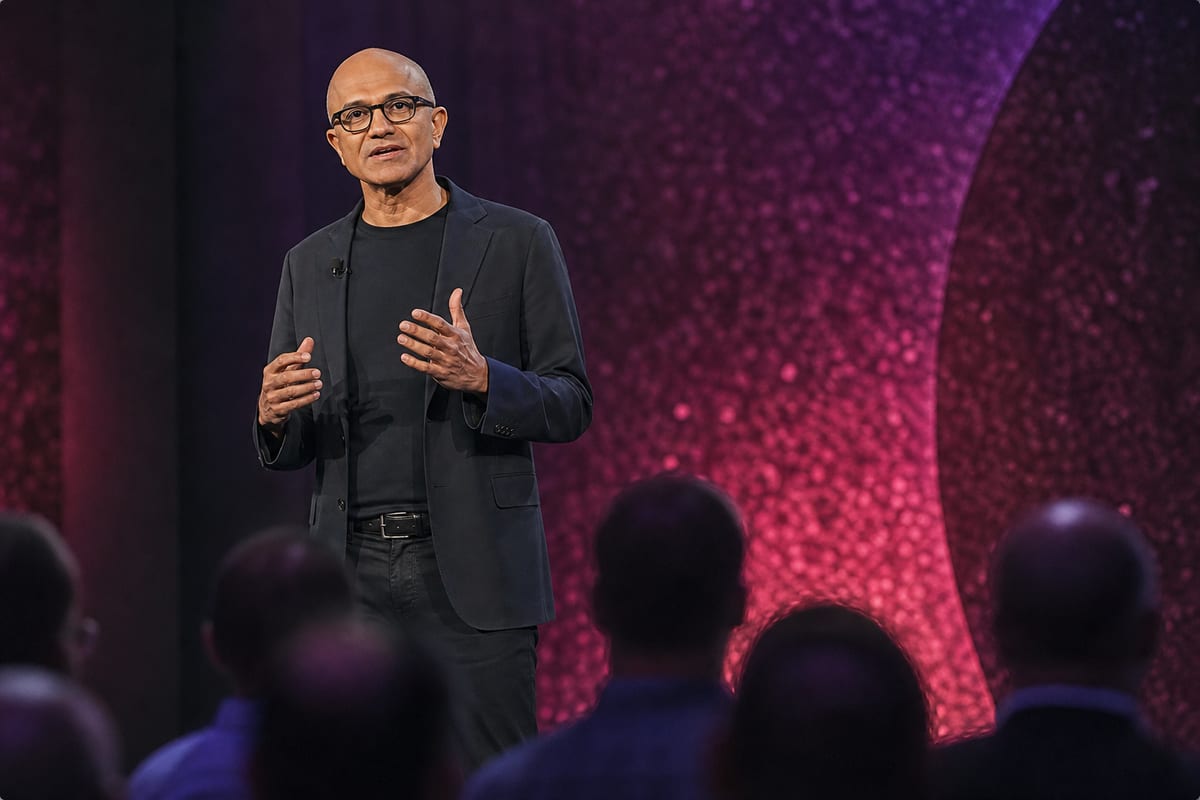
Microsoft unveiled the Microsoft Transparency Initiative at Ignite, with plans to participate in NIST's work on AI agents. The group is also considering standards developed in collaboration with other organizations. Its CEO, Satya Nadella, acknowledges that the explanations provided by a model about its own functioning are not sufficient to establish its reliability.
Microsoft Aims to Make Models More Verifiable
Observing a model's interactions does not grant access to its internal mechanisms, Satya Nadella explained. According to him, almost everything these systems touch can be observed, without their inner workings being visible. He also dismisses the independent proof value of the explanations they provide about themselves.
For the leader, trust cannot be granted by default to these technologies. He advocates for a separation between the provision of intelligence and the power exercised over it. Microsoft presents its transparency approach as a response to this challenge.
The group plans to work with other organizations on responsible, verifiable, and supplier-independent standards, and then incorporate this work into Microsoft AI, Foundry, and Copilot. It also announces its participation in the SI Agent Standards Initiative of the National Institute of Standards and Technology, NIST. However, the compatibility of its AI with NIST SI is not yet established.
Clients Must Retain Their Intelligence
At the Moscone Center in San Francisco, Nadella outlined three priorities for his "frontier ecosystem": the role of humans, the ownership of intelligence and learning by organizations, and trust. Microsoft aims to build a technical architecture that meets these imperatives. This emphasis on humans comes just weeks after layoff proposals were sent to 60,000 employees.
Nadella describes developers who no longer just produce code but build software factories where agents create software. He maintains that human intentions, judgment, experience, skills, and expertise remain important. However, the ownership of AI-generated programs, as well as their potential legal protection under copyright, remains ambiguous.
Le brief IA que les pros lisent chaque soir
Les 7 actus IA du jour, décryptées en 5 min. Gratuit.
Inclus dès l'inscription : notre sélection des meilleurs guides & comparatifs IA.
Choisissez votre rythme
Gratuit · Pas de spam · Désabonnement en 1 clic
For businesses, the leader presents the continuous accumulation and ownership of their learning and tacit knowledge as a central issue. He argues that the prosperity of a plurality of companies requires distributed intelligence, rather than being concentrated in a few models. He thus advocates for clients to retain control over their AI data.
Microsoft maintains significant commitments in cloud infrastructures intended for AI processing. The relevant data is primarily processed on equipment rented from the group, although part of the infrastructure may remain under the client's control. Anthropic and OpenAI, for their part, favor services that they govern access to without exposing the internal mechanisms of the models.
Copilot Welcomes Specialized Models and Collaborative Work
While Microsoft's historical architecture relied on ownership of the operating system, Nadella now assigns this role to Copilot for work. In this presentation, applications become extensions of the assistant. The leader claims that Office capabilities have been integrated into it.
He announced a new family of models intended for GitHub Copilot Fusion, which ensures orchestration and routing. According to Nadella, Fusion outperforms Claude Opus 5.5 from Anthropic on Terminal Bench, at a cost of less than half that of the competitor. This benchmark evaluates tasks performed by AI agents using a terminal.
The leader also introduced Copilot Workspaces, a collaborative variant in which team members share context with a model. Another product mentioned was Microsoft's decision model, launched about a month ago to compete with Jev from TypeSafe AI. Its Decisions 1.1 version is now available for general availability.
Nadella claims more accurate decisions and faster responses for this model. He indicates that over 4,000 clients have already used it.
Nadella Acknowledges Necessary Resilience Progress
Trust, a central theme of the CEO's speech at Ignite, also concerned Microsoft's existing services. A major outage had affected M365 the previous week. Nadella promised to regain trust after this incident.
He reminded how essential digital infrastructures are to the functioning of the world. The leader acknowledged that Microsoft still needs to work on the resilience expected by its clients. He committed the company to learn from its difficulties and continue its improvements.
Brief IA — L'actualité IA en français
L'essentiel de l'actualité de l'intelligence artificielle, décrypté et expliqué chaque jour.