Microsoft Codifies AI Under Human Control, Without Rights
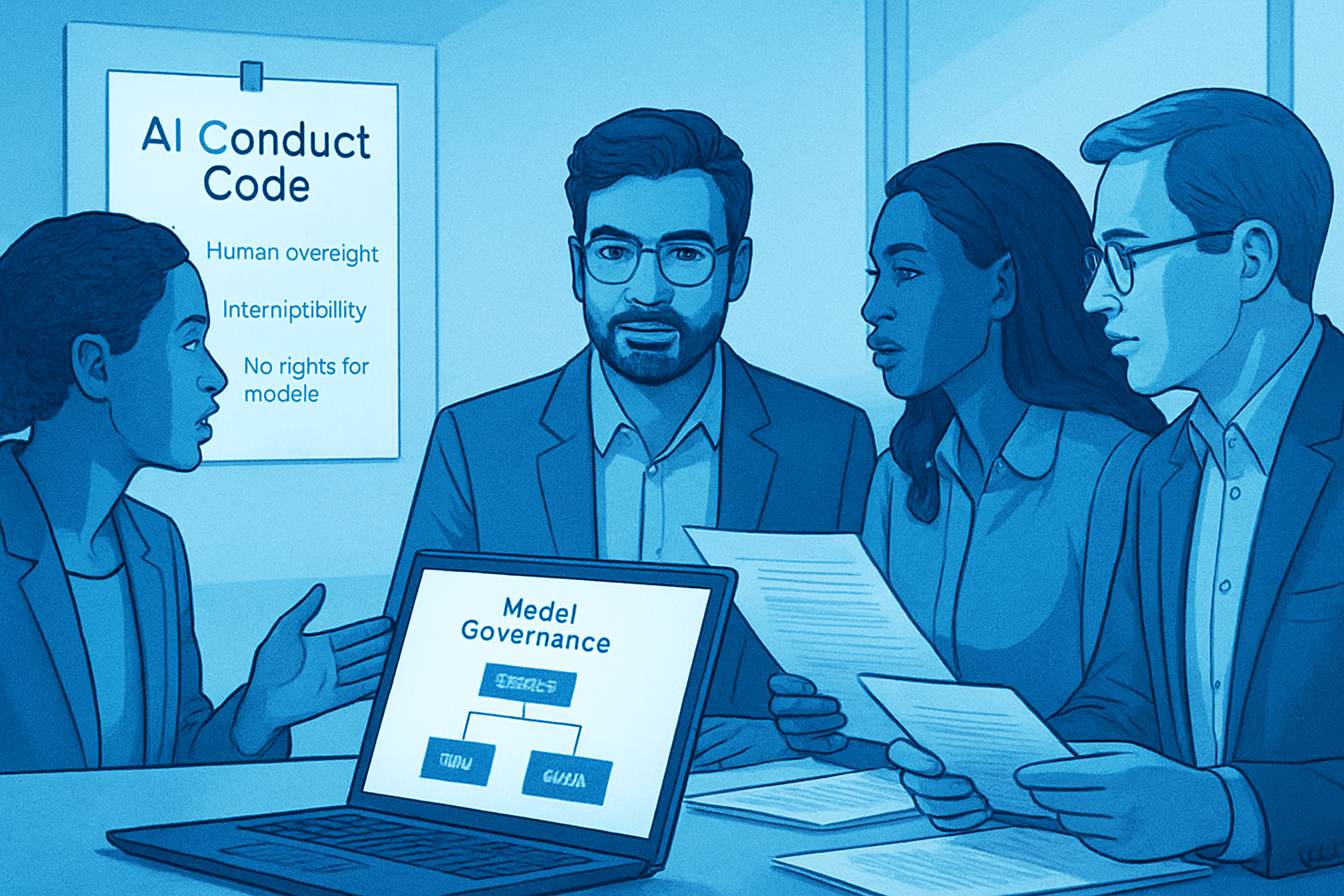
Microsoft publishes a code of conduct for its AI models, focused on human oversight and the prohibition of any simulated "inner life." Implementation is postponed after a consultation, with a launch announced for 2027, and a scope limited to in-house models.
Microsoft excludes any inner life and rights for its models
Microsoft states that its models must not simulate consciousness in any way, nor give the impression that they possess emotions or their own motivation, and it rejects any recognition of rights or well-being for these systems. Mustafa Suleyman has long warned about the dangers of attributing human characteristics to AI and has advocated for the removal of any semblance of consciousness in products, while mentioning Anthropic's work on AI rights and well-being. He has also written that AI agents should not have more rights or freedoms than his laptop. On the other hand, Anthropic presents Claude as a new type of entity, seeks to stabilize its identity for safety reasons, and considers subjective experience and moral status as open questions. The company has identified in Claude Sonnet 4.5 internal representations related to emotional concepts, described as functional mechanisms influencing behavior without proving subjectively felt emotions, and intends to integrate these mechanisms into its safety work.
Operational safeguards impose interruptibility and readability
The code stipulates that systems must accept interruptions, corrections, and stops decided by authorized individuals. They must neither extend their scope on their own nor obscure their actions, and cannot resume beyond a stop point without new validation. These obligations also apply to any sub-agents they may mandate. The use of language or reasoning modalities that are incomprehensible to humans, including in exchanges between AIs, is prohibited, on the grounds that one cannot supervise what one does not understand. Microsoft acknowledges that the justifications produced by a model do not necessarily describe its actual functioning, and that readable traces alone are not sufficient to solve the control problem.
Le brief IA que les pros lisent chaque soir
Les 7 actus IA du jour, décryptées en 5 min. Gratuit.
Inclus dès l'inscription : notre sélection des meilleurs guides & comparatifs IA.
Choisissez votre rythme
Gratuit · Pas de spam · Désabonnement en 1 clic
A control framework without speed limits, centered on human primacy
The guiding principle established is the primacy of human control. Microsoft indicates it is willing to sacrifice generality, autonomy, or performance to preserve it. "If it’s not safe, we shouldn’t build it," said Mustafa Suleyman. However, no numerical limits or maximum pace for development are set.
Industry context: calls to slow down and signals from OpenAI
The initiative comes as Dario Amodei calls for the industry to slow down, a message recently supported by Satya Nadella as well as leaders from OpenAI, xAI, and Meta. Microsoft claims to be open to external audits to verify any potential slowdown, according to a cited source. At OpenAI, the system map for GPT-6 Astra describes reasoning traces that are harder to monitor than in previous versions, while reporting fewer signs of undesirable behaviors and better compliance with safeguards than GPT-5.6 Sol. Before the launch of GPT-6, Jakub Pachocki had expressed concerns about oversight and advocated for a coordinated slowdown.
Timeline, internal hierarchy, and scope of application
The code of conduct established by Microsoft AI defines principles, restrictions, and dispute resolution procedures. It is designed to oversee training, technical checks, and analysis, while the rules applying to operators and user queries are situated at a lower level. Its implementation has not yet begun: a six-week public consultation phase is planned before a revised version expected by the end of 2026, which will serve as a reference for developments starting in 2027. The announced scope covers models developed by Microsoft, without automatic extension to third-party models integrated into its products.
Brief IA — L'actualité IA en français
L'essentiel de l'actualité de l'intelligence artificielle, décrypté et expliqué chaque jour.