Microsoft Challenges Google and OpenAI with Its Cybersecurity AI Model
Microsoft Tackles Cybersecurity with an Innovative AI Model
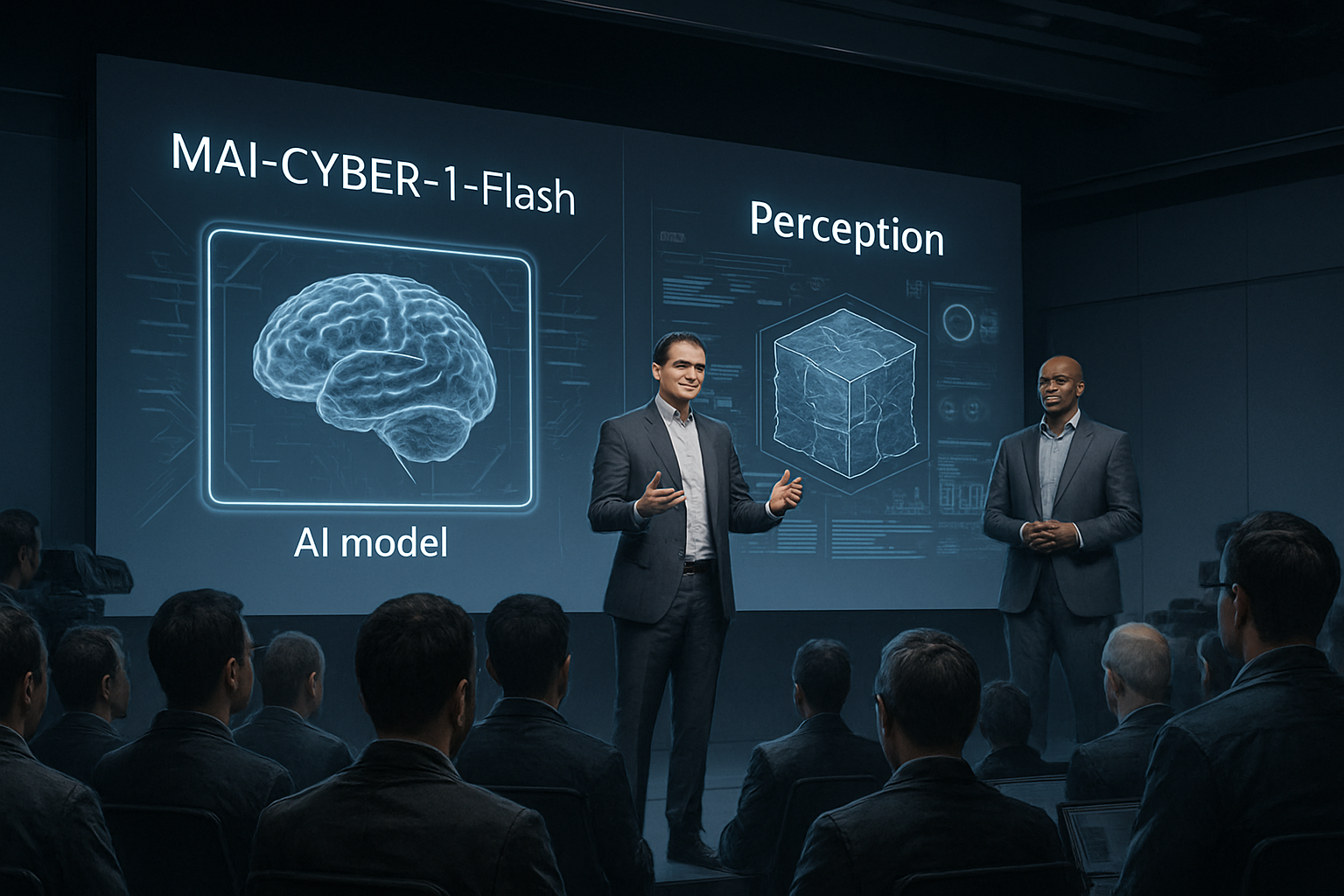
During a discreet event in San Francisco, Microsoft unveiled its first specialized cybersecurity model, along with a new AI-based security platform. This initiative directly targets industry giants such as Anthropic, Google, and OpenAI, highlighting Microsoft's ambition to position itself as a leader in this strategic field.
The model, named MAI-Cyber-1-Flash, is designed to identify complex vulnerabilities in difficult-to-analyze codebases. Integrated into Microsoft's MDASH tool, it aims to enhance the identification and correction of software flaws, a crucial task for companies seeking to secure their systems.
An Automated and Integrated Security Platform
The new platform, called Perception, has been developed to automate and assist various security workflows. It is capable of integrating with MDASH, thereby facilitating the detection and correction of bugs. This integration allows for the deployment of teams of agents that work in a coordinated manner to strengthen the security of IT systems.
According to Microsoft, MAI-Cyber-1-Flash stands out for its power and cost-effectiveness compared to competing models. Its performance has been evaluated on an AI cybersecurity benchmark, where it outperformed other reference models.
Impressive Performance on the Cyber Gym Benchmark
Mustafa Suleyman, co-founder of DeepMind and current CEO of Microsoft AI, expressed his enthusiasm about the results achieved. He stated that MAI-1 Cyber Flash, combined with GPT 5.4 within the MDASH framework, surpasses models such as Gemini, GPT 5.5 Cyber, GPT 5.6 Sol, and Mythos 5 on the Cyber Gym benchmark, considered the gold standard in the field.
Le brief IA que les pros lisent chaque soir
Les 7 actus IA du jour, décryptées en 5 min. Gratuit.
Inclus dès l'inscription : notre sélection des meilleurs guides & comparatifs IA.
Choisissez votre rythme
Gratuit · Pas de spam · Désabonnement en 1 clic
Suleyman also announced that these innovations would be put into production immediately, emphasizing the speed with which Microsoft intends to deploy its new solutions.
Responding to Cyberattacks with AI
In light of the increasing use of AI by hackers, Hayete Gallot, Microsoft's Vice President for Security, described Perception as a tool that enables companies to effectively defend against these new threats. The idea is to counter AI with AI, using the same speed and scale as attackers.
Perception employs a team-based approach involving red, blue, and green teams. Red teams simulate potential attacks, providing context on possible threats. Blue teams focus on detecting and prioritizing bugs, while green teams take corrective actions to eliminate these vulnerabilities.
Significant Efficiency Gains for Businesses
Dave Weston, Principal Engineer for Perception, described the platform as a major advancement in terms of efficiency for enterprise defenders. He explained that what previously required hours of manual work from multiple specialists can now be resolved in minutes thanks to automation and the integration of various security functions.
While AI offers new defensive capabilities, it is also accessible to cybercriminals, thereby increasing the number of potential threats. Microsoft's security tools, available in preliminary form on November 3, enter an already saturated market of AI-based solutions.
Fierce Competition in the AI Cybersecurity Sector
Earlier this year, Anthropic launched Mythos, a security platform made available to a select group of partner organizations through the Glasswing program. Meanwhile, OpenAI introduced its own security solution in May as part of the Day Break program. These initiatives demonstrate that competition is intense in the AI cybersecurity field, where each player seeks to offer increasingly effective and innovative solutions.
Brief IA — L'actualité IA en français
L'essentiel de l'actualité de l'intelligence artificielle, décrypté et expliqué chaque jour.