Microsoft Expands Agent Lockdown on Windows
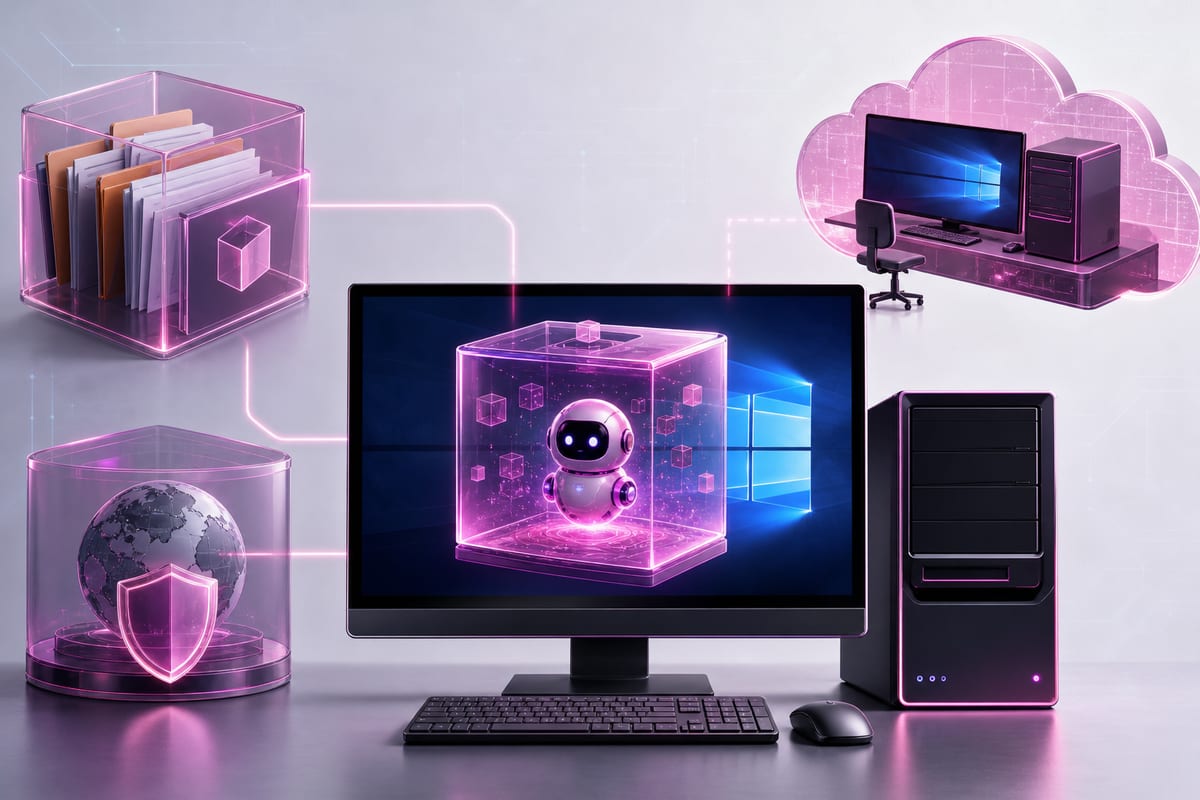
At Ignite 2026, Microsoft unveiled new protections for agents running on Windows, including enhanced process containers in preview and experimental local virtual machines. Windows 365 for Agents also becomes eligible for Copilot Credits. These announcements accompany the general availability of protections for security software and administrators.
OpenAI Activates Confinement in Codex
According to Microsoft, OpenAI has enabled Microsoft Execution Containers, or MXC, by default in Codex, while Meta is using it on tens of thousands of Windows PCs. More than 20 developers of agents or applications, including Anthropic, Box, Perplexity, and Replit, are also working with this technology. Generally available on Windows 11 since October, MXC also operates on Linux and macOS. Its integration into the Windows system allows for a choice between process containers, session containers, or WSL, virtual machines, and Windows 365 for Agents.
Each agent receives a separate environment, with rules on accessible files and networks that Windows enforces in real-time. Microsoft, which attributes productivity gains to agents but also recognizes new access risks, organizes its protection around confinement, identity, and management. This involves limiting their actions, distinguishing them from human actions, and monitoring their access. The company claims to have improved the quality of MXC and made agent impersonation more difficult since its general availability.
The preview of the enhanced process containers specifies the boundaries of the workspace, communications, network connections, and identity proofs. According to Microsoft, these restrictions reduce the risk of an agent accessing inappropriate data or affecting the rest of the PC. The learning and permissive modes, now generally available, allow for observing usual interactions with system services before imposing restrictions. Microsoft presents these modes as a way to enforce rules without disrupting legitimate usage.
Local Micro VMs are still experimental. They offer a virtualized separation for high-risk tasks, with isolation enforced by hardware.
Agents Access Software Without APIs
Windows 365 for Agents provides agents with cloud-hosted computers, connected to Microsoft Entra and managed with Intune like other machines in an organization. The agent can view the screen, click, enter text, and transfer data between software. This means it can interact with browsers, business applications, or legacy applications, as well as on-premises Windows applications, even those lacking APIs.
Already available as a computing tool in Microsoft Copilot Studio, the service is set to join Microsoft Foundry in preview early next year. Its eligibility for Copilot Credits integrates it, according to Microsoft, into a common management of expenses, billing, and governance. The company's business operations team itself uses Windows 365 for Agents.
Access to on-premises applications with agent identities is offered in preview. Persistent Cloud PCs, intended for long or continuous activities, are also planned in the Frontier preview. Additionally, Microsoft is extending the policies and governance of Agent 365 to local agents, particularly on Windows. With Entra, Intune, Defender, and Purview, organizations can apply their existing governance practices to them.
Copilot Fusion Utilizes Local Models
In preview, GitHub Copilot Fusion can direct programming tasks to local models on the developer's PC. Local context, actions, and models are also expected to join Copilot on Copilot+ PCs soon. Microsoft groups under the name Hybrid Intelligence a secure agent platform and a mechanism for distributing tasks between local models and cloud-hosted computing resources. The company presents this distribution as a means to secure usage and better control token spending.
Le brief IA que les pros lisent chaque soir
Les 7 actus IA du jour, décryptées en 5 min. Gratuit.
Inclus dès l'inscription : notre sélection des meilleurs guides & comparatifs IA.
Choisissez votre rythme
Gratuit · Pas de spam · Désabonnement en 1 clic
The Ignite announcements also include Direct Stream for Windows 365, as well as Windows Server 2028 in public preview, with Microsoft Foundry and support for new AMD and NVIDIA AI hardware. According to Microsoft, Windows performs critical tasks in organizations on over a billion devices. The company notes that organizations have integrated AI into their daily operations over the past year and that agents now operate between applications, files, and systems. Technology leaders it meets inquire about their security and large-scale deployment without excessive costs or risks.
Windows Limits Administrator Privileges
Now generally available, administrator protection allows local administrators to retain standard user rights by default. Windows Hello verifies their identity when an operation requires elevated privileges. These are granted only for the specific task at hand and cease when it is completed.
The Windows endpoint security platform, also generally available, enables publishers to transfer their critical kernel protections to user mode. Some protections were historically executed in the kernel, where a failure could, Microsoft reminds, affect the entire device. The company claims that this transfer improves resilience without sacrificing expected protection. The work initiated with its partners in 2024 includes Bitdefender, CrowdStrike, ESET, SentinelOne, Sophos, Trellix, and TrendAI.
Windows core protection is in preview in Windows Insider. It combines secure boot, virtualization-based security, and memory integrity into a verifiable state. Microsoft promises users better visibility into their PCs, while IT teams can obtain a binary verdict for each machine. Developers can also verify compliance with security requirements for their applications; Microsoft is working with its partners on their needs and plans to evolve this protection.
Autopatch Surpasses 150 Million Registered Devices
According to Microsoft, the use of Autopatch has increased by over 50% over the past year and now exceeds 150 million registered devices. The deployment of updates by its clients is, on average, more than 40% faster than those relying on on-premises management. Among Microsoft's fastest clients, more than two-thirds of devices receive security updates within a week. Autopatch also offers, according to the company, increased control, improved visibility into delivered features, and limited interruptions through a monthly restart.
Microsoft claims to have delivered patches for over 1,100 vulnerabilities in October, more than in the entire year of 2025. Its multi-model analysis system MDASH examines Windows code and would, according to the company, allow for earlier detection of flaws and faster corrections. Microsoft also asserts that AI is accelerating attackers: an exploit once reserved for experts can now require just a single prompt. The company anticipates a doubling of new vulnerabilities in the industry this year, but patches only protect devices after they have been installed.
Maintenance extends to software with Microsoft Intune Enterprise App Management, which already allows for large-scale deployment and administration. A preview automates updates for both applications distributed by IT teams and those installed by users. The controls and timelines mirror those of Autopatch.
Microsoft also claims to have improved the performance, reliability, and design of Windows over the year. A declarative management is standardized by the system to keep devices in the state defined by IT teams. According to the company, a few minutes are sufficient for applying Wi-Fi and VPN rules, which remain protected against deviations even when the device is offline.
Brief IA — L'actualité IA en français
L'essentiel de l'actualité de l'intelligence artificielle, décrypté et expliqué chaque jour.