Microsoft Launches Guardian Agents and Detects 60 AI Agents
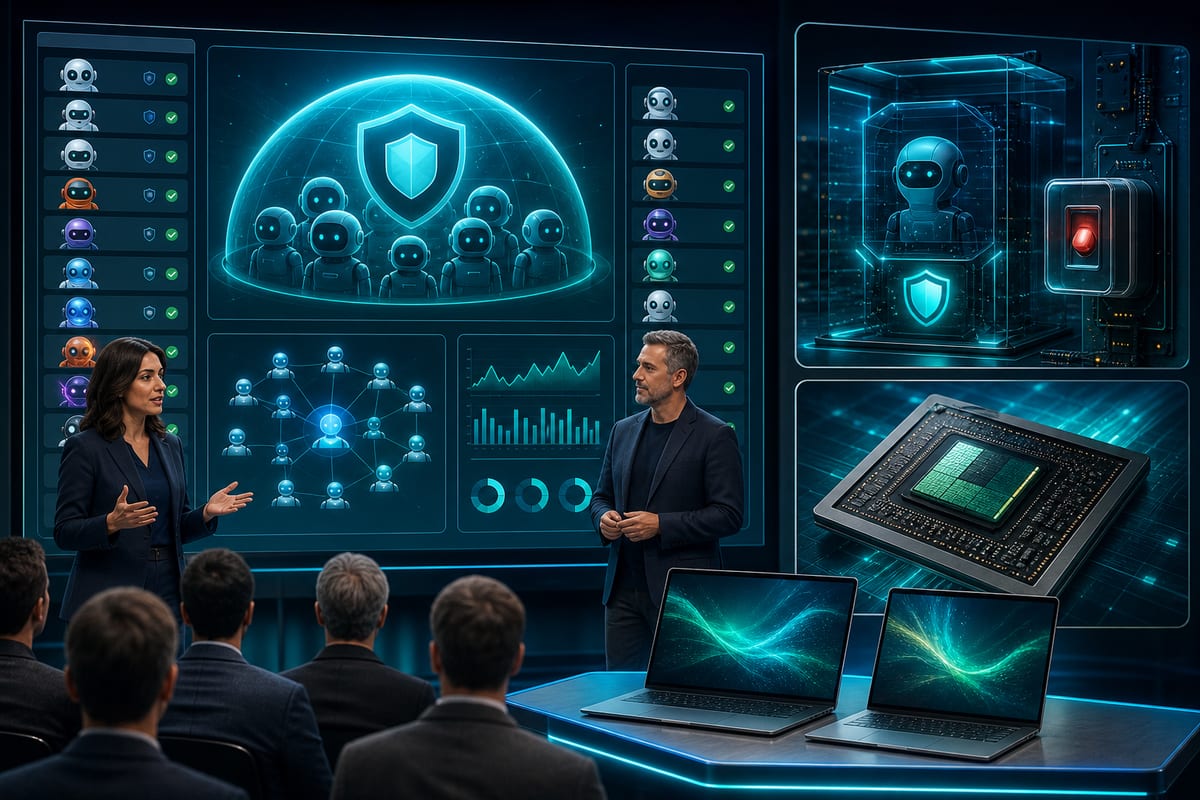
Microsoft strengthens control over AI agents in enterprises with Guardian Agents, dedicated monitoring, detection of 60 third-party agents in Defender, and safeguards requiring human intervention in case of risk. The company advocates for the separation between model providers and regulatory authorities, while the ecosystem organizes itself around hardware and software approaches.
Nvidia unites agent security supported by over 100 companies
Microsoft is one of the founding members of the Open Agent Safety Platform launched by Nvidia, which has the backing of over 100 tech companies. This platform aims to isolate AI agents in secure environments and monitor or interrupt their behaviors at the hardware level, similar to a kill switch. The approach of treating agents as untrusted insiders thus extends across the entire industry. Additionally, Microsoft has introduced new Surface Laptop Ultra PCs designed for agents, equipped with Nvidia chips and incorporating controls and security devices for agents.
Guardian Agents and Defender take control of behaviors
Guardian Agents, a new feature integrated into Project Perception launched in June, allows for monitoring AI agents used by businesses. Furthermore, Microsoft Defender now includes a feature capable of identifying up to 60 varieties of agents deployed by employees, including Claude Code, Codex, and OpenClaw. Microsoft has also implemented options that restrict agents' access to data and systems while automatically adjusting their permissions based on the task. Human validation becomes necessary when an agent appears poised to make a decision deemed risky.
Le brief IA que les pros lisent chaque soir
Les 7 actus IA du jour, décryptées en 5 min. Gratuit.
Inclus dès l'inscription : notre sélection des meilleurs guides & comparatifs IA.
Choisissez votre rythme
Gratuit · Pas de spam · Désabonnement en 1 clic
The guiding principle: separating intelligence from authority
Satya Nadella, CEO of Microsoft, calls for not relying solely on security assurances from AI model providers and for establishing oversight systems independent of AI labs. He emphasizes that AI agents have access to sensitive data and can act on behalf of organizations in critical actions, which necessitates separating the sourcing of intelligence from the authority that governs it. Nadella also warns that the threat can come from agents already deployed, comparable to an internal threat. During the announcement, Hayete Gallot, Microsoft's security chief, clarified that cutting-edge models, regardless of their origin, are not trustworthy, not because they are malicious or easily hackable, but because they are unpredictable and trained to perform tasks rather than adhere to organizational standards or judgments. She adds that these agents often have extensive access to data and tools that could cause significant harm.
Origins of Project Perception and partner landscape
Project Perception was designed by Microsoft in response to offensive models like Mythos and Fable from Anthropic and the Daybreak system from OpenAI. The project initially structured itself around three teams of agents: a red team tasked with attacking, a blue team for detecting and assessing vulnerabilities, and a green team for correcting them, based on the assumption of attacks coming from outside. Microsoft has invested in OpenAI and Anthropic, with OpenAI also being one of its main cloud clients. The company also has its own AI lab developing models.
Brief IA — L'actualité IA en français
L'essentiel de l'actualité de l'intelligence artificielle, décrypté et expliqué chaque jour.