Microsoft Launches MAI and Maia 300 for Cheaper AIs
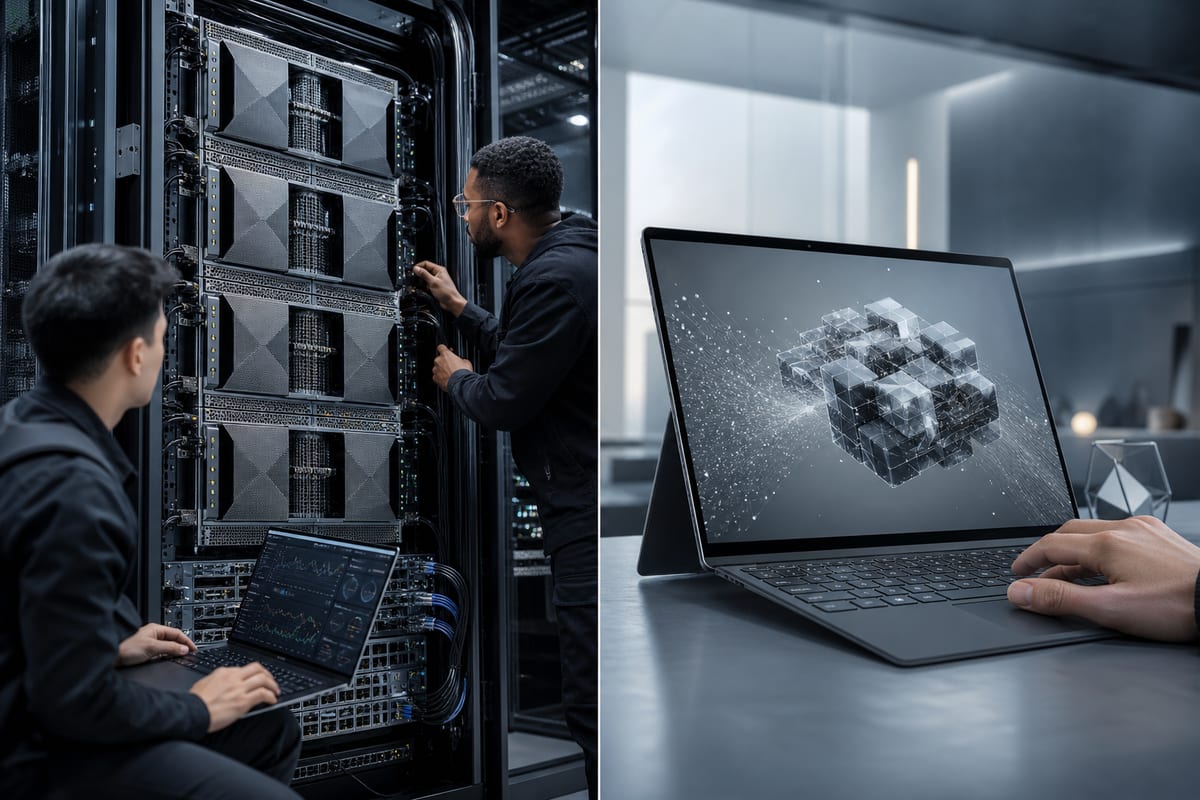
Microsoft highlights its MAI models and the new generation of Maia 300 accelerators, with announced gains in token costs and energy efficiency. Flash models, already utilized in MDASH and GitHub Copilot, support the majority of common tasks. The entire system integrates via Foundry and aims for performance deemed "sufficient" at a lower cost.
Maia 300 Enhances Computing and Memory, Aiming for Cheaper Tokens
The Maia 300 generation boasts a 36% increase in computing operations and 2.5x performance in wide-band memory, achieving approximately 2x improvement in performance per watt. This optimization is also expected to reduce token costs for end users, thanks to a tailored data flow architecture. Each rack houses 96 accelerators and can execute multiple tasks distributed across several racks. Maia is presented as capable of ensuring multi-tenant inference without blocking and adapting to load. In terms of usage, MAI-Cyber-1.1-Flash now handles 90% of tasks previously assigned to more expensive models, with operating costs down 18% compared to version 1.0.
MAI Integration in Foundry and Tools for Agents
Most MAI models are offered via Foundry, with the exception of two references reserved for other applications: MAI-Cyber-1.1-Flash powers the MDASH security system, and MAI-Code-1.1-Flash contributes to GitHub Copilot. Transitioning to MAI models is done through existing Azure OpenAI Foundry APIs, for example by deploying MAI-Thinking-1 and changing the client-side endpoint URL. Token limits per request help manage budgets. MAI-Thinking-1 supports function calls for integration with agents, can maintain encrypted reasoning chains between requests, and stream outputs in fragments, which is presented as enhancing the user experience. A new decision scoring model from Microsoft can serve as an agent router to choose steps and associated models.
Le brief IA que les pros lisent chaque soir
Les 7 actus IA du jour, décryptées en 5 min. Gratuit.
Inclus dès l'inscription : notre sélection des meilleurs guides & comparatifs IA.
Choisissez votre rythme
Gratuit · Pas de spam · Désabonnement en 1 clic
Microsoft Offers Local Inference with Flash Models
MAI's "Flash" models, delivered for local or cloud execution, are described as providing significant savings and fidelity close to solely hosted models. Local inference on NVIDIA RTX hardware consumes less energy than data center servers while remaining fundamental models. However, MAI-Code-1.1-Flash is not yet suitable for Arm-based Copilot+ PCs, as it requires more than 120 GB of RAM. A Surface Ultra equipped with NVIDIA RTX Spark and at least 128 GB of RAM should suffice, but the economic trade-off will depend on the intensity of agent usage. For cybersecurity, the Flash model offloads MDASH agents and transfers heavy operations to more powerful models.
Foundry Aggregates Over 11,000 Models and Anchoring Tools
Foundry provides access to over 11,000 models, including those from Anthropic, Hugging Face, Meta, Mistral, and DeepSeek. Microsoft continues to showcase its Cognitive Services models for vision and text, as well as the Phi series intended for edge use cases. The platform offers agent-centric features, including anchoring models to data sources supported by the IQ graph. The offering is presented as useful for building modern applications, as Microsoft's large in-house frontier models have been lacking until now.
MAI Prioritizes Inference Cost and Claims a "Humanistic" Approach
With MAI, Microsoft emphasizes lower token costs in a context where hyperscalers seek to amortize heavy investments and where "tokenmaxxing" is deemed unviable. The focus is on cheaper inference on dedicated hardware, and MAI describes its approach as "humanistic," sensitive to security and the environment. MAI covers common use cases such as cybersecurity, coding, and transcription, offers a tuning service, and includes MAI-Thinking-1 for sophisticated uses. Microsoft claims that this model has a reduced footprint while delivering expected results, with published benchmarks indicating good performance, and also shares favorable figures for larger models from Anthropic and OpenAI. The stated goal is to capture market share with results deemed "good enough" at a lower cost. On the hardware front, Azure Maia is optimized for Microsoft and OpenAI models, allows for non-uniform memory access, extends from rack to network, and relies on an SDLA approach with a chiplet design. Previous versions were described as fast.
Brief IA — L'actualité IA en français
L'essentiel de l'actualité de l'intelligence artificielle, décrypté et expliqué chaque jour.