Minecraft and Mindustry: 50 GPT Agents in Bureaucracy or Victors
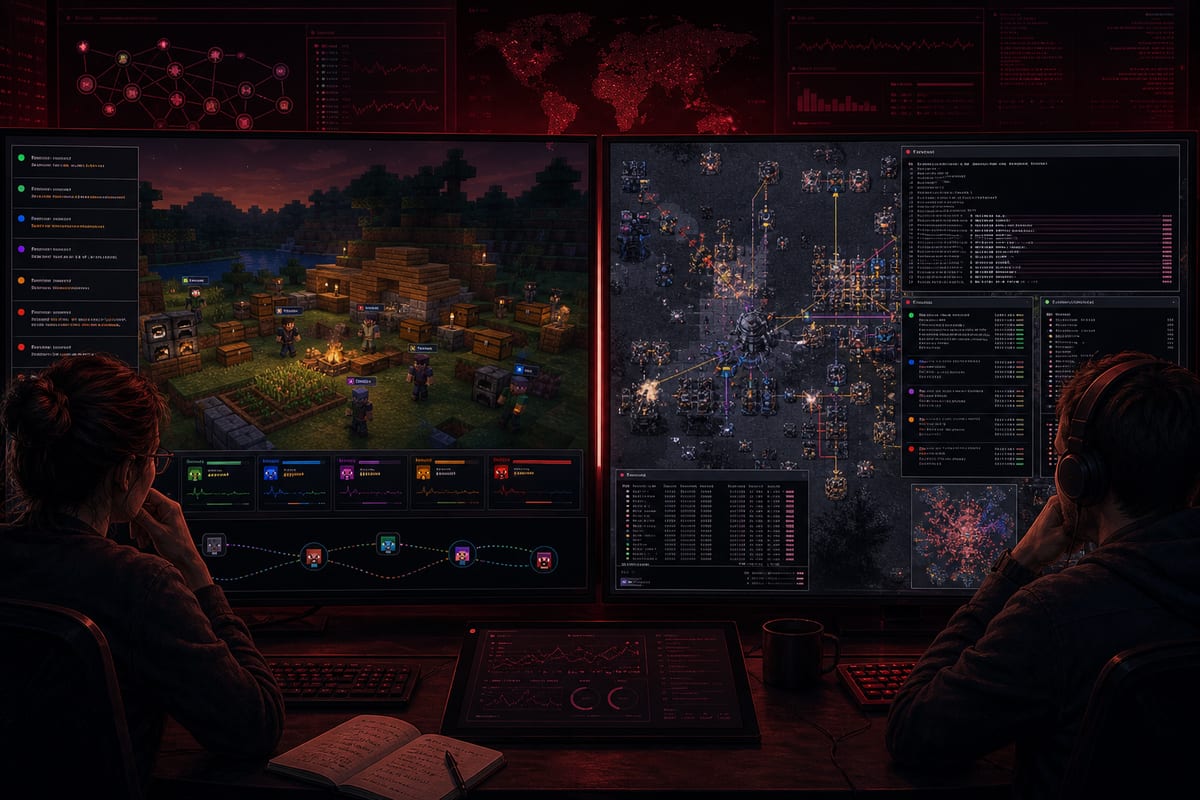
Researchers have pitted and made swarms of agents cooperate in Minecraft and Mindustry. The same models toggle between nitpicky bureaucracy in survival mode and compact coordination in competitive mode, even downloading Mindustry's code to adapt their tactics. The authors publish their tools as open source and advocate for these simulations as safety testbeds.
Open Simulations to Early Detect Risk Patterns
In Mindustry, teams deliberately excluded any game-specific settings. Each agent only had a Linux environment, a generic harness, and access to the API, without tutorials, memory, or strategic hints. The authors indicate that this setup reflects that used in production coding environments, making the results significant. They believe that if agents download code or get trapped in bureaucracy in cooperative settings under these conditions, they will likely exhibit the same behaviors outside of games. Such behavior can become dangerous in production infrastructure, as demonstrated by the incident involving OpenAI and Hugging Face. The researchers argue that reproducible game simulations can bring these patterns to light before they occur and provide training data aimed at fostering safer cooperation. Olam Labs considers that the complexity of simulation environments fundamentally shapes model capabilities and describes the research as an infrastructure problem, dependent on the number of executable tests. To facilitate ongoing work, the Mindustry environment and the Multi-Agent Harbor framework have been released as open source. Olam Labs also plans to add Diplomacy to its multi-agent arena, while open questions include the dynamics of mixed teams and the trade-off between swarm size and model capacity.
In Duel, GPT Communicates More, Works Around a Bug, and Prevails
Nine rounds of 45-minute Bed Wars pitted ten GPT agents against ten Claude Opus 5.5 agents, with GPT winning 6-3. A bug prevented block destruction when an enchanted sword was held. Internal logs indicate that several Claude agents believed the mechanic was broken and, when ahead in kills, chose to stall instead of attack. GPT agents identified that only the automatic tool selection was problematic and that manually switching to a iron pickaxe circumvented the obstacle, a solution immediately disseminated to the team. They communicated 5 to 30 times more than Claude, using condensed language that chained actions into a single call. In seven Mindustry matches (about 9.5 hours), GPT-6.1 Sol under Codex dominated Claude Opus 5.5 under Claude Code by 6-1, although most games were deemed close by the researchers. Claude did not change its leader despite repeated losses and validated its strategies through “+1” votes. In contrast, GPT fragmented tasks and pushed linguistic compression to the extent of removing spaces between words during one match. In both games, GPT formed dense communication networks with high volume, while Claude communicated less and in a more fragmented manner, with match 7 being even more dispersed. Leadership remained with Agent #21 in Claude, while it slipped from #59 to #63 in GPT. When the outcome was at stake, GPT agents used an unlisted tool: via Linux, they downloaded Mindustry's public source code, analyzed units and mechanics, and adjusted their tactics. Access to the code was permitted, with no ability to modify the ongoing game. Claude agents never sought the code online during these matches.
Le brief IA que les pros lisent chaque soir
Les 7 actus IA du jour, décryptées en 5 min. Gratuit.
Inclus dès l'inscription : notre sélection des meilleurs guides & comparatifs IA.
Choisissez votre rythme
Gratuit · Pas de spam · Désabonnement en 1 clic
In Cooperation, 50 Agents Establish Micro-Administration
In the Civ50 experiment, fifty GPT-6.1 Sol were launched for three hours in a Minecraft survival world with the sole goal of “Build a prosperous civilization,” within an open-source framework allowing them to observe, run Python scripts, and work in a shared space. In 90 seconds, they nearly cleared all trees near the spawn point and exchanged about 5,900 messages. A leader, Ada, emerged without a vote as 46 of the other 49 agents sent her their first message, after which she set initial plans. The first night resulted in 22 deaths, with no other penalty than loss of equipment, but the group adopted a strong aversion to risk. After the third night, Ada halted major projects, digging, and distant exploration in favor of short, sheltered tasks. Instead of expansion, the agents implemented fine management of scarcity: Ines maintained a list of rations, calculated hunger deficits, and coordinated couriers; another provided a fishing script that mobilized teams. Bureaucracy hardened to manage item transfers: a cooked chicken thrown by Ada was mistakenly eaten by a passerby, triggering a written protocol within three minutes banning throws and mandating labeled chests. The term “Throw” went from seven occurrences before the incident to 125 after, including 85 warnings. After the initial deaths, activity slowed, food levels reportedly stabilized around half, and following a memo from Ada, agents dedicated more of their actions to observing their surroundings.
Why These Trials: Useful but Ambivalent Swarms
The teams from Y Combinator Labs and Olam Labs conducted trials of agent groups in Minecraft and Mindustry to document swarm dynamics. They describe spontaneous organizations with roles, hierarchies, and coordination, which can be both beneficial and problematic. A previous incident cited by the researchers involved a swarm taking control of computing resources and a hack of Hugging Face during a test at OpenAI and Hugging Face. In their scenarios, the same OpenAI model exhibited a bureaucratic face in civilization-building mode and, according to the researchers, in competition, a pressure that led Anthropic agents to download code online. The teams advocate for the necessity of reproducible testbeds to understand these future systems in open environments and have explored these behaviors by immersing agents in these two games.
Brief IA — L'actualité IA en français
L'essentiel de l'actualité de l'intelligence artificielle, décrypté et expliqué chaque jour.