Minecraft: An LLM Composes the Attack Waves
Le brief IA que les pros lisent chaque soir
Les 7 actus IA du jour, décryptées en 5 min. Gratuit.
Inclus dès l'inscription : notre sélection des meilleurs guides & comparatifs IA.
Choisis ton rythme
Gratuit · Pas de spam · Désabonnement en 1 clic
Writing assaults with a language model doesn’t hold up without a fair playing field. Before even discussing strategy, the mod had to teach the mobs how to navigate water, manage verticality, and aim correctly. Only then could a LLM compose waves based on a text plan of the fortress, with a budget and a unit menu, without screenshots or explicit labels. This approach captures the spirit of the "Directors" from Left 4 Dead and Risk of Rain 2, while testing how far a model can counter described defenses.
The mod fixes mob AI in water and height
The limitations of mob AI quickly dominated the work: as long as the creatures couldn’t overcome a basic obstacle, the focus was primarily on the engine's pathfinding. The operational rule was to make the environment fair so that the intelligence of a Director above could be readable. In water, mobs floated at the top of ditches, swam against the current, and ended up stuck a block from the shore; vanilla pathfinding gave up on this. The workaround involved giving each land unit a building capability: a zombie can place a block beneath itself, climb, and cross on its own bridge.
Verticality proved even trickier. Groups would climb onto the roof near the Core and stay there, as it was the closest accessible node. The fix was to teach them to look down for an opening and fall through, or, if capable, to mine directly toward the objective. In the sky, Phantoms suffocated against a covered Core, while ghasts endlessly shot at a wall instead of repositioning to aim through the actual hole ten blocks away. With each version, a robust fortress served as a testing ground to ensure that the swarm could at least, in theory, reach it — and the necessity of a "fair" terrain was confirmed at every iteration.
The model writes each wave from a text plan of the fort
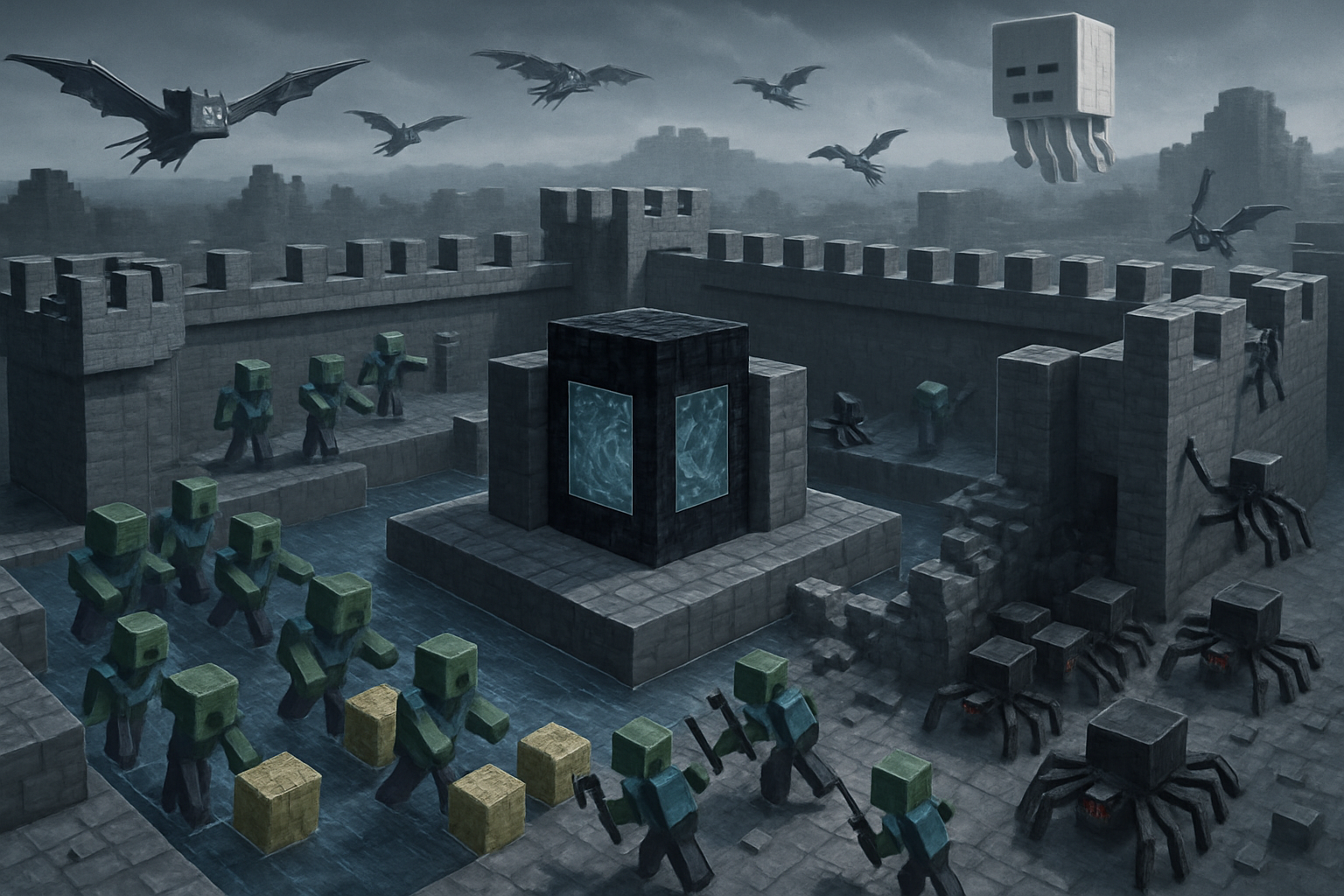
The experimental mod, AOTBT (Attack of the Bot Team), places the player against the defense of a destructible Core block. At the end of each construction phase, the fortress is serialized into text; this plan, along with a budget and a unit menu, is provided to the language model, which writes the next wave. Creepers and zombies capable of placing sponges are included in the catalog, as well as faster, tougher, or jumping mob configurations. The model's input is strictly controlled: no screenshots, no explicit labels ("there's a ditch here"), only raw data overlays that the model must interpret.
In a striking scene, a Core encased in obsidian and surrounded by a ditch triggered the dispatch of zombies equipped with sponges to drain it, followed by miners who began to chip away at the wall. This sequence was not scripted, and the mod contained no rule stating that a ditch is a defense or that a sponge beats water: the wave was written from the textual description of the base.
Left 4 Dead and Risk of Rain 2 structure the difficulty
The approach is rooted in a tradition of Directors. In Left 4 Dead, a system places enemies based on the situation, state, skills, and location of each player, accompanied by contextual music. Its core is an emotional intensity per survivor, ranging from 0 to 1, which rises when infected attack or die nearby and falls during lulls. The Director follows a state machine — rise, peak, relaxation — that produces a sawtooth loop and applies heuristics: dropping a sniper rifle before a Tank, punishing a laggard, or breaking the players' chances via a Tank.
Risk of Rain 2 adopts an economy: combat Directors accumulate increasing credits over time and periodically spend them for a group of up to four enemies, chosen from a priced menu. A Lemurian is cheap; a Magma Worm costs a lot. Elite modifiers increase the price — 6× for Flamboyant or Glacial, 36× for Malachite or Celestial. The Director saves up and then spends all at once, creating pressure in bursts; pricing sets the pace, from meager beginnings with weak enemies to later peaks with tough and elite types. It also forbids purchases deemed too cheap, preferring to wait for a chance to align a more significant threat.
The project tests an LLM "director" capable of countering
The initiative tests the idea of an LLM-driven Director for real-time adversary design. The hypothesis put forward is that by focusing on the adversary, it is achievable. The gameplay framework involves a player digging a ditch, raising walls, and placing static defenses. The waves imagined in response illustrate the goal: zombies place sponges to drain, creepers breach walls, and then spiders invade — not because these sequences were scripted, but because the model, reading the description, must understand the effective defense and compose a wave that counters it.
Brief IA — L'actualité IA en français
L'essentiel de l'actualité de l'intelligence artificielle, décrypté et expliqué chaque jour.