Mistral: Limited EU Data and Priority Access
Le brief IA que les pros lisent chaque soir
Les 7 actus IA du jour, décryptées en 5 min. Gratuit.
Inclus dès l'inscription : notre sélection des meilleurs guides & comparatifs IA.
Choisis ton rythme
Gratuit · Pas de spam · Désabonnement en 1 clic
Mistral: Limited EU Data and Priority Access
Mistral now offers clients the option to process AI requests via servers located in Europe or the United States, while also selling priority access during peak times. However, these options come with significant limitations.
When companies integrate Mistral's AI into their own products, requests are sent to one of the provider's servers. Two questions are crucial for professional clients: where is this server actually located, and what happens when many requests are sent simultaneously? Mistral now provides answers to these questions, presenting them in a blog post as part of a broader strategy for European sovereignty in AI.
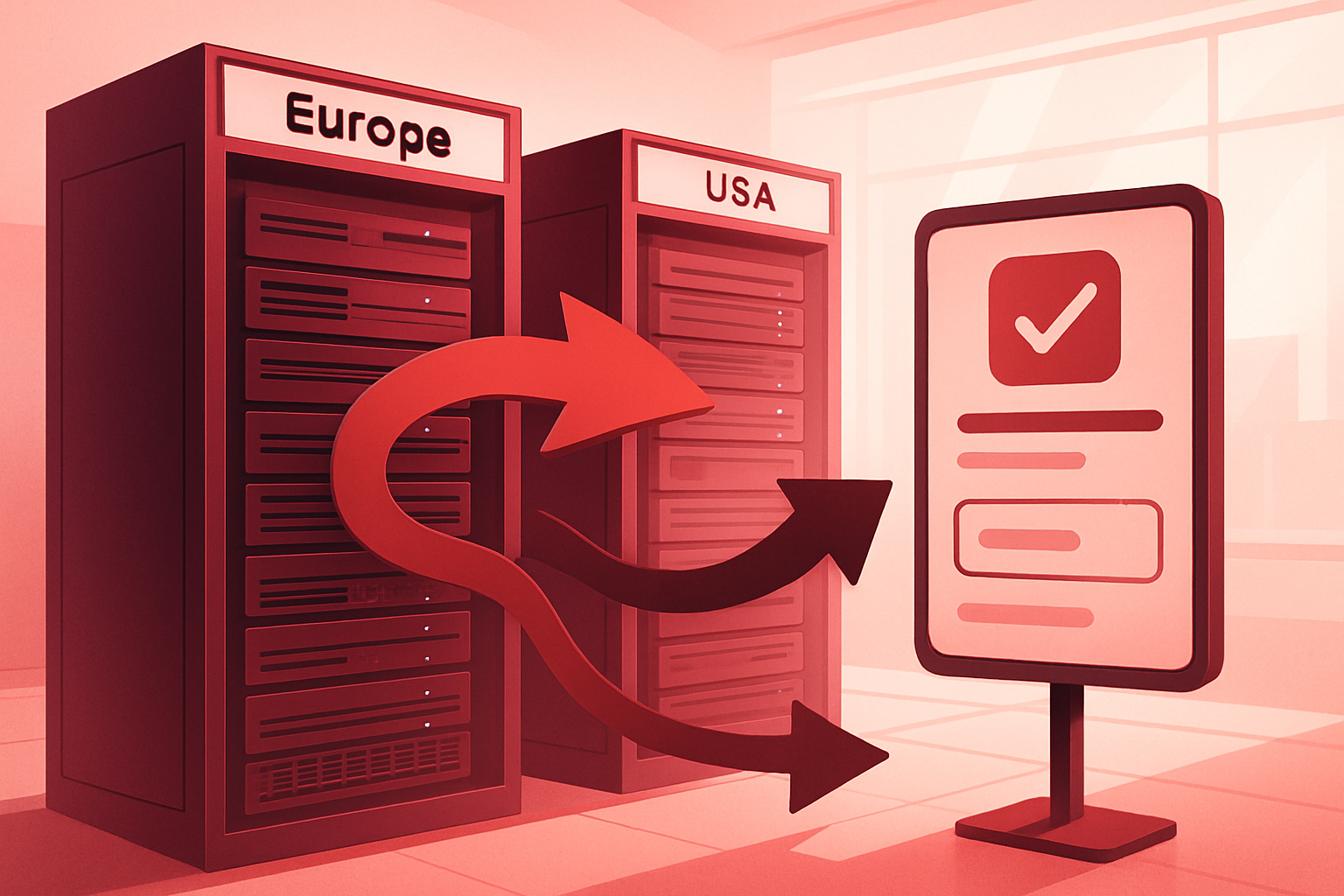
Regional inference is now generally available. Clients can send requests to a European endpoint (api.eu.mistral.ai) or an American endpoint (api.us.mistral.ai), and processing remains within that region. This is important for banks, government agencies, and insurers that must prove that customer data never leaves the EU. Shorter network paths also mean reduced latency. Anyone using the default endpoint has no guarantee regarding where their request is processed. Regional routing costs an additional 10% on top of standard rates.
EU Data Processing Comes with Significant Limits
However, among the additional tools on the platform, only function calling works with regional endpoints, meaning the model's ability to trigger external APIs. Agents, batch processing, and file management are not available at regional addresses. The selection of models also varies by region. Mistral does not publish a fixed list; clients must query each endpoint to see what is offered.
The likely reason is the gap between a simple model request and the storage of an intermediate state. A standard model call does not require persistent storage. Agents, batch jobs, and file storage retain data beyond a single call, such as intermediate steps or uploaded documents. Mistral refers to these features as "stateful." They likely require additional on-site infrastructure, although the company has not confirmed this.
The scope is also narrower than the term "sovereignty" suggests. Account settings, API keys, billing, and usage statistics can still be processed outside the chosen region, according to the documentation. The blog post also mentions limited and secure transfers to subcontractors outside the region. What is regional is the computation step, not the entire platform. Whether requests are stored or logged afterward depends on a separate setting called Zero Data Retention.
What this means in practice is that clients who send a contract text directly to a model can process it via the EU endpoint. Anyone needing agents or file management via the API Files will not benefit from the same guarantee.
Why Companies Would Pay for Faster Queues
The second offering is the Priority Tier, currently in open beta. All clients share the same data centers. When many requests arrive simultaneously, response times increase. The Priority Tier is a fast lane: requests from paying customers are processed before regular traffic when the load is high. Mistral targets use cases where latency costs real money, such as a customer service chatbot or a production system on a manufacturing site.
This tier includes a 99.5% availability SLA, a contractually guaranteed service level that allows for about three and a half hours of downtime per month. Mistral's standard tier does not offer such a guarantee.
Clients activate priority access via a single API parameter called service_tier. By setting it to "auto," the request is sent through the fast lane when capacity is available. The default is "standard_only," which follows the regular path. Each client also benefits from individually negotiated rate limits regarding the number of requests per minute that receive priority processing. Exceeding this limit does not cause the request to fail; it simply reverts to standard processing. The API response indicates which tier actually processed the request, allowing clients to verify if they are getting what they paid for.
Mistral charges 1.75 times the standard price, which is a 75% markup. Discounts from prompt caching, where repeated text segments are stored and charged at lower rates, still apply. These discounts can reach 90% and are calculated first according to the documentation, with the priority markup applied afterward. The Priority Tier is not self-service. Clients must sign a contract with Mistral's sales team.
Third-Party Models Join the Platform
Mistral is also opening its platform to open models from other providers. The first is GLM-5.2 from the Chinese AI company Z.ai, which operates under the same rules and regional guarantees as Mistral's own models. To fund the required computing capacity, Mistral collects multi-year purchase commitments from major clients, grouped as European Computing Units. The idea is that building new data centers in Europe will only be profitable if enough companies commit long-term.
Mistral is a member of the Open Secure AI Alliance and Nvidia's Nemotron coalition. The company views hosting third-party model weights on its platform as a natural extension of this work.
Brief IA — L'actualité IA en français
L'essentiel de l'actualité de l'intelligence artificielle, décrypté et expliqué chaque jour.