Fashion: A Solo Founder Orchestrates CLO and E-commerce with AI
Le brief IA que les pros lisent chaque soir
Les 7 actus IA du jour, décryptées en 5 min. Gratuit.
Inclus dès l'inscription : notre sélection des meilleurs guides & comparatifs IA.
Choisis ton rythme
Gratuit · Pas de spam · Désabonnement en 1 clic
For Yana Welinder, AI acts as a project manager overseeing specialized tools: Codex does not produce CAD files on its own but works with CLO to deliver what she expects. In the face of uncertainty, she advances both humans and the agent in parallel, particularly in the development of sewing patterns. Her organization, designed for asynchronous and voice-based work, spans from design to the e-commerce site, without a team of engineers.
Patterns and orchestration: she combines humans and AI agents
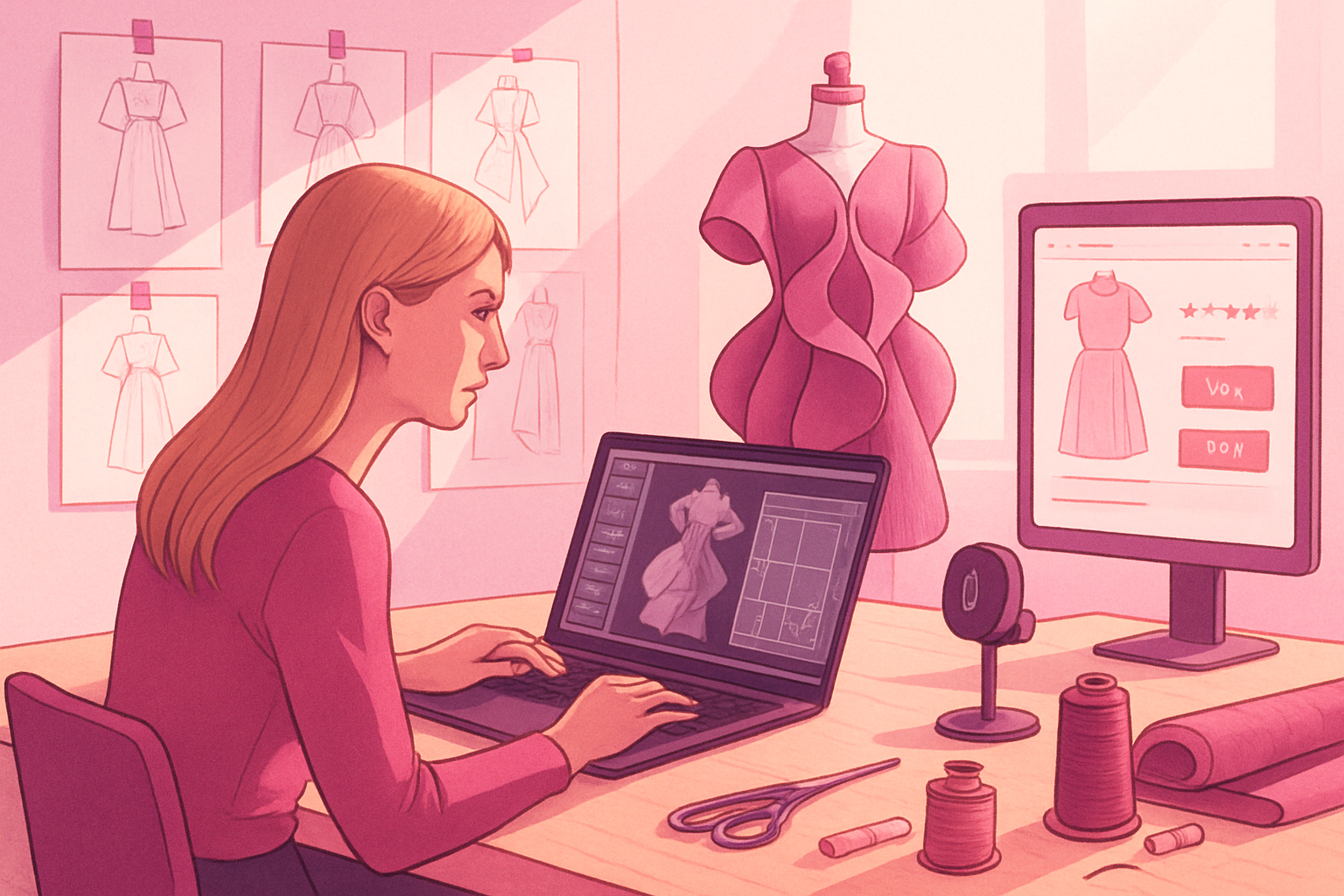
Transforming designs into precise sewing patterns remains, according to Yana Welinder, one of her toughest challenges. Rather than imposing a single path, she has human pattern makers and Codex work simultaneously, testing both approaches, comparing their deliverables, and selecting the best solution. She also points out that Codex cannot, on its own, produce a finished CAD file, whereas by operating the professional software CLO, it delivers the expected elements. She describes a recurring pattern in her workflow: the AI orchestrates, the specialized software executes, and, in her view, SaaS does not disappear but gains a new type of user. She adds that AI can continue to advance while she focuses on physical tasks, and that this asynchronous, voice-centered collaboration can significantly expand the daily output of a solo founder.
From sculptural concept to CAD: AI removes a bottleneck
Yana Welinder designed a dress inspired by Ruth Asawa, characterized by large sculptural shapes. She claims that such a piece would have been extremely difficult to produce in the past, not due to a lack of 3D printing, but because of the extensive CAD work required. She argues that AI has removed this obstacle in this specific case. Specifically, she used Codex to drive CLO and generate the required CAD files for 3D printing without prior training on the software, and confirms that by operating CLO, the agent delivered the elements she needed.
Sourcing and sales: AI covers the operational chain
Beyond design, Yana Welinder relies on AI to map manufacturers and contact them. She has also set up a complete e-commerce site, integrating voting mechanisms and payments. Her organization allows for in-depth research, stepping away to sew or drape, and then resuming work by voice, with the AI continuing to process tasks in the background, according to her. This approach is part of a solo project: Yana Bana is an AI-native fashion brand built without a team of engineers.
Specifying through prompts and choosing the right image tool
Before any image generation, Yana Welinder writes a detailed "fashion prompt" describing the silhouette, behavior, and movement of the fabric, down to the expected sound. She asserts that this upfront investment significantly improves results and believes that the ability to precisely define "the right one" helps both humans and AI, even outside of fashion. She observes that many image models produce attractive pieces but are close to existing ones, while ChatGPT Images 2.0 would remain, in her view, much truer to her sketches. In her workflow, ChatGPT and Codex are used to transform these sketches into realistic visuals and to operate professional 3D software. From this experience, she derives the idea that it may no longer be necessary to master every complex tool to achieve a professional rendering.
Brief IA — L'actualité IA en français
L'essentiel de l'actualité de l'intelligence artificielle, décrypté et expliqué chaque jour.