Meta's Muse: Rejecting Training and Its Impact on Advertising
Le brief IA que les pros lisent chaque soir
Les 7 actus IA du jour, décryptées en 5 min. Gratuit.
Inclus dès l'inscription : notre sélection des meilleurs guides & comparatifs IA.
Choisis ton rythme
Gratuit · Pas de spam · Désabonnement en 1 clic
Users of Muse have a switch to exclude their interactions from model training and options for targeted or complete deletion. Meta assures that it removes identifying information and does not directly feed its advertising systems, while warning that certain actions through Muse may alter the ads displayed. This flexibility contrasts with Instagram and Facebook, where training on public content is enabled for American adults, and full opt-out exists only in the EU.
Your actions in Muse can influence the ads displayed
Meta indicates that using Muse can affect the ads shown to the user. For example, if Muse browses a site at the user's request, that activity is considered the user's; a clothing creator can then use this visit to target an ad on Instagram. Similarly, if Muse makes a reservation at a restaurant or helps find a product on Facebook Marketplace, this can also indirectly influence the ads seen. However, Meta clarifies that it does not share conversations or Muse data present in the user's virtual machine with its advertising systems. In comparison, on Instagram and Facebook, Meta uses public content from American adult users to train its models, and only the European Union offers a true opt-out option.
Disable training and delete your interactions in Muse
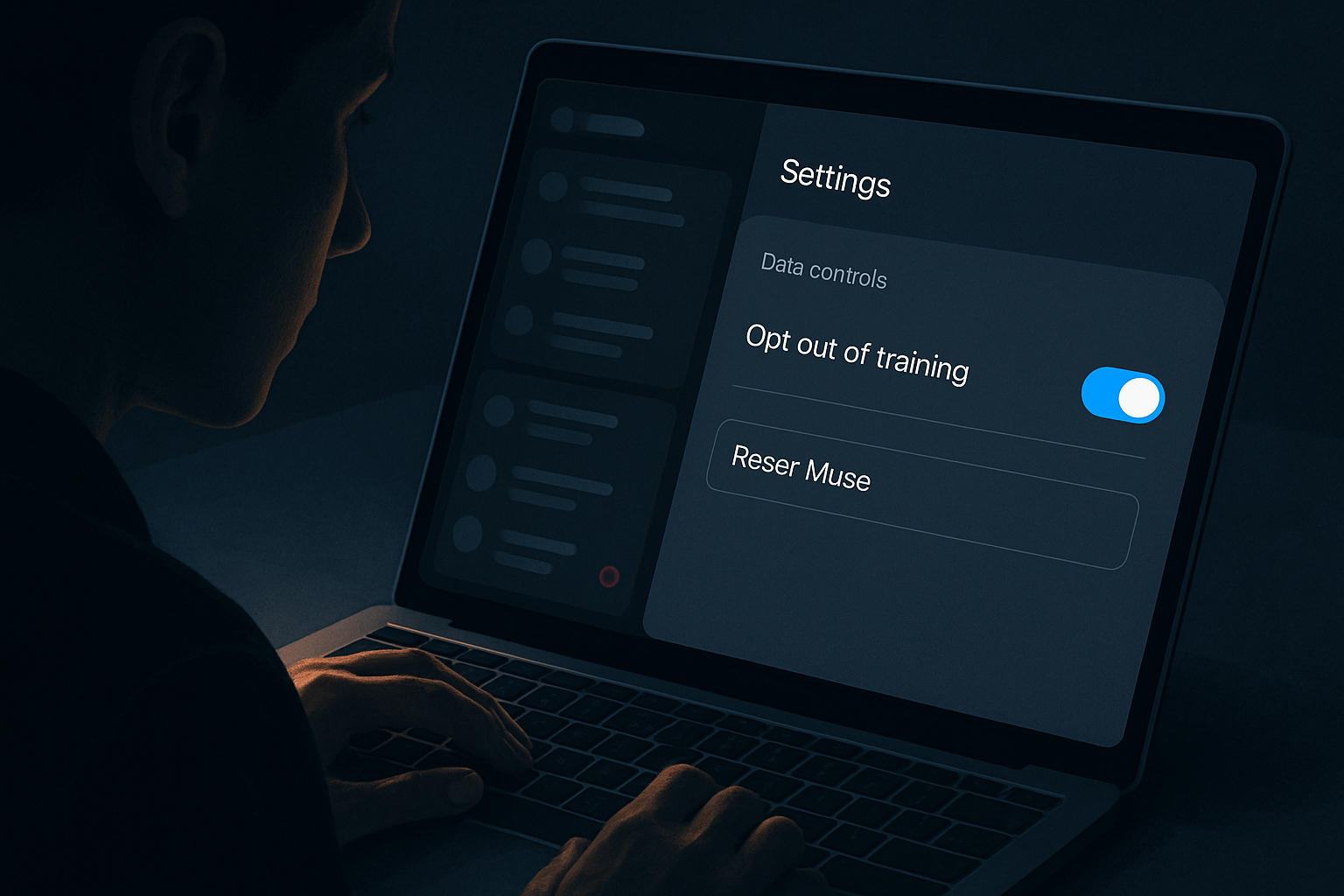
Muse allows users to refuse having their discussions used for model training. To do this, one must click the button at the bottom of the sidebar, access Settings, then Data Controls, and turn off the switch labeled "Help improve our AI models." Other control options are available: the "Reset Muse" option, located on the same screen, allows for the permanent deletion of all information, including chat history, files, and active tasks, according to Meta. It is also possible to delete individual discussions by selecting them in the sidebar and then choosing "delete."
What Meta claims to filter and its justification for the default setting
Meta states that it removes personally identifiable information, such as names, email addresses, phone numbers, and social security numbers, before using user interactions for training. The company believes that the default setting, which allows training, is beneficial as it helps improve Muse for everyone as the product is used collectively. Meta reminds that those who do not wish to participate can opt out via a simple switch in the Muse settings. Muse is Meta's artificial intelligence agent, which has recently gained popularity.
Brief IA — L'actualité IA en français
L'essentiel de l'actualité de l'intelligence artificielle, décrypté et expliqué chaque jour.