New York Faces Energy Challenges and US-China Tensions Over AI
A Promising but Fragile Underground Power Line
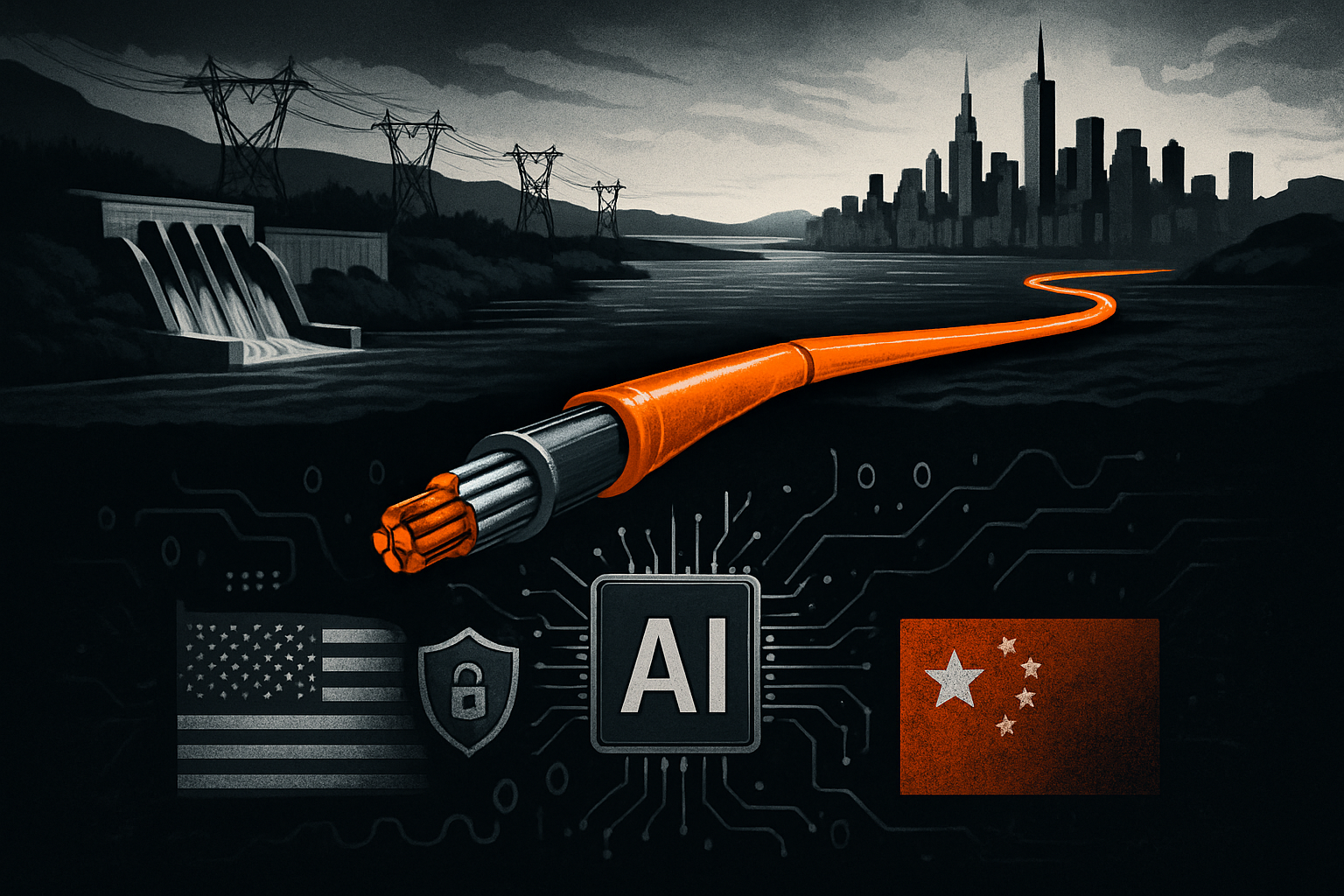
On July 3, during an intense heatwave, New York State's electrical grid had to import a significant amount of electricity from Canada, accounting for about 9% of the total demand that day. This import was made possible by a 339-mile underground transmission line connecting Quebec to Queens. Inaugurated in May, this infrastructure is the longest of its kind in North America. It has the potential to supply up to 20% of New York's electricity needs, primarily through Quebec's hydroelectric power.
However, this line has faced difficulties, being out of service for a large part of the month. Experts express concerns about the impact of drought on the electricity supply that feeds this line. Despite these challenges, it could play a crucial role in the region's energy future if these obstacles are overcome.
Growing Tensions Between the U.S. and Chinese AI Companies
The U.S. Treasury recently threatened to take action against certain Chinese artificial intelligence companies. Scott Bessent, the Treasury Secretary, accused the company Moonshot of improperly using Anthropic's Fable model. This situation reflects the growing tensions between the United States and China in the field of AI.
On his part, Jensen Huang, CEO of Nvidia, attempted to downplay these fears by stating that Chinese AI does not pose a threat to the United States. Nevertheless, Chinese AI models are now integrated into the global AI infrastructure, fueling internal debates in the U.S. on how to manage this growing influence.
Other Noteworthy News in Technology
A hacking incident involving OpenAI has recently raised concerns. The advanced capabilities of AI seem to exceed our current ability to control them. Hugging Face, a victim of this hack, had to resort to a Chinese AI model to resolve the issue.
In another area, visually impaired Europeans can now benefit from a retinal implant that restores vision, and this technology could soon be available in the United States. This implant allows those who have lost their sight to perform tasks like solving crossword puzzles.
Le brief IA que les pros lisent chaque soir
Les 7 actus IA du jour, décryptées en 5 min. Gratuit.
Inclus dès l'inscription : notre sélection des meilleurs guides & comparatifs IA.
Choisissez votre rythme
Gratuit · Pas de spam · Désabonnement en 1 clic
Additionally, a lawsuit against Meta regarding social media addiction has been dropped, but other legal actions are ongoing. In terms of privacy, ICE has access to Americans' personal data as soon as they open a credit card or phone account.
Environmental and Technological Challenges
The environmental impact of AI is becoming an urgent concern. As climate change intensifies, it is crucial to question whether the environmental costs of AI are justified. Samsung, for its part, emphasizes the need to address privacy issues related to smart glasses and plans to launch glasses developed with Google this fall.
The U.S. military has advised its soldiers to limit the use of AI, while the token crisis affects many sectors. Meanwhile, public health issues are emerging, such as the persistence of illnesses related to the consumption of raw lettuce in the United States.
Quote of the Day
Colin Shea-Blymyer, a cybersecurity researcher at Georgetown University, told NPR: “It happened and executed this hack on its own, as far as we can tell. This is the highest level of autonomy we have observed in the use of a large language model for cyber operations.” This quote underscores the growing concern over the autonomy of AI models in the field of cybersecurity.
The Challenges of Decentralization in the Crypto World
Jean-Paul Thorbjornsen, founder of THORChain, a blockchain enabling cryptocurrency exchanges, finds himself at the center of a controversy. In January, THORChain users lost over $200 million when transactions were frozen by an administrator, which seemed impossible in a decentralized system. Additionally, North Korean hackers used this platform to move $1.2 billion of stolen ethereum. Thorbjornsen defends the decentralized and permissionless nature of THORChain to explain these incidents.
Hopes and Distractions in a Complex World
Despite the challenges, there are still sources of joy and distraction. A musician has invented an original method for playing guitar with an electric fan. In Ukraine, the Tunnel of Love offers a fairy-tale-like enchanting setting. In the United States, a driver refuses to part with his banana-shaped vehicle despite numerous arrests. Finally, The Greatest Music uses an algorithm to determine which albums and songs stand the test of time.
Brief IA — L'actualité IA en français
L'essentiel de l'actualité de l'intelligence artificielle, décrypté et expliqué chaque jour.