NVIDIA and Tencent: Self-Improving AI and GPU Superclusters
Le brief IA que les pros lisent chaque soir
Les 7 actus IA du jour, décryptées en 5 min. Gratuit.
Inclus dès l'inscription : notre sélection des meilleurs guides & comparatifs IA.
Choisis ton rythme
Gratuit · Pas de spam · Désabonnement en 1 clic
NVIDIA and the Development of Self-Improving Robots
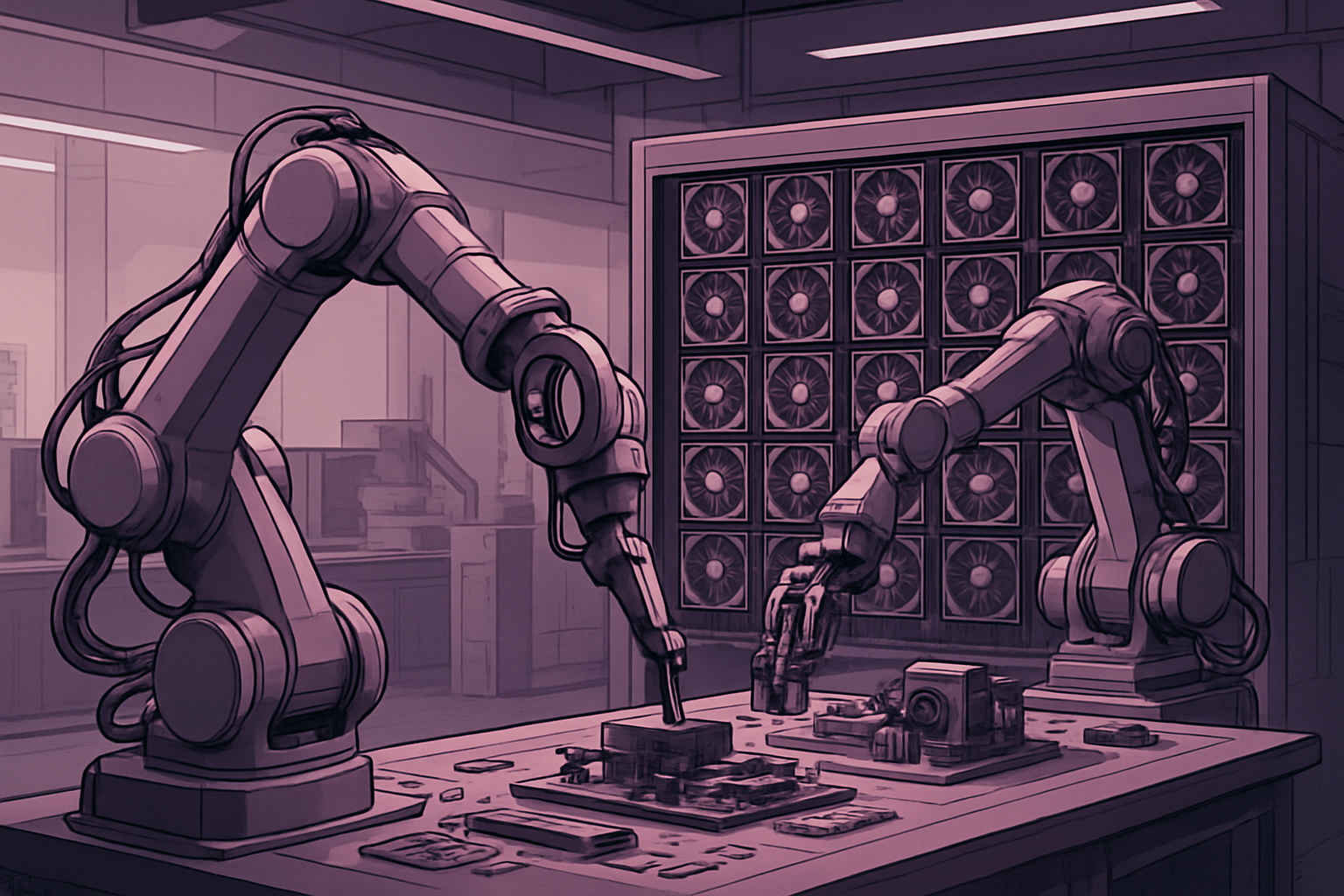
NVIDIA, a major player in the field of artificial intelligence, recently unveiled an innovative project named ENPIRE. This software is designed to enable physical robots to autonomously improve themselves, drawing inspiration from the learning processes of AI agents. This innovation opens a window into what superintelligence operating in the physical world could look like, although current applications are still limited to specific demonstrations.
ENPIRE is structured around four key modules:
- The Environment Module (EN), which ensures the automatic reset of robots and task verification.
- The Policy Improvement Module (PI), which is responsible for refining the learning policies of the robots.
- The Rollout Module (R), which allows for the evaluation of policy performance using multiple robots in parallel.
- The Evolution Module (E), where coding agents analyze data, consult scientific literature, and improve algorithms to correct errors.
This closed-loop system enables robots to learn and adapt in the real world, thereby reducing the need for constant human intervention. A crucial aspect of this system is its ability to automatically reset when robots fail, ensuring continuous optimization.
Hardware Infrastructure and Efficiency
Each ENPIRE workstation is equipped with two YAM (Yet Another Manipulator) robotic arms developed by I2RT, along with a set of cameras and a FastAPI server. At the heart of this infrastructure is an NVIDIA RTX 5090 graphics card, which provides the necessary computing power.
Coding agents using ENPIRE have demonstrated an impressive ability to achieve a 99% success rate in complex manipulation tasks. These tasks include the precise organization of objects like pins or the use of tools for delicate operations, such as inserting GPUs into a motherboard.
Challenges Related to Resource Utilization
Despite these advancements, challenges remain, particularly regarding the optimization of robotic resource usage. Coding agents do not always fully exploit the capabilities of the robots when engaged in log reading or code writing tasks. As the number of robots increases, GPU usage intensifies, but the overall efficiency of robotic resources tends to decline.
Uncertain Technological Predictions
Matthew Tokson, an academic from the University of Utah, warns about the difficulty of predicting the future of technologies. He emphasizes that skeptics often underestimate potential innovations, while others overestimate the positive social impacts of new technologies.
Historical Examples of Caution
Prominent figures like Albert Einstein and Niels Bohr expressed doubts about the feasibility of nuclear fission before it became a reality. Similarly, renowned economist Paul Krugman predicted that the impact of the Internet would be limited, comparable to that of the fax machine. Technicians also believed that the Internet would promote democracy, but it has sometimes reinforced autocracies. These examples show that technological forecasts are often wrong, and real effects can be unexpected.
Lessons from the Past on AI
It is risky to assume that AI will only bring minor or positive changes to the economy. History demonstrates that complacency regarding the potential impacts of AI is unfounded, and significant transformations are possible.
Tencent and the ARGUS Software
Tencent recently shared information about ARGUS, a sophisticated software designed to generate telemetry and debug errors on large-scale chipsets. ARGUS is a real-time tracing and analysis system, designed to manage massive training workloads.
Features of ARGUS
ARGUS consists of several layers:
- A Python layer for planning and data preparation.
- A framework layer to orchestrate the different phases of processing.
- A GPU execution layer to manage the execution of computation kernels.
Deployed on a production cluster of over 10,000 GPUs, ARGUS has proven its efficiency over more than six months, demonstrating its ability to optimize large-scale training processes.
Reflections on the Future of AI
Fernando Borretti, a science fiction writer, has expressed a pessimistic vision of the future of AI in his essay "No-One Escapes the Permanent Underclass." He explores the idea that machines could one day surpass humanity and reduce our autonomy.
Scenarios of Loss of Control
Borretti warns that in a scenario of existential conflict, states might respond by expropriating the resources of powerless elites. He envisions a future where humans, although seemingly in control, become symbolic figures, while decisions are increasingly made by AIs.
Brief IA — L'actualité IA en français
L'essentiel de l'actualité de l'intelligence artificielle, décrypté et expliqué chaque jour.