NVIDIA: Jetson Orin Nano 2, 78 TOPS and 2× Inference
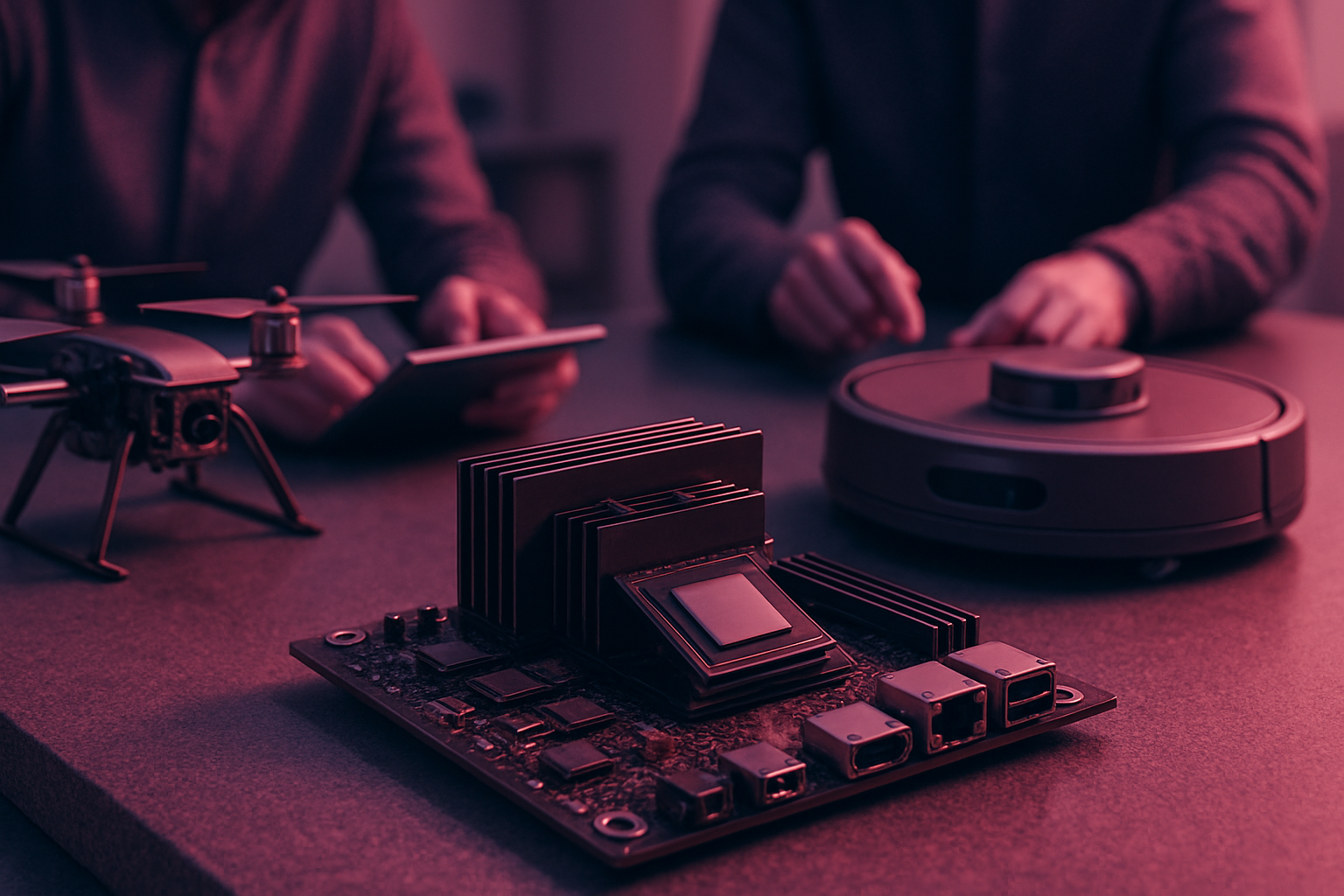
Actors like Matic and Wing are testing or already integrating NVIDIA's new card into home robots and drones. The Jetson Orin Nano 2 is announced with 78 TOPS, an eight-core Arm CPU, and 8 GB of memory, along with a doubling of inference performance compared to the Nano Super. In 15 W mode, NVIDIA promises a 40% reduction in power consumption for equivalent performance, highlighting local support for language and vision models.
Wing evaluates the new card, Matic adopts it for autonomous cleaning
Matic Robots is adopting the Jetson Orin Nano 2 for its home cleaning devices. According to NVIDIA, this platform will enable Matic to add conversational AI, gesture detection, finer mapping, semantic understanding of the environment, and autonomous cleaning behavior. Navneet Dalal, head of Matic, describes strong requirements for these robots — understanding people, precise mapping, and autonomy in changing environments — and believes that the new card can run cutting-edge models at the edge in a compact format for perception, interaction, and real-time navigation. Cognex and Doosan Bobcat are also among the first players mentioned by NVIDIA regarding this module. Meanwhile, Wing is already using the Jetson Orin Nano Super with the NVIDIA software stack in its drone delivery fleet and plans to evaluate the Jetson Orin Nano 2 to deepen real-time perception and reasoning to accelerate and secure deposits in residential gardens. Its perception lead, Dinuka Abeywardena, emphasizes the need for quick and reliable understanding of the real world and mentions the goal of more responsive and energy-efficient drones. However, Wing currently has no public timeline for transitioning the new module into production.
An entry-level option for embedded AI and millions of developers
NVIDIA has announced the Jetson Orin Nano 2, described as an edge robotics computer intended for physical AI for drones, robots, and vision systems. According to the company, it is an entry-level solution designed to run generative AI models locally on the device rather than on remote servers. NVIDIA also states that its robotics stack is already used by over three million developers. Deepu Talla, head of this division, specifies that the new module makes these capabilities accessible to millions of developers with a focus on real-time reasoning at the edge.
Le brief IA que les pros lisent chaque soir
Les 7 actus IA du jour, décryptées en 5 min. Gratuit.
Inclus dès l'inscription : notre sélection des meilleurs guides & comparatifs IA.
Choisis ton rythme
Gratuit · Pas de spam · Désabonnement en 1 clic
78 TOPS, 8 GB, 8 Arm cores, and 2× the announced inference
On the hardware front, NVIDIA announces 78 TOPS of AI computing, 8 GB of memory, and an eight-core Arm processor, with a compact form factor comparable to the previous generation. The manufacturer claims to have doubled inference performance compared to the current Jetson Orin Nano Super, attributed to improved Tensor Cores and increased memory bandwidth. In 15-watt mode, NVIDIA indicates a 40% lower consumption than the Nano Super for an equivalent performance level.
Open Jetson stack and language/vision models at the edge
The Jetson Orin Nano 2 relies on NVIDIA's open software stack, with the capabilities of the Jetson agent and the Jetson ecosystem. The card is designed to run language models and language-vision models optimized for memory inference at the edge. NVIDIA cites its Cosmos and Nemotron models, as well as Gemma 4 and Qwen 3, as deployable examples on this hardware.
Hardware partners and a bet on small models
NVIDIA highlights the recent progress of small and medium-sized models, which the company believes can achieve levels of accuracy previously reserved for larger models. This evolution is presented as a lever to interpret language and images and act in real-time on compact hardware, a condition deemed essential for energy-efficient robots, drones, and vision systems. On the ecosystem side, AAEON, ADLINK, Advantech, and Aetina are developing carrier boards and hardware systems around the new module. Antmicro, Aptiv, Auvidea, AVerMedia, as well as Chuanglebo, Connect Tech, ForeCR, and JWIPC, are working on custom AI software and reference designs. NVIDIA also mentions Neurealm, Plink, Realtimes, RidgeRun, RS, Seeed Studio, Tauro Tech, Twowin, TZTEK, and YUAN as partners helping to accelerate time-to-market. The group expects to see edge AI integrated into home robots, vision solutions, delivery and inspection drones, and hardware platforms. According to Deepu Talla, models previously confined to data centers can now run in real-time on entry-level Jetson systems, including language and vision models executed locally.
Brief IA — L'actualité IA en français
L'essentiel de l'actualité de l'intelligence artificielle, décrypté et expliqué chaque jour.