Nvidia Launches Flora for Low-Cost Robotic Video Annotation
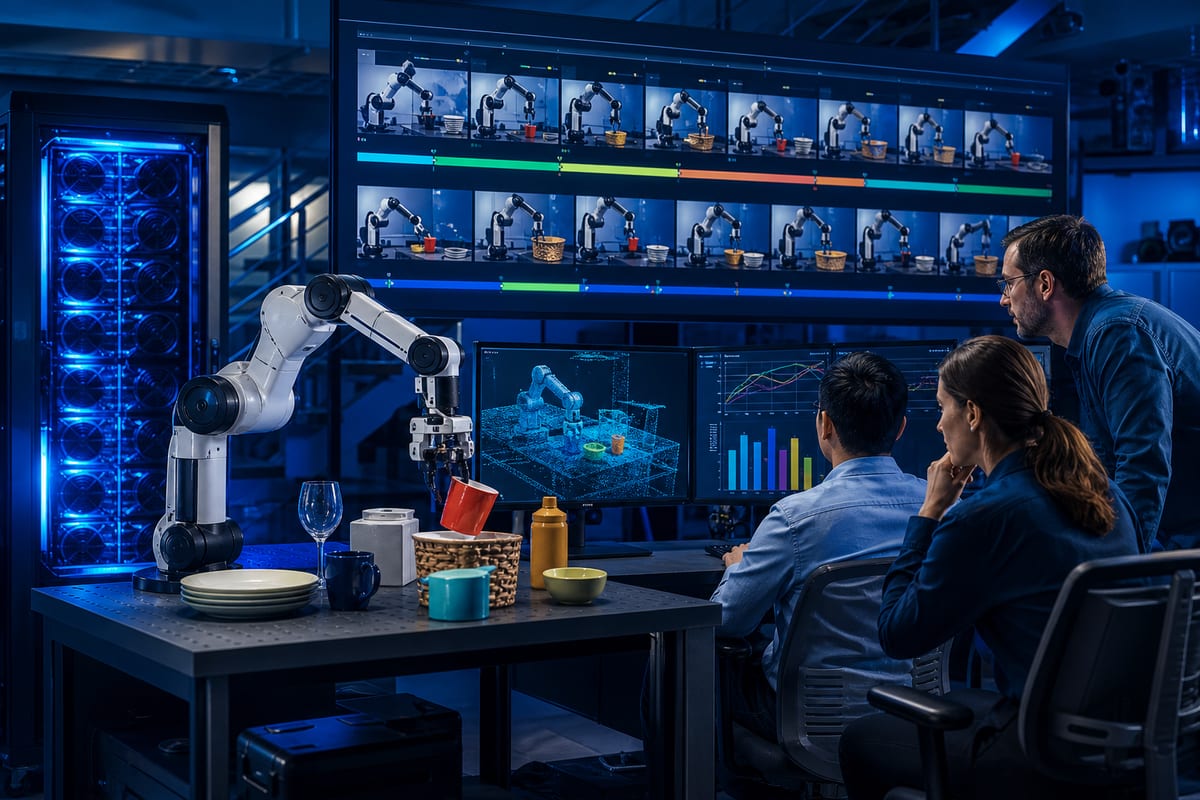
Nvidia has made Flora, a video annotation engine designed for robotics, publicly available. The company projects costs of $0.72 per hour and claims net advancements in action detection and episode evaluation, while acknowledging discrepancies based on benchmarks and trade-offs regarding false positives.
Tests Pitting Flora Against Astra with Targeted Gains and Possible Biases
On WGO-Bench, Flora excels in detecting action boundaries, although it falls behind GPT-6 Astra in overall score and behind Gemini 3.8 Flash for description accuracy. Researchers attribute the gains primarily to temporal localization. On DenseCaptionBench, Flora ranks first for human recordings but comes in second behind Astra for robot videos. Researchers point out a methodological issue, as GPT-6 Astra is involved in both the evaluation of descriptions and is among the models being evaluated. Flora outperforms its competitors for human recordings, result appreciation, and step-by-step evaluations, while Astra maintains an advantage on WGO-Bench, robot videos, and criterion-based evaluations. On RoboRewardBench, Flora shows a 27.8% lower error rate compared to Astra, particularly in situations where tasks are only partially completed, with Flora awarding 3 points out of 5 while Astra only grants 1. Flora-Rewarder detects 53.3% of failed steps within an episode, while no competitor exceeds 11.7%, and Astra detects none. The downside is an over-reporting of about 11% of normal steps as errors. Astra remains better ranked for criterion-based ratings and trajectory ranking. In a sequence rich in short hand movements, Flora identifies 34 actions out of 37, while Astra only recognizes four, but Flora sometimes over-segments and can mislabel its descriptions, such as confusing plate wiping with napkin folding.
Projected Costs at $0.72/h and Claimed Quality at 57.1%
In a test involving 50 videos, Nvidia indicates that Flora achieves slightly better results than GPT-6 Astra, the latter utilizing its full reasoning capabilities. The company estimates the annotation cost at approximately $0.72 per hour with Flora, compared to about $88.50 with GPT-6 Astra, and reports that Claude Opus 5 performs worse while costing around $42 per hour. Nvidia announces an annotation quality of 57.1% at the cost of $0.72 for Flora, versus 53.7% at $88.49 for GPT-6 Astra. These amounts remain projections, calculated by Nvidia based on an assumed price of $10 per GPU per hour, and do not constitute production measurements.
Le brief IA que les pros lisent chaque soir
Les 7 actus IA du jour, décryptées en 5 min. Gratuit.
Inclus dès l'inscription : notre sélection des meilleurs guides & comparatifs IA.
Choisissez votre rythme
Gratuit · Pas de spam · Désabonnement en 1 clic
Three Qwen3.5 Models for Segmenting, Describing, and Rating
Flora relies on three distinct Qwen3.5 models. One model with 9 billion parameters handles action segmentation, while another model with 27 billion parameters focuses on generating contextual descriptions. A third model of 27 billion, named Flora-Rewarder, assigns a rating from 1 to 5 based on the success of an episode, labels each half-second of execution as normal, suboptimal, or failed, and provides scores according to the criteria specified in the prompt. A model specialized in segmentation and another for captions produce descriptions associated with timestamps, while a single reward model performs three types of analyses. The system aims to slice videos temporally, provide action descriptions, and evaluate both the execution and the outcome of episodes. Nvidia asserts that these components cover the three necessary label families.
Announced Large-Scale Internal Use and Availability
Nvidia states it uses Flora for training its GR00T models, with a reported capacity of up to 200,000 hours of annotated video per day across 512 GPU GB300. Models related to Flora are available on the Hugging Face platform.
Positioning Against Commercial Services and Data Strategy
Flora is presented as an open alternative to commercial offerings such as Scale AI's Physical AI Data Engine, enabling research teams to expand their datasets and explore approaches like transferring human demonstrations to robots. Nvidia links this release to its investments in open models and a longer-term effort to address the scarcity of training data through simulation and automation of processing. At the GTC earlier this year, the company showcased a pipeline that automatically prepares, multiplies, and evaluates data, to which Flora adds detailed labels and reward signals derived from videos. This approach fits into a strategy encompassing hardware, data, simulation, and models. In the same usage scope, Google offers Gemini 4 Argon, designed to identify steps in training videos and signal failed actions. According to Nvidia, the needs cover three types of annotations, which are not adequately addressed together by current tools, and the large models capable of producing them remain costly for very large volumes.
Brief IA — L'actualité IA en français
L'essentiel de l'actualité de l'intelligence artificielle, décrypté et expliqué chaque jour.