OATs: An Expressive AI Avatar for Everyday Objects
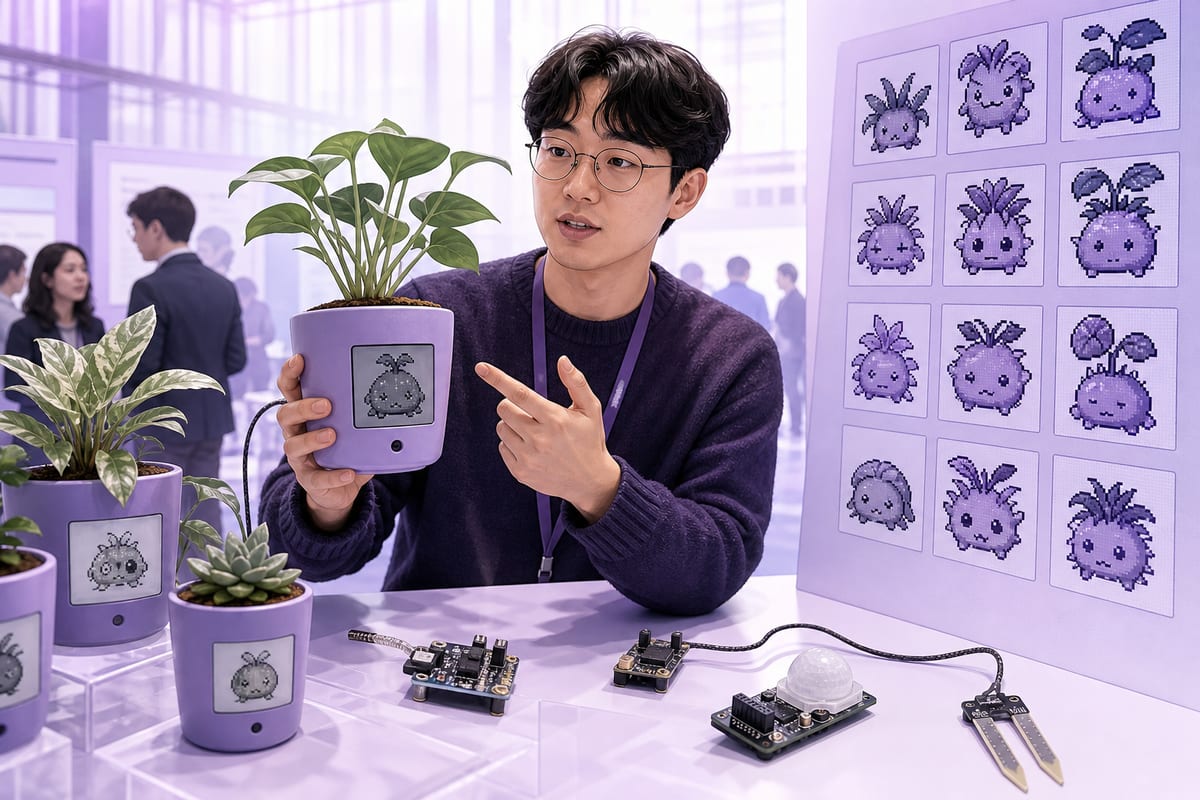
Researchers at Carnegie Mellon are testing OATs, an AI avatar that attaches to an object and expresses its "mood" based on sensors. The prototype impressed during demonstrations, while maintaining limited autonomy and reigniting the debate on anthropomorphism in AI.
Short Autonomy and Limited Interactions Announced by Kim
The OATs system boasts an autonomy of three to four days. When paired with a sound level sensor, it lasts only one day. The modules recharge via USB-C and use a lithium-ion polymer battery. Daehwa Kim notes that interactions have been intentionally limited to the emotions displayed on the E Ink screen.
Observed Uses: Activity, Alerts, and Self-Monitoring
Daehwa Kim reports three recurring ways to use OATs. First, to know if an object is in use, such as a coffee machine that makes the avatar react when the grinding starts. Second, to alert nearby individuals when an object is operating, like a 3D printer known for its fumes, through the visible avatar. Finally, to motivate daily activities, such as an OAT attached to a dumbbell to track workout frequency. A simple case mentioned involves a skateboard: without detected movement for a few days, the avatar appears sad; once used, it displays joyful expressions.
Architecture and Configuration: Sensors, E Ink, and Module Cost
Each OAT combines an E Ink screen and internal or external sensors capable of measuring humidity, temperature, soil moisture, light, presence, and movement. The avatar sprites are generated with Google Gemini's Nano Banana, which produces emotions based on detected states. Configuration is done through a web portal that allows users to name the avatar and select relevant sensors for the targeted object. The application generates "positive" and "negative" behaviors based on the name and description of the object, with the option to adapt these rules, for example, to the type of plant. The main hardware module costs about $20.
Le brief IA que les pros lisent chaque soir
Les 7 actus IA du jour, décryptées en 5 min. Gratuit.
Inclus dès l'inscription : notre sélection des meilleurs guides & comparatifs IA.
Choisissez votre rythme
Gratuit · Pas de spam · Désabonnement en 1 clic
Anthropomorphism Debate: Industry Practices and Design Choices
The demonstration sparked a discussion about attributing human traits to avatars. In the industry, anthropomorphized terms like "hallucinate" are used to describe chatbots, and Anthropic has introduced a "dream" function where its agent cleans its local memory in the background. Such vocabulary can influence moral judgments and increase unwarranted trust. Daehwa Kim believes that anthropomorphism can help modify certain behaviors, noting that people easily name a car or a bike, but less so a smartphone, while calling for caution. She anticipates more relationships between users and AI in the future.
Positioning: Award-Winning Prototype, Active Demonstration, and Open Commercial Perspective
Presented in early November in Detroit at an ACM symposium, the project received two honorable mentions and attracted many visitors. An idea competition was organized, and an online gallery showcases sprites created by the public, from the animated conference badge to the panda avatar of an Owala water bottle. Kim aims to transpose the attachment of virtual pets to physical objects, shifting attention beyond smartphones. While some encourage her to commercialize kits, no decision has been made. The OATs remain a device of AI avatars on small E Ink screens, designed to attach to everyday objects and interact with their states.
Context of Mentioned Physical AI Gadgets
The project is part of a sequence of devices giving a body to AI, including attempts like the Humane Ai Pin, upcoming hardware designed with Jony Ive for OpenAI, and Meta's Muse Charm expected in December for the Muse agent. This wave also leverages "cuteness" as a driver for adoption.
Brief IA — L'actualité IA en français
L'essentiel de l'actualité de l'intelligence artificielle, décrypté et expliqué chaque jour.