UN and Google Launch Data Portal for AI Agents
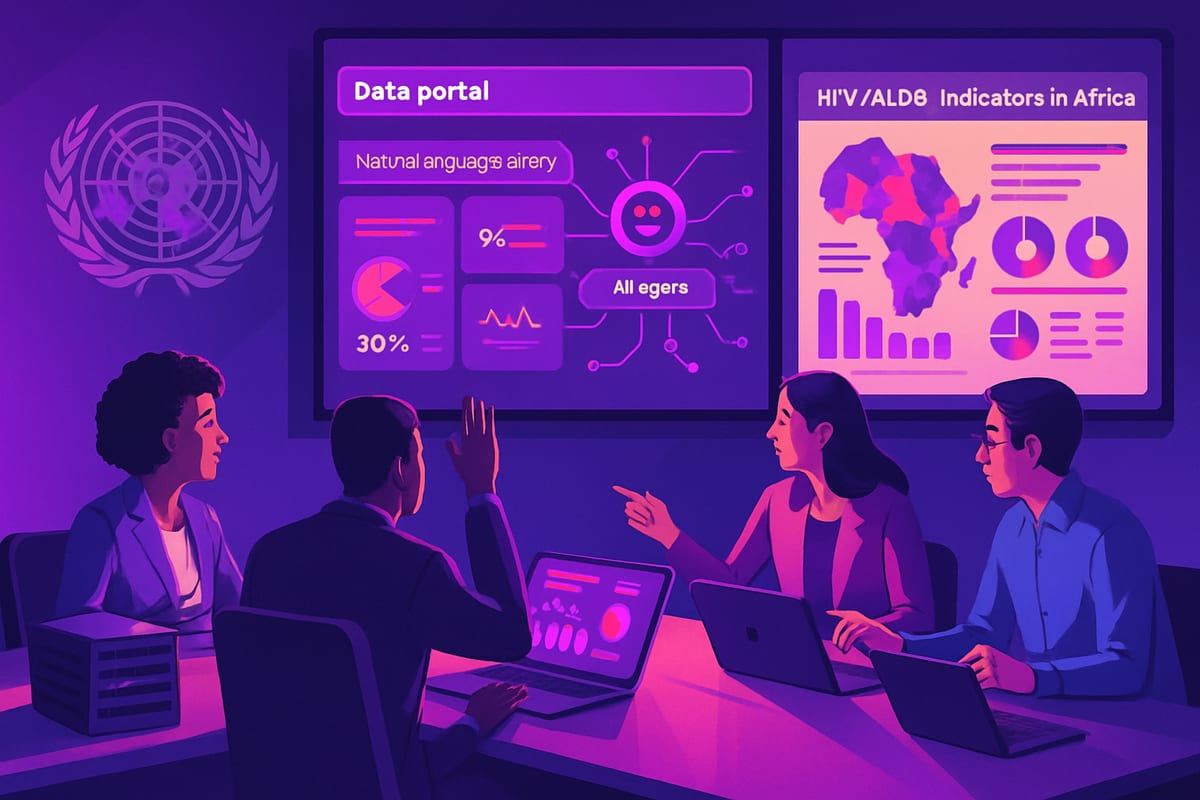
The UN launches UN System Data Commons, a portal based on Data Commons and compatible with MCP to make its statistics queryable in natural language and by AI agents. Hosted under UN governance, it aims for 80% of statistical datasets by 2027, with support of $2 million from Google.org. This shift comes as tests conducted by UNICEF reveal an average accuracy of 21.2% on factual questions, and Google emphasizes the need for human review.
Human Validation of Conclusions and Integrated Traceability
Prem Ramaswami, head of the Data Commons team at Google, emphasizes that providing authorized data to an AI system does not guarantee the validity of its conclusions and recommends that a human verify the results before any citation or publication. The platform allows for tracing each statistic back to its original UN source. Google has also demonstrated that an agent connected via the MCP can aggregate multiple indicators and generate dashboards, charts, and written analyses without manual intervention for data set searches. During a demonstration, an AI system used metrics such as HIV infections, AIDS-related mortality, and life expectancy to produce an infographic on the impact of PEPFAR in Africa.
Natural Language Search and Access via MCP for AI Agents
Named UN System Data Commons and built on Google’s open-source Data Commons platform, the new portal allows querying UN agency statistics in natural language. This portal replaces the UNData site, which previously used a traditional database interface. Compatibility with the Model Context Protocol allows for a direct connection of AI systems to external data sources. Data Commons was launched by Google in 2018 to structure public datasets from multiple origins, and the support for MCP, added last year, now enables agents to directly query statistics and their sources.
UN Governance, Dedicated Funding, and 2027 Goal
The system is hosted on an instance governed by the UN and designed to be maintained, operated, and evolved independently by the organization, according to Prem Ramaswami. Google has adopted a train-the-trainer approach during deployment, with the UN team quickly gaining expertise. Google.org has provided $2 million for capacity building and technical support for the underlying infrastructure. Currently, 26 UN entities are involved, and nearly 20 agencies are providing data at launch. The platform aims to host 80% of the statistical datasets of the UN system by 2027. According to Shantanu Mukherjee, acting director of the UN Statistics Division, this project represents a significant advancement in scale, scope, and flexibility, connecting so many agencies for the first time and making the data actionable by AI.
Le brief IA que les pros lisent chaque soir
Les 7 actus IA du jour, décryptées en 5 min. Gratuit.
Inclus dès l'inscription : notre sélection des meilleurs guides & comparatifs IA.
Choisissez votre rythme
Gratuit · Pas de spam · Désabonnement en 1 clic
Rising Demand and Current Model Limitations Assessed by UNICEF
According to João Pedro Azevedo, an evaluation conducted by UNICEF on six major language models and over 133,000 responses to questions related to global development indicators revealed an average accuracy of 21.2%. The evaluation included OpenAI's GPT-4o and GPT-4o-mini, Anthropic's Claude Sonnet 4.5 and Haiku 4.5, as well as Google’s Gemini 2.5 Flash and Gemini 2.0 Flash. About three out of five responses did not provide usable figures, often because the models nuanced their answers. When the same questions were posed two days later to the same versions, the numbers obtained coincided only about half the time among comparable cases. The report corresponds to a working paper being prepared for submission to a journal, having not yet undergone peer review; the organization plans to make its methodology, as well as its code and data, public upon publication. Furthermore, UNICEF's data site records over 6 million monthly visits and is among the agency's most frequented platforms. Between January 1 and September 14, the number of visits from links in ChatGPT responses to the site increased by 67%, representing 6.4% of all sessions during that period, with UNICEF estimating that about one in ten visits now comes from AI assistants. João Pedro Azevedo highlights the importance of preparing reliable channels as these uses become more widespread.
Brief IA — L'actualité IA en français
L'essentiel de l'actualité de l'intelligence artificielle, décrypté et expliqué chaque jour.