OpenAI Enhances GPT-5.6 Sol and Restricts Free Access to Luna
Le brief IA que les pros lisent chaque soir
Les 7 actus IA du jour, décryptées en 5 min. Gratuit.
Inclus dès l'inscription : notre sélection des meilleurs guides & comparatifs IA.
Choisis ton rythme
Gratuit · Pas de spam · Désabonnement en 1 clic
OpenAI Improves GPT-5.6 Sol and Restricts Free Access to Luna
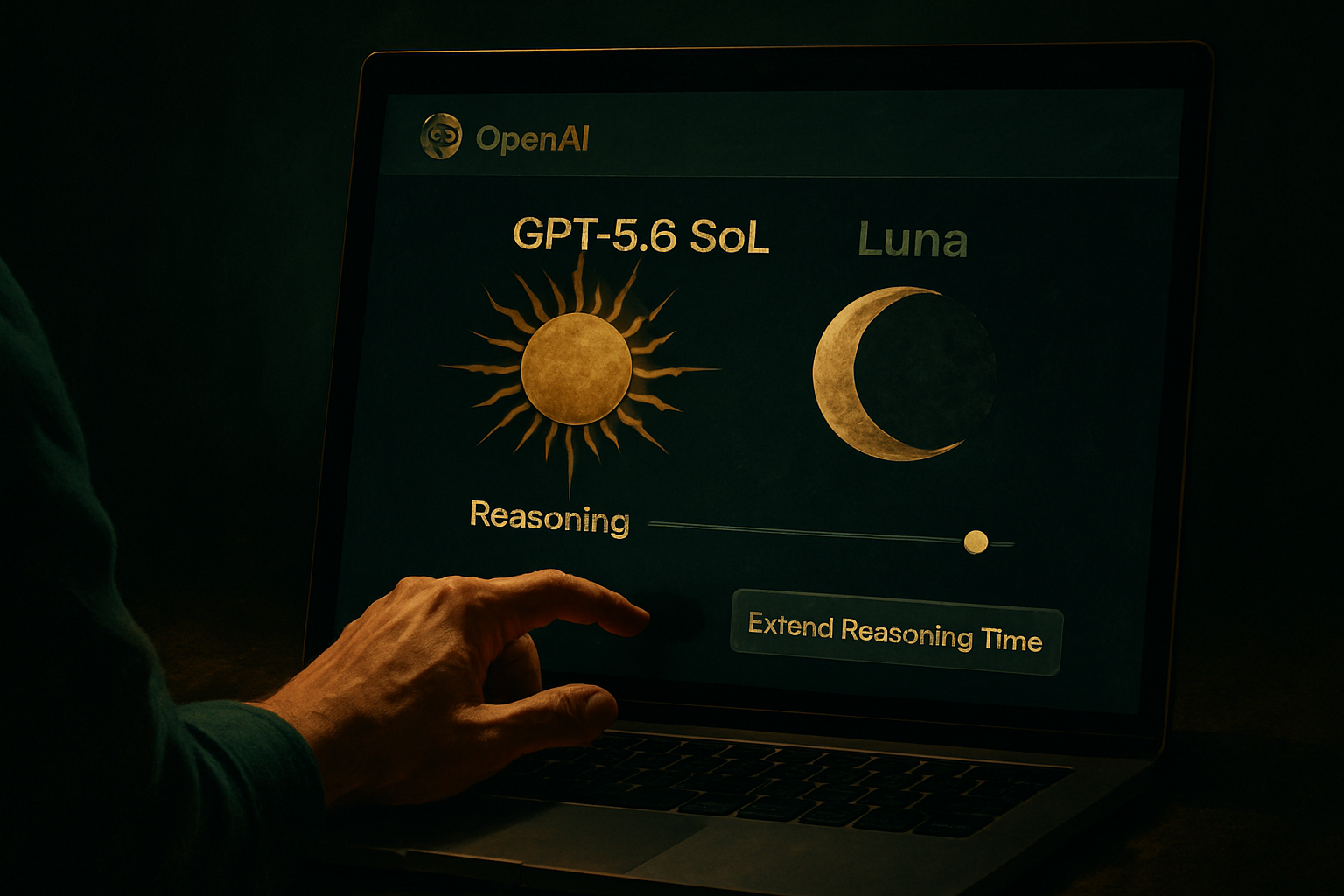
OpenAI is offering Plus and Pro users a more targeted GPT-5.6 Sol along with a slider to adjust the depth of responses. Free users will benefit from unlimited text conversations with the less powerful GPT-5.6 Luna model.
OpenAI claims that GPT-5.6 Sol now eliminates unnecessary details and excessive formatting. For simple questions, it provides a straightforward answer with just the right amount of context, while for more complex tasks, it offers a more comprehensive response while making the key recommendation easy to spot.
The company also claims improved factual accuracy. In an internal evaluation using queries in finance, medicine, and law, responses containing at least one factual error decreased by about 62% for GPT-5.6 Luna and 68% for GPT-5.6 Sol compared to GPT-5.5 Instant. These figures have not been independently verified.
The update only applies to ChatGPT. GPT-5.6 Sol remains unchanged in ChatGPT Work and Codex.
Paying Users Get More Control Over Reasoning
A new slider allows paying users to adjust the effort that ChatGPT puts into a response. Lower settings are suitable for everyday questions, while higher settings are intended for planning, research, and programming. The slider was already available in ChatGPT Work.
OpenAI wants quick responses and in-depth reasoning to seem like they come from a single model rather than two with different tones. An OpenAI developer recently explained which setting among the five corresponds to which type of task. The slider works on web, mobile, and desktop.
However, it is legitimate to question whether these controls actually help users make better use of AI. Users have largely ignored the model selector, and choosing the right model for a task is likely far more important than selecting from five levels of reasoning. Adding more settings to manipulate does not enhance the experience.
Free Users Get More Conversations but a Weaker Model
GPT-5.6 Luna will become the default model for Free and Go users later this week, according to OpenAI's release notes. Unlimited text conversations and a new "Think" button for more difficult questions will follow next week, although limits on file uploads, image generation, and other tools will remain in place.
Luna may perform well for its size, but smaller models are generally more prone to errors and less reliable. A case involving the previous Instant model, which produced a completely erroneous data analysis compared to its larger reasoning counterpart, clearly highlighted this risk. Given that the Think button only allows Luna, the smaller model, to reason longer rather than switching to a more powerful model, free users lose access to OpenAI's most effective reasoning capabilities.
Brief IA — L'actualité IA en français
L'essentiel de l'actualité de l'intelligence artificielle, décrypté et expliqué chaque jour.