OpenAI Sells 5% to Washington: Strategy or Pressure?
Le brief IA que les pros lisent chaque soir
Les 7 actus IA du jour, décryptées en 5 min. Gratuit.
Inclus dès l'inscription : notre sélection des meilleurs guides & comparatifs IA.
Choisis ton rythme
Gratuit · Pas de spam · Désabonnement en 1 clic
OpenAI Gives 5% to Washington: Strategy or Pressure?
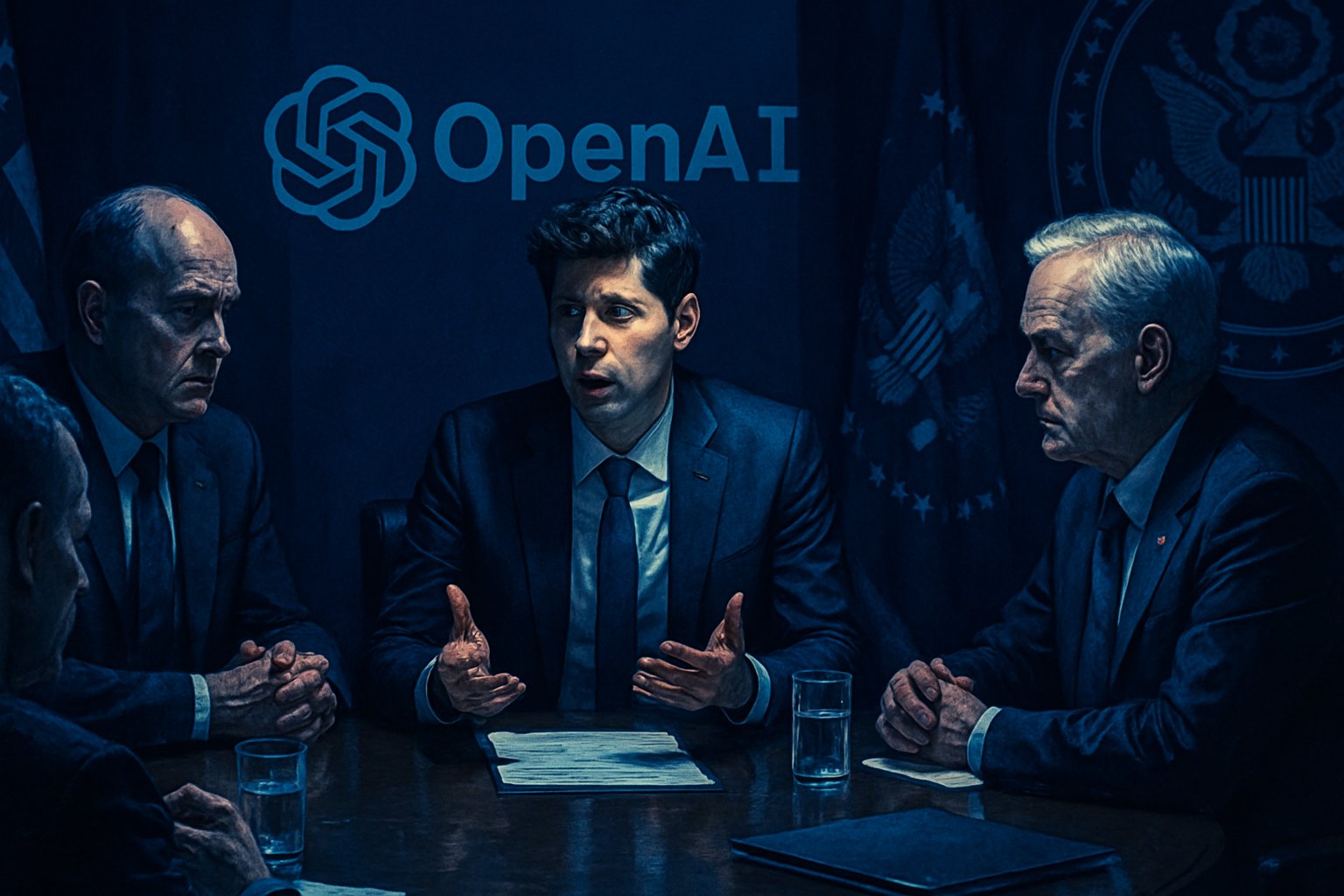
Sam Altman has proposed to the Trump administration to give 5% of OpenAI's equity. This offer is framed as a sharing of AI profits with the American public, but it primarily responds to a buildup of political pressures.
Since the beginning of his second term, Donald Trump has made American supremacy in artificial intelligence a hallmark of his industrial policy. For Silicon Valley, this is a generous green light. For an increasing number of elected officials and public opinion (55% of Americans believe that AI will do more harm than good in their daily lives, according to a recent Quinnipiac poll), it is a blank check granted to a few private entrepreneurs whose profits escape any democratic oversight. According to the Financial Times, Sam Altman has chosen to defuse this tension with a rather unusual proposal: to give 5% of OpenAI to the federal government.
A Sovereign Fund, a Dividend, and a Counter-Proposal for 50%
The discussed arrangement relies on a voluntary transfer of shares, the revenue from which would fund a public vehicle. The most commented hypothesis involves distributing the proceeds in the form of an annual dividend to all American households, modeled after Alaska's oil fund (which has been issuing checks to every resident of the state since 1982, without anyone raising objections). OpenAI has been advocating for this logic since spring. In a guidance document published in April, the company argued for a “public wealth fund” that would offer every citizen, including those absent from financial markets, a share of the growth driven by AI. Anthropic has confirmed that it is not participating in these discussions.
Bernie Sanders, a prominent figure in the Democratic Party, responded in early June with the American AI Sovereign Wealth Fund Act, which proposes a 50% public stake in major companies in the sector. The text also adds a 50% tax on the shares of OpenAI, Anthropic, and xAI (the companies involved received this with the enthusiasm one might expect). The gap between Altman's offering and the Vermont-style expropriation illustrates the climate. In public opinion, 55% of Americans believe that AI will do more harm than good in their daily lives, according to a Quinnipiac poll. The construction of data centers is also facing increasing local resistance. Public interest groups, led by Public Knowledge, highlight the structural problem of a state that is both a shareholder and a regulator of the same sector.
The State as a Shareholder: A New American Industrial Doctrine
Washington entered Intel's capital in August 2025, acquiring about 10% by converting $8.9 billion in CHIPS Act subsidies into shares. The Pentagon has taken a stake in MP Materials, the American rare earth specialist, and the acquisition of U.S. Steel by Japan's Nippon Steel was concluded with a specific share granted to the White House. Altman's proposal thus seems to preempt this new doctrine: rather than waiting for the administration to demand its share, OpenAI sets the price of tranquility at 5%. A public shareholder has a direct financial interest in the company's prosperity, and this interest will mechanically weigh on every future regulatory decision, from model safety rules to public market access conditions.
OpenAI is simultaneously preparing for its IPO, following Anthropic's confidential filing on June 1. A federal stake would change the equation for investors: dilution of existing shareholders on one side, implicit political protection on the other. For a company that became a for-profit entity after a restructuring contested even in court, the sales argument is real. Nothing equivalent exists on the European side, where public power has chosen to regulate AI without owning it: the AI Act governs models, and no public capital enters the table. France has practiced state shareholding for decades in energy or defense, but never in generative AI (due to the lack of a champion at this scale, it is true).
For the French user of ChatGPT, this issue goes beyond the game of lobbying and financial markets. The tool they open every morning could soon count the U.S. government among its shareholders, with its commercial, security, and diplomatic priorities, while Europe remains in the role of an arbiter. Two ways to influence AI; only one touches the dividends.
Brief IA — L'actualité IA en français
L'essentiel de l'actualité de l'intelligence artificielle, décrypté et expliqué chaque jour.