OpenAI Challenges Apple: A Lawsuit with Personal Stakes
Le brief IA que les pros lisent chaque soir
Les 7 actus IA du jour, décryptées en 5 min. Gratuit.
Inclus dès l'inscription : notre sélection des meilleurs guides & comparatifs IA.
Choisis ton rythme
Gratuit · Pas de spam · Désabonnement en 1 clic
OpenAI Denounces Apple's Lawsuit
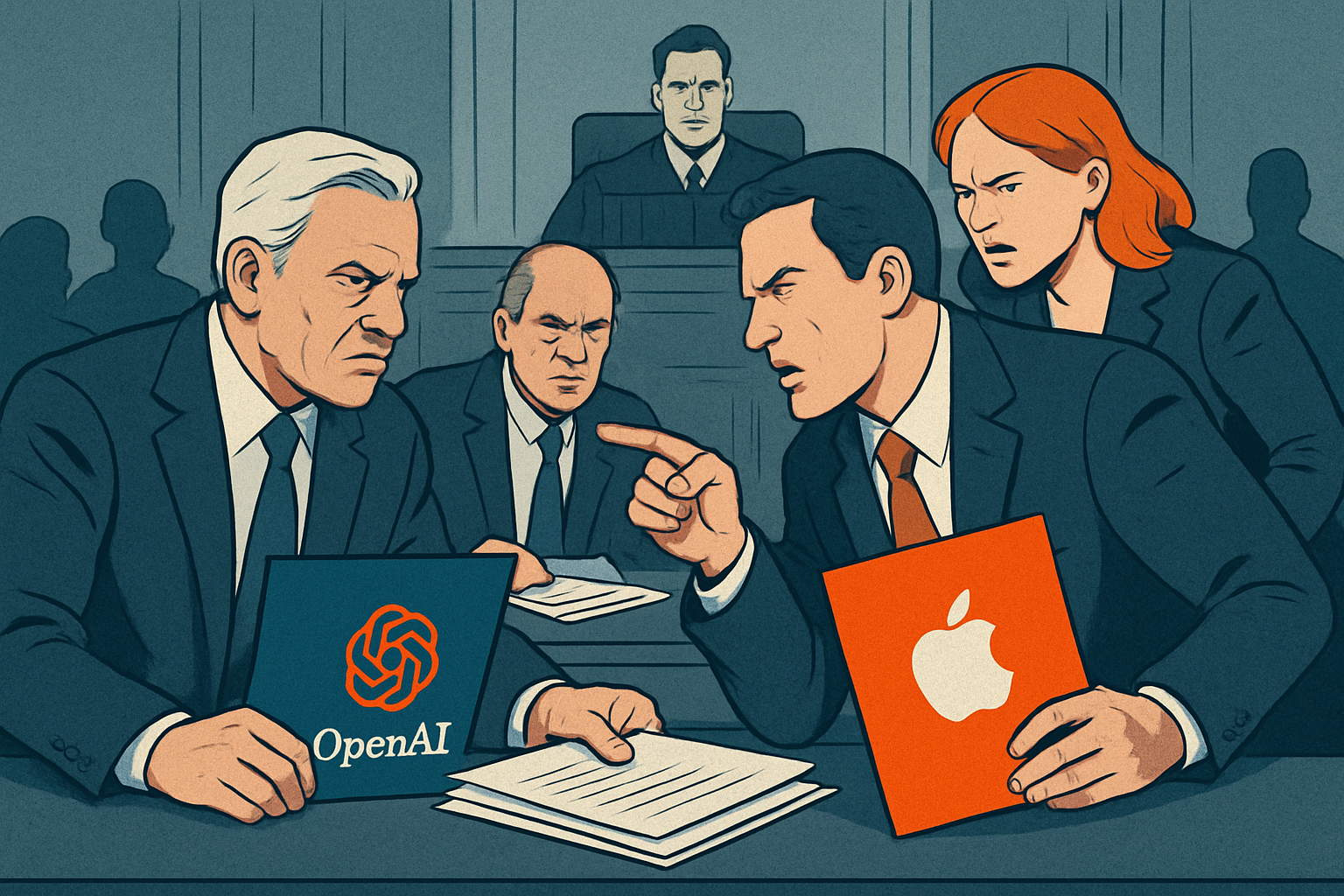
Three weeks after Apple filed a high-profile lawsuit accusing OpenAI of stealing trade secrets, OpenAI has responded forcefully. In a recent blog post, the company, known for developing ChatGPT, described Apple's lawsuit as "negligent, aggressive, and strangely personal." This statement marks an escalation in the conflict between the two tech giants.
Apple's Allegations
Apple initially alleged that two of its former employees, Chang Liu, a software engineer, and Tang Tan, a veteran with 24 years of experience, improperly accessed Apple's proprietary technologies after leaving the company to join OpenAI. However, OpenAI contests these allegations, asserting that it was Apple's own deficient security that allowed these employees to access its systems, a problem that Apple was already aware of.
Apple's Injunction Request
This case takes a new turn as Apple has sought the U.S. District Court for the Northern District of California to expedite the judicial process. Apple wants OpenAI to be compelled to "collect and return" all information belonging to Apple. For OpenAI, whose launch of its first AI hardware device is imminent, the implications of this lawsuit could be significant. OpenAI maintains that the initial allegations are unfounded and that the case should be dismissed.
OpenAI's Evidence
To support its defense, OpenAI has made public certain text and email exchanges between the two companies and their lawyers. These documents, filed with a California federal court, reveal a tense dynamic between the two parties. OpenAI criticizes Apple's handling of communications, highlighting mistakes on their part that preceded the filing of the lawsuit.
Communication Errors
The exchanges released by OpenAI are heavily redacted, but they appear to corroborate the claim that Apple made errors before filing the lawsuit. Apple's outside counsel, Gabriel Gross, reportedly sent an email to the wrong person at OpenAI in February regarding Apple's concerns. Che Chang, OpenAI's legal counsel, then contacted Apple's in-house lawyers to clarify the situation, questioning Gross's legitimacy as a representative of Apple.
Messages Between Liu and Apple
OpenAI also published what it claims are text messages exchanged between Liu and Apple employees after his departure. These messages show that Liu continued to be solicited for advice on Apple projects even after leaving the company. On his last day of employment at Apple, Liu organized file transfers with an unknown Apple employee. The exchanges continued after his departure, addressing file transfer issues and seeking Liu's advice on Apple projects, despite him no longer working there.
Apple's Allegations About Downloads
In its preliminary injunction request, Apple stated that these exchanges do not justify the unauthorized downloads of large technical files from its cloud storage, carried out by Liu from February to April 2026. Apple also included text messages where Liu allegedly mentioned finding a way to access Apple's cloud storage system without authorization, to which he responded "LOL." Apple claims he advised others who had left Apple for OpenAI on how to access Apple files in this manner "to avoid issues with the security team."
A Major Judicial Stakes
The court will have to decide between the conflicting accounts of these two tech giants. For OpenAI, proving Apple wrong is crucial, as the lawsuit could have financial repercussions and damage its reputation. OpenAI has made it clear that it has no intention of appropriating Apple's trade secrets.
Brief IA — L'actualité IA en français
L'essentiel de l'actualité de l'intelligence artificielle, décrypté et expliqué chaque jour.