OpenAI and Anthropic Confront Open Weights: Critical Issues
Le brief IA que les pros lisent chaque soir
Les 7 actus IA du jour, décryptées en 5 min. Gratuit.
Inclus dès l'inscription : notre sélection des meilleurs guides & comparatifs IA.
Choisis ton rythme
Gratuit · Pas de spam · Désabonnement en 1 clic
Conflict Over Language Models: An Open Battle
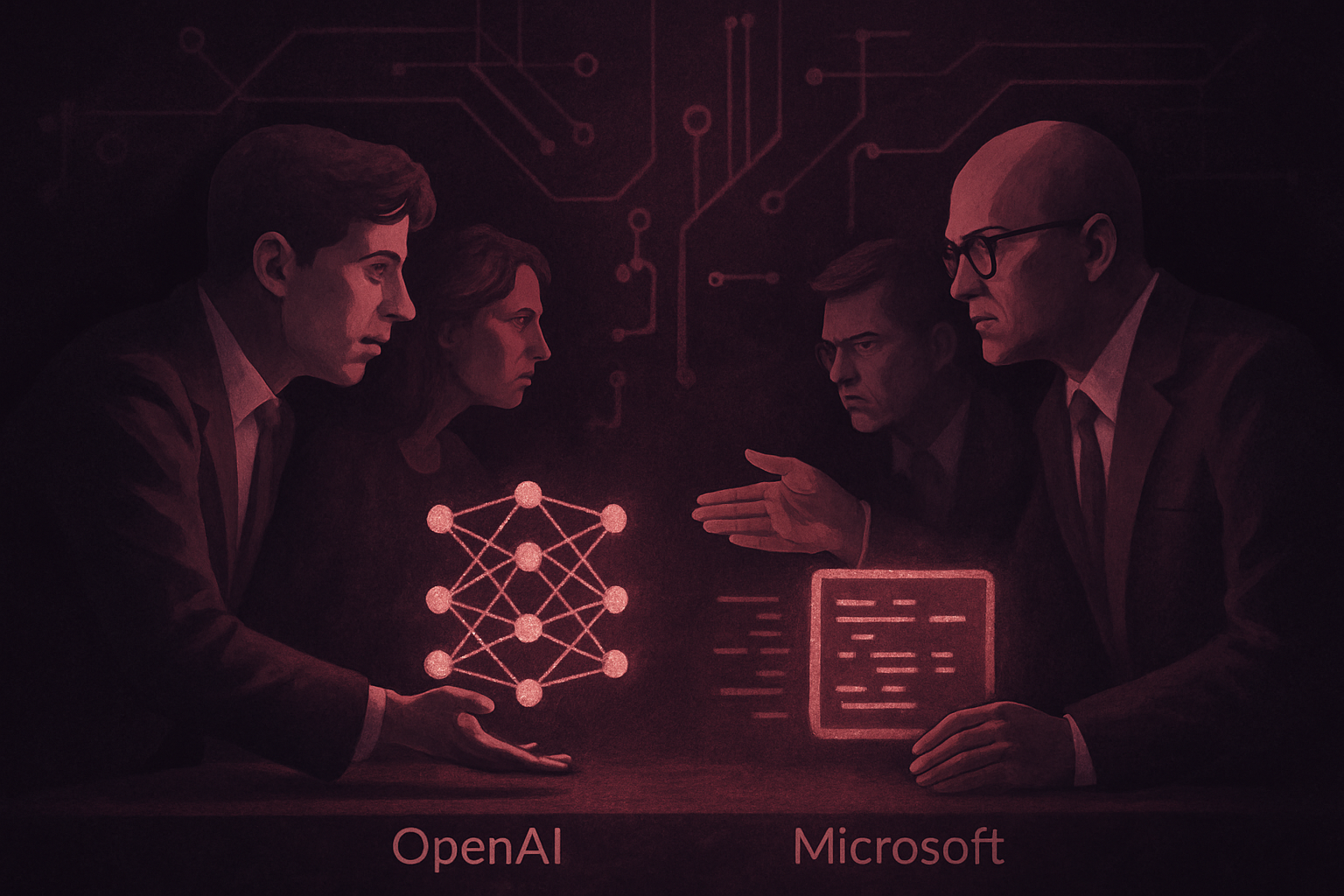
The global tech scene is currently witnessing an intense confrontation between two distinct approaches to language models: open weights and closed systems. Open weights, while not synonymous with open source, are seen by many as the future of artificial intelligence. On one side, companies like Anthropic and OpenAI advocate for proprietary models, while on the other, a majority of players champion openness.
The Kimi K3 model from Moonshot AI, for example, has demonstrated impressive performance, being faster than the Anthropic Fable 5 in certain aspects and nearly as fast as both the Fable 5 and OpenAI's GPT-5.6 in others. This advancement has raised concerns among American AI companies and the Trump administration. Michael Kratsios, former director of the Office of Science and Technology Policy, suggested that Moonshot AI stole ideas from Anthropic by distilling the Fable to develop its K3, although many consider these practices legitimate within the framework of open weights.
Kratsios acknowledged that legitimate distillation is crucial for open innovation, but he warned against large-scale distillation practices that could harm American research. The line between legal and illegal use of models remains blurry and largely depends on the perspective taken.
Microsoft and Support for Open Weights
In response to the controversy surrounding the Kimi K3, Microsoft released a policy statement titled "Open Weights and American Leadership in AI." This statement defines open weight models as systems that anyone can download, inspect, modify, and run on their own infrastructure. Microsoft argues that these models benefit the entire tech ecosystem, including major American companies like Amazon, Nvidia, and Google.
Nearly 200 Silicon Valley startups, grouped under the Little Tech Association, have also urged the Trump administration not to restrict access to Chinese open source models. Microsoft's statement links open weights to the economy, asserting that open models allow startups, universities, hospitals, factories, and public institutions to match the right model to the right task without paying exorbitant prices. Microsoft also claims that open weights enhance security by facilitating the simulation of attacks and the identification of vulnerabilities, an argument often used to promote open source.
China and Its Vision for Open Weights
China, under the leadership of Xi Jinping, firmly supports open weights. Xi recently stated that the development of AI should be a global collaboration rather than a competition between nations. He sees open source as a unique opportunity to share the benefits of AI on an international scale.
Distinction Between Open Weights and Open Source
It is important to note that open weights are not synonymous with open source. According to the Open Source Initiative (OSI), open weights generally involve the availability of trained weights but not necessarily the training data or complete source code. This distinction is often misunderstood. The OSI emphasizes that without the open sharing of research, AI as we know it would not exist.
Stefano Maffulli, former head of the OSI, expressed his preference for fully open source AI while settling for open weights for now, continuing to advocate for greater data transparency.
Strategies and Political Implications
In Washington, the message is clear: open weights are integrated into American industrial policy. The coalition led by Microsoft urges policymakers not to impose hasty restrictions on downloadable models and not to confuse legitimate techniques like distillation with technology theft.
The debate surrounding open weights has become central to the discourse on competition in the AI industry. The open source movement has already proven its effectiveness in creating shared infrastructure and driving innovation. Microsoft and its allies argue that this logic now applies to AI, even if it does not strictly align with the definition of open source.
OpenAI and Anthropic: The Resistance of Proprietary Models
Despite their statements of support for open source, Anthropic and OpenAI seem to adopt a more conservative approach. Anthropic, for instance, did not sign the policy statement on open weights, raising questions about its true intentions.
Dario Amodei, CEO of Anthropic, attempted to clarify his position by stating in a blog post that "we have never advocated for a ban on open weight models." However, he insisted that his primary concern is the risk that authoritarian governments build more powerful AI models than those developed by the United States.
These concerns raise questions about the safety of AI models, but there is no concrete evidence that Chinese models are inherently more dangerous. AI attacks are already a reality, and models like Claude from Anthropic have been widely shared online.
Ultimately, this confrontation pits those who support open models against those who prefer a more closed approach. It is not just a matter of philosophy, but a struggle to determine who benefits from openness and who sets the safety standards.
Brief IA — L'actualité IA en français
L'essentiel de l'actualité de l'intelligence artificielle, décrypté et expliqué chaque jour.