OpenAI and Anthropic: AI in Service of American Public Health
An Unprecedented Partnership for American Public Health
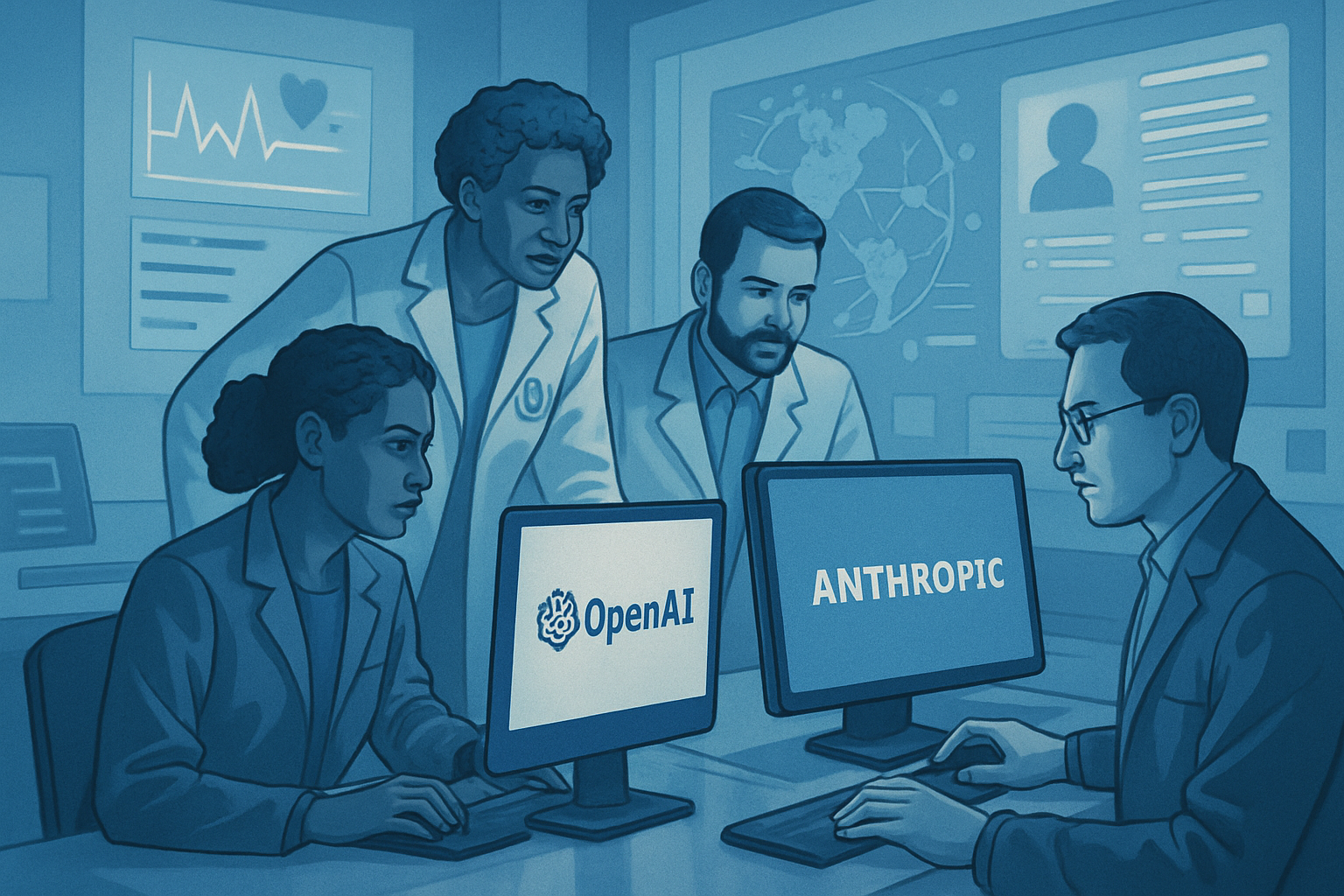
Public health agencies in the United States are preparing to integrate generative artificial intelligence tools into their operations through an innovative program. This initiative, which brings together the Coalition for Health AI, OpenAI, Anthropic, and Accenture, aims to explore the potential applications of AI in the field of public health.
The program, named Public Health Use Case and Learning Scaling Engine or PULSE, will be implemented across ten different jurisdictions, including state, local, tribal, and territorial levels. The primary goal is to develop practical recommendations for public health agencies considering the adoption of similar technologies.
Significant Resources for Practitioners
As part of this project, OpenAI and Anthropic have generously offered ten enterprise licenses that will allow 2,000 public health professionals to access their AI tools. Accenture, a key player in this partnership, will oversee the integration of participants and contribute to the development of practical guides based on the trials conducted.
Practitioners will thus have access to the enterprise AI products developed by OpenAI and Anthropic. However, the Coalition for Health AI has not yet specified which specific products, model versions, or configurations will be used in these trials, nor how the two providers will be distributed among the different pilots.
Trust at the Heart of the Initiative
According to Dr. David Lakey, former Texas Health Commissioner, the success of any technological transformation relies on trust, governance, and execution. He emphasizes that the PULSE program is designed to help agencies navigate these challenges and implement AI in a practical and effective manner.
Five Application Areas for AI in Public Health
The board of the Coalition for Health AI has identified five key areas where AI could have a significant impact:
- Biosurveillance and prediction of drug waves
- Social determinants of health and mapping of SDoH
- Operations and efficiency, analysis of community feedback
- Public communications and multilingual translation hub
- Automated retrieval of clinical data and FHIR query engine
The NIST AI risk management framework recommends a rigorous assessment of AI systems based on their intended use, operational environment, affected parties, and potential consequences. However, the Coalition for Health AI has not yet published specific guidelines regarding evaluation, privacy, security, or human review for these five use cases.
Challenges of AI Integration
The PULSE program includes an automated clinical data retrieval engine and a FHIR query engine. However, the announcement does not detail the exact role of generative AI in these processes. It remains to be clarified whether the AI models will generate queries, retrieve records, summarize returned information, or combine these functions.
Additionally, it is not specified whether potential errors, such as incorrect queries or unsupported summaries, will be verified by staff before the information is used.
Some applications may involve demographic, geographic, clinical, or population health data. The Coalition for Health AI has not yet indicated whether the pilots will use identifiable records, de-identified information, synthetic data, or aggregated datasets.
Le brief IA que les pros lisent chaque soir
Les 7 actus IA du jour, décryptées en 5 min. Gratuit.
Inclus dès l'inscription : notre sélection des meilleurs guides & comparatifs IA.
Choisissez votre rythme
Gratuit · Pas de spam · Désabonnement en 1 clic
Compliance and Data Protection
The U.S. Department of Health and Human Services requires organizations to comply with HIPAA to protect certain electronic health information. Cloud computing guidelines stipulate that organizations must adhere to HIPAA requirements when cloud systems process protected health information.
However, HIPAA will not necessarily apply to every participating organization or workflow. Its applicability will depend on the agency, the data involved, and the function being performed.
OpenAI assures that the inputs and outputs of its commercial services, including ChatGPT Enterprise and its API, are not used to train or improve its models by default. Anthropic adopts a similar policy for its commercial products.
Towards Clear and Defined Governance
The pilots of the PULSE program are expected to begin in the fall of 2026, with guides anticipated for publication in 2027. These documents will serve as a reference for other public health agencies.
The Coalition for Health AI has not yet defined the evaluation measures for the pilots nor specified whether each use case will be assessed according to distinct criteria.
NIST guidelines recommend identifying AI functions requiring human oversight and training users to understand the system's performance and limitations. They also cover testing, validation, monitoring, documentation, privacy, and management oversight.
A Transformative Potential for Public Health
According to Elizabeth Kelly from Anthropic, public health teams are often asked to do more with less, and AI can be a solution, provided it is introduced carefully and with the right safeguards.
Data from the National Association of County and City Health Officials reveals that nearly 40% of local health departments do not use AI. The Coalition for Health AI hopes that the PULSE program will encourage these departments to reevaluate their workflows and improve their operational efficiency.
PULSE will provide enterprise licenses, integration, peer communities, and implementation guides. However, the minimum requirements for personnel, infrastructure, interoperability, or cybersecurity for participating jurisdictions have not yet been specified.
Eligible participants include state and territorial health departments, county and municipal agencies, tribal authorities, Indian health organizations, and health departments of large cities.
Towards Broader Adoption of AI in Health
PULSE aims to convert the results from 10 jurisdictions into recommendations for broader use. However, it is not yet clear how these guides will account for differences in agency size, technical systems, legal responsibilities, personnel, or procurement arrangements.
PULSE is part of the broader efforts of the Coalition for Health AI to establish governance standards for AI in health. In May, the organization announced plans to develop recommendations covering eight governance areas through workshops and working groups involving over 150 representatives from health AI.
The coalition has begun publishing guides on organizational policies regarding AI, governance structures, and internal resources. Further recommendations are expected to follow to cover other aspects of AI management in health.
Meanwhile, the Coalition for Health AI is collaborating with the Joint Commission to align its governance guides with its voluntary certification for the responsible use of AI in health. However, the announcement of PULSE does not specify whether participating public health agencies will be evaluated under this certification.
Dr. Brian Anderson, Executive Director of the Coalition for Health AI, emphasizes that public health agencies approached the COVID-19 pandemic after years of limited investment in technology. The PULSE program aims to provide them with hands-on experience with AI before broader adoption.
Finally, Dr. Ashish Jha, former COVID-19 response coordinator at the White House, stresses the importance of implementing AI thoughtfully to reshape public health. The PULSE program will allow for testing which applications work and documenting the results for other agencies.
Brief IA — L'actualité IA en français
L'essentiel de l'actualité de l'intelligence artificielle, décrypté et expliqué chaque jour.